In this lesson
If a chord normally starts on beat 1 in 4/4, play it on the preceding “4-and” to start it an eighth note early. Let it ring across beat 1. The numbered beats keep their spacing. In the exercise here, the next fresh attack comes on beat 2.
You will compare an Am-to-C change on beat 1 with the same change half a beat earlier, on 4 &. Both examples last two bars of 4/4. Start with beginner strumming patterns if counting 1 & 2 & 3 & 4 & is new.
What changes when the chord comes early?
In the first model, play Am for one complete bar, then start C on the next bar’s 1. In the second, C starts on the previous bar’s 4 &. Keep that C sounding through the next 1 without striking again. An attack on a weaker part of the beat carried across a stronger beat is one way to create syncopation.
Here “anticipating” describes the early sound of the whole chord. Preparing your fingers early for a change that still sounds on 1 leaves its timing unchanged.
This is a chosen practice rhythm. A song or another player may need the change on 1. Agree on the timing rather than moving every chord early.
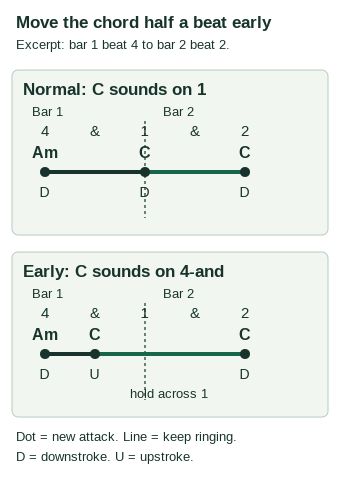
Count the boundary before using a guitar
Say 3 & 4 & 1 & 2 & evenly. Tap only on the numbers to keep the quarter-note pulse. Then say “change” on the & after 4 while the tapping continues. Leave the next 1 in its usual place.
For the strumming motion used below, the hand travels down on each number and up on each &. Move just clear of the strings when there is no attack. On the held 1, that means a downward movement that does not strike or mute the strings. Here, a skipped strike leaves C ringing. A written rest would require silence in this guitar part. Rests and ties separates those actions.
Check Am and C
Use standard tuning, E A D G B E from string 6 to string 1, with no capo. Both shapes leave low E out and use strings 5 through 1. Read the patterns below from low E to high E; x means leave out, 0 means open and the other numbers are frets. The small numbers inside the diagram dots are finger numbers: index 1, middle 2 and ring 3.
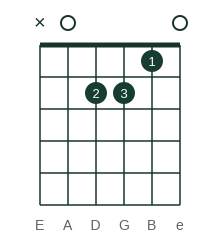
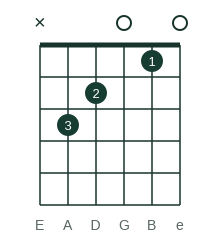
For this change, the index and middle can stay in place while the ring moves. Use that option only if it stays comfortable. The first-chord lesson gives placement checks.
Form each grip without a beat and pick its five strings separately. Then try a downstroke from A through high E and an upstroke back from high E through A. For these two scores, every attack uses those same five strings, so the written chord and all its tied notes are explicit. Finish the upstroke after string 5, leaving low E quiet. If an intended string is missed, return to the separate string checks before adding the pulse. Work without a pulse first, take breaks and stop if playing hurts.
Model 1: C starts on the next 1
Set the metronome to four beats per bar at 60 BPM, one click per numbered quarter-note beat. Choose a slower pace if needed. Before playing, count one full silent bar: 1 & 2 & 3 & 4 &.
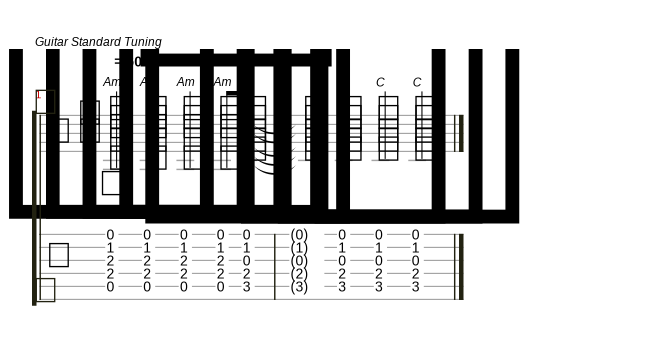
In the tab below, the top line is string 1. Stacked fret numbers give the positions for a chord. In the early-change score, the five parenthesized frets on bar 2’s beat 1 continue the C already ringing, without a new strum. The curved ties in the notation above refer to those same notes. A squared inverted-U marks a downstroke; a V marks an upstroke. The tab-reading guide explains strings, frets and rhythm symbols.
Downstrum Am on bar 1’s 1, 2, 3 and 4. Change to C for bar 2’s 1, then downstrum it again on 2, 3 and 4. Every upward return passes clear. Let each chord ring until its next attack or the change.
Normal change: C on beat 1: score and practice
Downstrum Am on bar 1 beats 1, 2, 3 and 4. Downstrum C on bar 2 beats 1, 2, 3 and 4. Every upward return passes clear. Standard tuning/no capo, strings 5 through 1 for every attack; keep low E quiet. Two bars of 4/4 at quarter-note 60 BPM, eight beats and eight sounded chord attacks. Count one fresh silent bar before a guitar attempt; no count-in is included in the score. Damping after the last full beat happens on the following 1, or downstrum Am there to repeat continuously. There is no tie across that repeat boundary. Pause suspends playback; Play continues; Stop resets to bar 1.
The score contains 2 played bars at 60 BPM, without a count-in. Follow the lesson's count-in and stopping instructions when you play. The guitar staff uses the usual octave-transposing treble convention; the tab gives the physical string and fret.
The static score is available without loading the player.
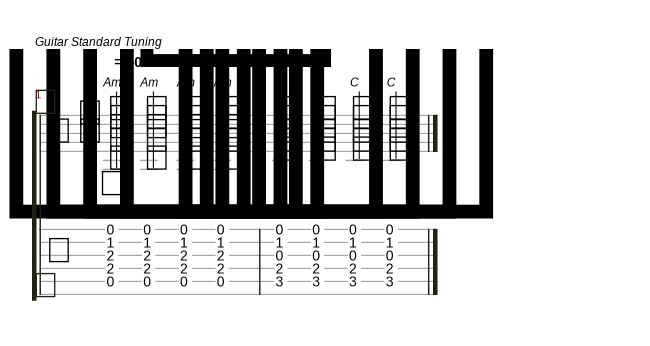
Scroll sideways for the complete score. Interactive notation loads when you ask for it. Practice audio loads separately and starts only after Play. Synthetic audio is a timing reference; it does not check your guitar or replace the instructions for stopping the strings.
There are eight chord attacks over eight quarter-note beats. At 60 BPM the two played bars last eight seconds, excluding your manual count-in. After bar 2’s full beat 4, gently damp all strings on the following 1 without another strike. To repeat continuously, downstrum Am there instead. After stopping or losing the count, use a fresh silent bar before another attempt.
Model 2: C starts on 4-and
Keep the same numbered pulse and the same two-bar length. Bar 1 begins with Am downstrokes on 1, 2, 3 and 4. After the strike on 4, form C in time to upstrum C on 4 &. That last Am lasts half a beat before the C attack.
Let C ring across the bar line through 1 &. Pass clear of the strings on both movements there. Downstrum C again on 2, 3 and 4. The score ties the C eighth note at 4 & to its quarter note on the following 1: together they make one continuous one-and-a-half-beat C, ending at the fresh attack on 2. Do not strum the tied destination.
Early change: C on 4-and: score and practice
Downstrum Am on bar 1 beats 1, 2, 3 and 4, then upstrum C on 4-and. Hold that C across bar 2 beat 1 without a new attack; pass clear on 1 and 1-and. Downstrum C on 2, 3 and 4. The tied C lasts one and a half beats from 4-and until the fresh attack on 2. Standard tuning/no capo, strings 5 through 1 for every attack; keep low E quiet. Two bars of 4/4 at quarter-note 60 BPM, eight beats and eight sounded chord attacks. Count one fresh silent bar before a guitar attempt; no count-in is included in the score. Damping after the last full beat happens on the following 1, or downstrum Am there to repeat continuously. There is no tie across that repeat boundary. Pause suspends playback; Play continues; Stop resets to bar 1.
The score contains 2 played bars at 60 BPM, without a count-in. Follow the lesson's count-in and stopping instructions when you play. The guitar staff uses the usual octave-transposing treble convention; the tab gives the physical string and fret.
The static score is available without loading the player.
Scroll sideways for the complete score. Interactive notation loads when you ask for it. Practice audio loads separately and starts only after Play. Synthetic audio is a timing reference; it does not check your guitar or replace the instructions for stopping the strings.
This model still has eight sounded attacks: five in bar 1 and three in bar 2. The extra attack on 4 & replaces the attack on the next 1. Each bar still contains four beats. At 60 BPM, the early C begins 3.5 seconds after the first Am; the next C attack is at 5 seconds. The synthetic player is a timing and pitch reference, without an automatic count-in or a prescribed speed for the pick’s sweep across the strings.
After bar 2’s full fourth beat, damp on the following 1. For continuous repetition, downstrum Am there instead; there is no tie across this repeat boundary. In either player, Pause suspends playback and Play continues from there. Stop resets to the beginning. For a fresh guitar attempt, count your silent bar before starting again.
Isolate 4-and, 1 and 2
If the whole model is difficult, form C first and practise only its boundary rhythm. Count one silent bar, then another bar silently through beat 4. Upstrum C on that bar’s 4 &, pass clear down on the following 1 and up on its &, then downstrum C on 2. Let it ring for that beat and gently stop the strings on 3. Pause before another fresh count-in.
Once that works, put the Am downstroke back on the beat 4 immediately before the C upstroke. Work on this small change without clicks first if forming C needs more time. Return to the full model at a comfortable pace. The beat spacing stays even when the hand passes clear.
If the early change loses the pulse
If C lands on 4 instead of 4 &, say both halves of that beat: Am on “four”, C on “and”. If the following 1 gets another strum, say “hold” there and keep the down movement clear of the strings.
If the strings go quiet at the bar line, check whether your hand touched them during a movement that should pass clear. A tie needs the existing notes to continue. Guitar notes naturally fade; that alone is not an instruction to strike again.
If the change rushes the next beat, stop and count the boundary without guitar. Slow down or practise the two grips without a beat. Do not insert extra time between 4 & and 1 to finish the fingering.
Try the timing with the chords reversed
Suppose the normal version has one bar of C, then Am arriving on the next 1. To move that change half a beat early, which chord sounds on bar 1’s 4 &? What happens on bar 2’s 1, and where is its next fresh attack?
Check the reversed-change answer
Downstrum C on bar 1’s 1, 2, 3 and 4. Then upstrum Am on its 4 &. Hold Am through bar 2’s 1 & without another attack, then downstrum Am on 2. Continue with Am on 3 and 4. The two bars still have eight attacks and eight beats. Both shapes keep low E out. After bar 2, damp on the following 1 to finish, or downstrum C there to repeat this reversed model. That repeat boundary has no tie.
Use beginner chord progressions to compare other changes at their stated bar boundaries. Work on each timing choice separately before mixing them.
Source notes
Open Music Theory’s syncopation chapter explains shifted offbeat attacks and clear tie notation. IROCKU’s written Anticipating the Beat discusses changing to the next chord on 4-and in a piano setting. The guitar grips, two-bar comparisons, diagram and transfer task here were prepared for IGDb; no source song, score, image, video or recording is reproduced.