A muted string rake is one pick motion through muted strings into a note you want to hear. In this exercise the D and G strings give two short clicks. The pick keeps moving towards the thinner strings and lands on G at fret 8 of the B string.
Set up two clicks and one clear note
In standard tuning, fret B at 8 with your ring finger. Pick it by itself first. Keep B fretted and rest your index finger lightly across D and G near fret 6. Pick D and G separately. Each should make a short click. If you hear a ringing note, shift the index finger a little and try again.
Start the pick on the A-string side of D. Pass through D, G and B in one slow downstroke. Stop the stroke after B so you leave high E alone. Listen for two quiet clicks and a clear G. If the G cuts off, check that your muting finger stays clear of the vibrating part of B.
Land on beat 1
Set the metronome to 60 BPM with four beats per bar. Keep it visible in a separate window or use another device. Start it and count a full bar from the higher click. Begin the exercise on the next 1.
| When | What to play |
|---|---|
| Bar 1, beat 1 | Pick B fret 8 alone. Let G ring through beat 4. |
| Bar 2, beat 1 | Stop the ringing note. Quietly set your fingers for the rake. |
| Bar 2, and of 4 and a of 4 | Count 4 e and a. Brush muted D on and, then muted G on a. |
| Bar 3, beat 1 | Continue the stroke onto B fret 8. Let G ring through beat 4. |
Stop the last G on the next 1, then count in again to repeat. Strike a muted string wherever tab shows an X. The rests in bar 2 give you time to reset. When the slow version is steady, try starting the rake closer to the next 1. Keep the clear note on 1 as the clicks move closer together.
Rake through two mute clicks into G: score and practice
At 60 BPM in 4/4, play G at fret 8 of B on beat 1 of bar 1. Stop on the next 1. Keep beat 1 through the start of beat 4 quiet in bar 2 and fret B at 8 before you rake. With one slow sweep towards the thinner strings, brush the muted D string on the and of 4, brush muted G on the a of 4 and pick the fretted B string on beat 1 of bar 3. Let G ring for four beats and stop on the following 1.
The score contains 3 played bars at 60 BPM, without a count-in. Follow the lesson's count-in and stopping instructions when you play. The guitar staff uses the usual octave-transposing treble convention; the tab gives the physical string and fret.
The static score is available without loading the player.
If part of the score is off screen, scroll sideways within the score.
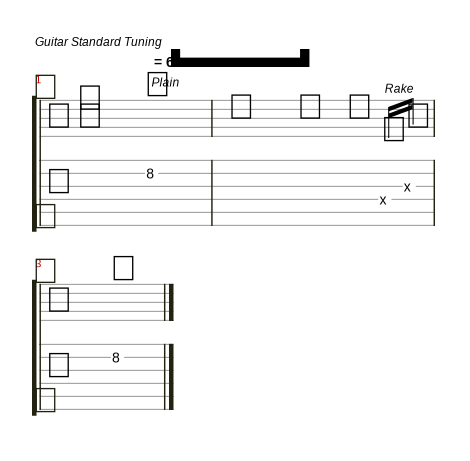
Interactive notation loads when you ask for it. Practice audio loads separately and starts only after Play. Synthetic audio is a timing reference; it does not check your guitar or replace the instructions for stopping the strings.
Check the landing
Which sounds land before beat 1, and which sound lands on it?
The D and G clicks come before it. The G pitch at B fret 8 lands on beat 1 of bar 3. If you hear the G pitch early, slow the pick motion down and count the last four subdivisions of bar 2 again.
Try the dead-note strumming lesson if you want more practice making a short click with the fretting hand. The three-string sweep-picking drill gives you a similar pick path with all three notes sounding.
Keith Wyatt demonstrates a rake with picking-hand muting. Total Guitar describes a version using a spare fretting finger. The counted exercise above was written for IGDb. Keith Wyatt’s blues lesson · Total Guitar on string rakes