Pick a fretted note and let it ring. To stop it, ease the pressure from your fretting finger while its tip still touches the string. You’ll hear the pitched note followed by silence. This exercise puts that cutoff on a counted beat.
Practise the release on high E
Use standard tuning without a capo. Put your index finger on fret 3 of the thin high E string, close behind the third fret wire. Pick that string alone. It sounds G.
Ease off the pressure until the note stops. Keep your fingertip lightly against the string. If you hear open E, check whether your fingertip came clear as the string was still moving. Try again with less movement. Press gently again before the next pick stroke. If you hear a click without a clear G, check that the string is fretted before you pick.
Keep the same attacks and change the release
Set a metronome to 60 BPM and four beats per bar. Keep it visible beside the lesson or use a separate device. Count four clicks before playing. In both bars, pick high E at fret 3 on 1 and 3.
- Bar 1. Let the first note ring through beat 2. Pick again on 3 and let that note ring through 4.
- Bar 2. Pick on 1 and ease the pressure on 2. Keep the string quiet for that beat. Pick on 3, ease the pressure on 4 and stay quiet until the next 1.
Let G ring, then cut it off: score and practice
In 4/4 at 60 BPM, count four beats before playing. Use fret 3 of the high E string for every note. Pick on beats 1 and 3 in both bars. In bar 1, let each note ring for two beats. In bar 2, release the fretting pressure on beats 2 and 4 and keep the string silent for each full beat. To repeat, fret and pick again on the next 1. To finish, leave the string quiet after the last rest.
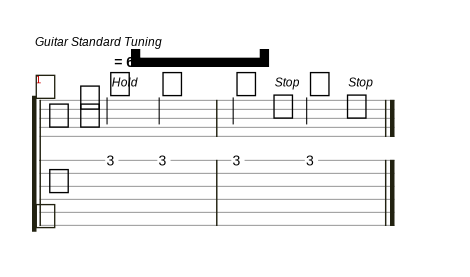
The score contains 2 played bars at 60 BPM, without a count-in. Follow the lesson's count-in and stopping instructions when you play. The guitar staff uses the usual octave-transposing treble convention; the tab gives the physical string and fret.
The static score is available without loading the player.
If part of the score is off screen, scroll sideways within the score.
Interactive notation loads when you ask for it. Practice audio loads separately and starts only after Play. Synthetic audio is a timing reference; it does not check your guitar or replace the instructions for stopping the strings.
The two half notes in bar 1 each last two beats. In bar 2, “Stop” sits above each quarter rest to show exactly when to stop the string. The guide to rests and ties shows how to count the same rests on an open string.
To repeat without a break, fret the string again and pick on the next 1. To finish, let the last rest run through beat 4 and leave the string quiet.
When should the note stop in bar 2?
Ease off the pressure on beats 2 and 4. Keep light contact during each rest. The only pick strokes are on 1 and 3.
For a percussive sound from the beginning of a stroke, try dead-note strumming. Touch the string lightly before the pick strikes to make the click.
Further reading
- David Grissom describes easing finger pressure to shorten a ringing note. Guitar World’s lesson on fret-hand muting
- Hub Guitar explains how to release fretting pressure to control how long a note rings. Fret Hand Muting