Play open low E with your thumb, then play fret 2 on the A string with the same thumb. Repeat that E–B pair at an even pace. You have an alternating bass. In the second bar, you will add two higher notes while the thumb keeps the same beat.
Get four even thumb plucks
Use standard tuning. Fret the A string at fret 2 and leave both E strings and the G string open. The D and B strings stay quiet. Set the metronome to 60 BPM and four beats per bar. Keep its page visible. Count four clicks and start on the next 1.
Play low E on 1 and 3. Play the fretted B on the A string on 2 and 4. Let each bass note last until the next click. As you pluck the A string, touch the low E lightly with the edge of your picking hand to stop it. Before you pluck low E again, lift the edge of your picking hand clear. Ease your fretting pressure on the A string and keep your finger touching it as low E starts. Press fret 2 down again before the next A-string pluck. If the two releases are awkward, practise the hand movements slowly without the click.
Add a finger on the same click
The bass stays the same in bar 2. On 1, pluck open G with your index finger at the same time as low E with your thumb. On 3, pair low E with open high E, using your ring finger on the high string. The two bars use E, G and B, the notes of an Em chord.
| Beat | Thumb in both bars | Added finger in bar 2 |
|---|---|---|
| 1 | Open low E, string 6 | Open G, string 3, with index |
| 2 | A string, fret 2, sounding B | No new upper note. Touch G with your index finger to stop it. |
| 3 | Open low E, string 6 | Open high E, string 1, with ring |
| 4 | A string, fret 2, sounding B | No new upper note. Touch high E with your ring finger to stop it. |
If a pair comes out as two separate sounds, rest the thumb and finger on their strings before the click. Pluck both together, then play the next bass note on time.
On the 1 after bar 2, ease the pressure on the A string and keep touching it to stop the note. To repeat, play open low E on that same click and start the thumb-only bar again. To stop, let the click pass with the strings quiet.
Em alternating thumb with two upper notes: score and practice
At 60 BPM in 4/4, use your thumb for open low E on beats 1 and 3 and A-string fret 2 on 2 and 4. Stop each bass note as the next one starts. In bar 2 add open G with your index on 1 and open high E with your ring finger on 3, together with low E. Stop each higher note on the next click. Release the fretted A string on the following 1, then stop or start the low E on the same click.
The score contains 2 played bars at 60 BPM, without a count-in. Follow the lesson's count-in and stopping instructions when you play. The guitar staff uses the usual octave-transposing treble convention; the tab gives the physical string and fret.
The static score is available without loading the player.
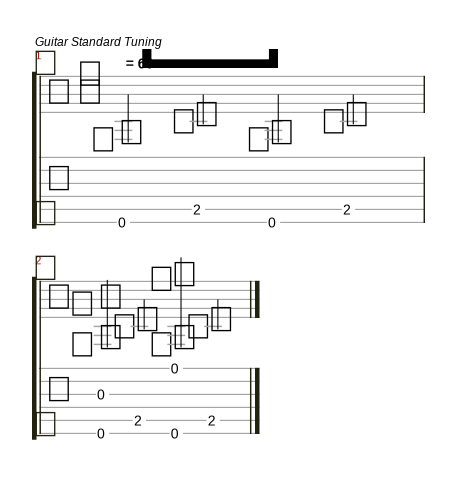
Scroll sideways for the complete score. Interactive notation loads when you ask for it. Practice audio loads separately and starts only after Play. Synthetic audio is a timing reference; it does not check your guitar or replace the instructions for stopping the strings.
The score uses p for thumb, i for index and a for ring. Repeat this 2-bar score returns to the first low E. Count in with the metronome when playing the exercise yourself.
Check what stays the same
Which bass note do you play on beat 3 of each bar, and what changes in bar 2?
Play open low E on beat 3 in both bars. In bar 2, add open high E at the same time with your ring finger.
A steady alternating thumb is the foundation of Travis-style accompaniment. Once these two bars feel even, try the first fingerpicking patterns on Em and Am if you want more practice assigning fingers to strings.
Sources
Jamie Stillway teaches the alternating bass on its own before adding upper notes on the beat or between beats. David Hamburger describes how the pattern can continue as chords change. Fender shows one starting finger assignment for the upper strings. The Em bars above were written for IGDb. Learn the Nuts and Bolts of Travis Picking · What Is Travis Picking? · How to Play Classic Country on Guitar