Economy picking alternates downstrokes and upstrokes on a string and uses a short sweep for some string changes. In this exercise, the third note on G and the first note on B both use downstrokes. The pick moves towards B after playing G, then plays B on the next subdivision. Play the same six notes with strict alternate picking first so you can feel how the pick travels in each version.
Start with the alternate-picking exercise across strings if you want to work on one stroke at a time.
Find the six notes
Use standard tuning and play just the G and B strings. On G, play frets 4, 5, 7. Try your index, middle and little fingers. On B, play frets 5, 7, 8. Try index, ring and little. Your index moves from fret 4 to fret 5 when you change strings. The notes are B, C, D, E, F♯ and G.
Play the two notes around the string change on their own first. Pick G fret 7 down. For the alternate version, clear the B string and bring the pick to the high-E side of it. Pick B fret 5 up. For the economy version, let the downstroke travel towards B. You can rest lightly against B until it is time to play it down. Give both notes their own attack. As B sounds, ease the pressure at G fret 7 and keep that finger touching G lightly to stop the open string ringing.
Play both versions at the same tempo
Set the metronome to 60 BPM and four beats per bar. Press Start metronome. Keep it visible in a separate window or on another device. Count a full bar from the higher click, then play on the next 1.
| Count | String and fret |
|---|---|
| 1, and, 2 | G frets 4, 5, 7 |
| and of 2, 3, and of 3 | B frets 5, 7, 8 |
| 4 | Damp both strings and bring the pick back to the D-string side of G. |
Play bar 1 down, up, down, up, down, up. Play bar 2 down, up, down, down, up, down. Both bars use one note on every half-beat until the rest. In bar 2, the two downstrokes fall on 2 and the and of 2. Leave the whole of beat 4 quiet in each bar. After bar 2, start bar 1 again on the next 1 if you want to repeat.
The squared mark in the score means downstroke. The V-shaped mark means upstroke. IGDb wrote this exercise so you can compare the two pick routes with the same frets and counts.
Alternate and economy picking from G to B: score and practice
In 4/4 at 60 BPM, both bars play G-string frets 4, 5 and 7, then B-string frets 5, 7 and 8. Each note lasts an eighth and beat 4 is silent. Alternate uses down, up, down, up, down, up. Economy uses down, up, down, down, up, down. Both versions first play the B string on the and of 2. Dampen both strings for beat 4, return the pick to the D-string side of G, and restart on the following 1 to repeat.
The score contains 2 played bars at 60 BPM, without a count-in. Follow the lesson's count-in and stopping instructions when you play. The guitar staff uses the usual octave-transposing treble convention; the tab gives the physical string and fret.
The static score is available without loading the player.
If part of the score is off screen, scroll sideways within the score.
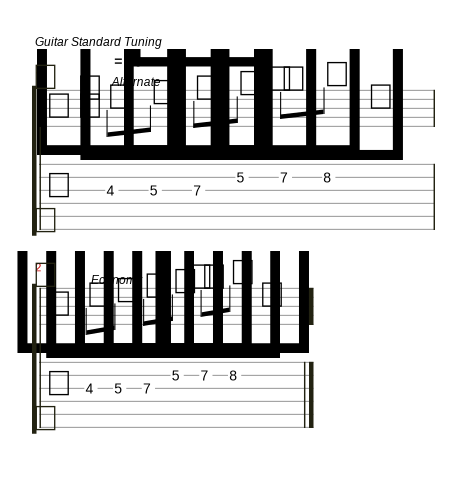
Interactive notation loads when you ask for it. Practice audio loads separately and starts only after Play. Synthetic audio is a timing reference; it does not check your guitar or replace the instructions for stopping the strings.
Check the crossing
Does the first B-string note arrive on the same count in both bars? Which side of the B string does the pick approach from?
B fret 5 lands on the and of 2 in both bars. In bar 1 the pick starts that attack from the high-E side and travels up. In bar 2 it reaches B from the G-string side and continues down. If those two notes in bar 2 arrive as a quick brush, stop after G fret 7 down and wait for the next half-beat before sounding B.
The three-string sweep-picking drill gives you a longer same-direction move and practice turning the pick around. Chris Brooks demonstrates the change from G to B in his economy-picking lesson. Troy Grady illustrates how sweeping fits into economy picking.