In this lesson
In strict alternate picking, the next picked note uses the opposite stroke, even when it is on another string. After a downstroke comes an upstroke; after an upstroke comes a downstroke. Moving to another string does not restart the pattern.
These two short exercises use the same notes, C4 and G4, with different numbers of picks before the string change. You will compare a change made with a downstroke and one made with an upstroke. Aim for steady, separate notes.
Use standard tuning, E A D G B E from string 6 to string 1, without a capo. You need the pick-grip guide, downstrokes and upstrokes and tab-reading basics. In the usual playing position, a downstroke moves towards the high-E side of the strings; an upstroke moves towards the low-E side. Those directions describe the pick’s motion, not whether the next note is higher or lower.
Find two notes before adding a count
Use only the two thinnest strings:
| Target | Position | Suggested fretting finger |
|---|---|---|
| C4 | String 2, B string, fret 1 | Index, finger 1 |
| G4 | String 1, high E string, fret 3 | Ring, finger 3 |
These are sounding pitches, with middle C called C4. The numbers in tab are frets, while finger 1 and finger 3 above identify fingers. You are playing separate notes, not strumming a chord.
Find C with your index finger and G with your ring finger. There is no need to hold a full chord. Let the finger for the unused note touch its string lightly without pressing it to the fret, so that string stays quiet. Check each note slowly before counting. If reaching the positions feels uncomfortable, pause and adjust your hand; stop if playing hurts.
For these exercises, sound one note at a time. When changing from C to G, release the index finger’s fretting pressure but keep it touching the B string to stop C. Press the high E at fret 3 with your ring finger and pick G. To return, release the ring finger’s pressure while keeping contact with high E, then press and pick C. Lifting a finger clear of a string can leave an open note ringing.
Practise that change without a beat first. If a string still rings when lightly touched, adjust the contact until it is quiet before adding timing. This is a stopping action, not a request to pluck a muted note.
Read the pick marks

The score uses a squared inverted-U mark for a downstroke and a V-shaped mark for an upstroke. Every note is picked once. There are no hammer-ons, pull-offs, strums or skipped strings in these examples.
Exercise 1: two picks on each string
Use 4/4, with four quarter-note beats per bar. At the score’s 60 BPM, each numbered beat lasts one second. Count an empty 1 2 3 4 before starting; the optional player has no count-in. You can slow it down if needed.
| Beat | Note and position | Pick stroke |
|---|---|---|
| 1 | C4: string 2, fret 1 | Down |
| 2 | C4: string 2, fret 1 | Up |
| 3 | G4: string 1, fret 3 | Down |
| 4 | G4: string 1, fret 3 | Up |
Two C notes, then two G notes: score and practice
One 4/4 bar at quarter-note 60 BPM. Pick B-string fret 1 twice, then high-E fret 3 twice: C4 C4 G4 G4, down up down up on 1 2 3 4. One note at a time; stop the old string as the next begins. On the following 1, stop G to finish, or stop G and restart C down if repeating. Four attacks, four beats; no count-in bar.
The score contains 1 played bar at 60 BPM, without a count-in. Follow the lesson's count-in and stopping instructions when you play. The guitar staff uses the usual octave-transposing treble convention; the tab gives the physical string and fret.
The static score is available without loading the player.
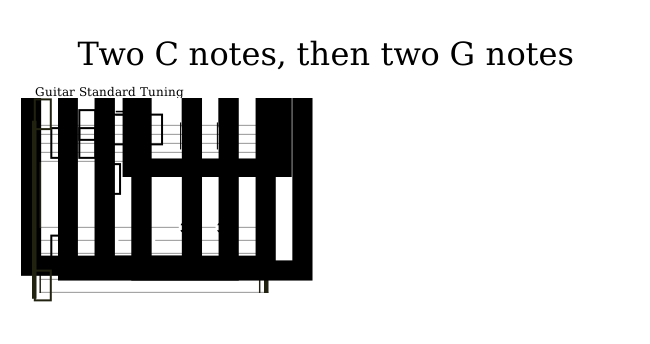
Scroll sideways for the complete score. Interactive notation loads when you ask for it. Practice audio loads separately and starts only after Play. Synthetic audio is a timing reference; it does not check your guitar or replace the instructions for stopping the strings.
Keep C fretted for its two attacks. On 3, stop C as G begins, using the finger-contact method above. Keep G fretted through its two attacks. Each written note lasts one beat; pick again on 2 and 4 even though the pitch repeats.
After beat 4, stop G on the following 1 without picking again. That finishes one pass: one bar, four beats and four picks. To repeat continuously instead, stop G and pick C with a downstroke on that same following 1. Do not insert an extra beat. The player’s Repeat control repeats the whole one-bar score.
The string change on beat 3 follows an upstroke on beat 2, so G starts with a downstroke. Keep the alternating order when your hand moves to the other string.
Exercise 2: three picks before the change
Use the same tuning, positions, 4/4 count and quarter-note 60 BPM. Stop the first exercise and count a fresh empty bar before this separate exercise. Only the note on beat 3 changes: it is now another C.
| Beat | Note and position | Pick stroke |
|---|---|---|
| 1 | C4: string 2, fret 1 | Down |
| 2 | C4: string 2, fret 1 | Up |
| 3 | C4: string 2, fret 1 | Down |
| 4 | G4: string 1, fret 3 | Up |
Three C notes, then one G note: score and practice
Separate one-bar 4/4 exercise at quarter-note 60 BPM. Pick B-string fret 1 three times, then high-E fret 3 once: C4 C4 C4 G4, down up down up on 1 2 3 4. One note at a time; stop C as G begins. On the following 1, stop G to finish, or stop G and restart C down if repeating. Four attacks, four beats; no count-in bar.
The score contains 1 played bar at 60 BPM, without a count-in. Follow the lesson's count-in and stopping instructions when you play. The guitar staff uses the usual octave-transposing treble convention; the tab gives the physical string and fret.
The static score is available without loading the player.
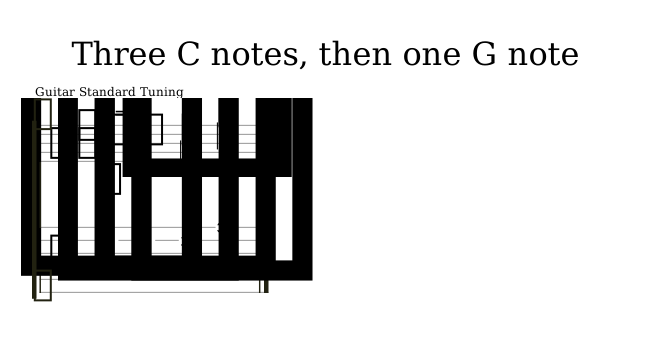
Scroll sideways for the complete score. Interactive notation loads when you ask for it. Practice audio loads separately and starts only after Play. Synthetic audio is a timing reference; it does not check your guitar or replace the instructions for stopping the strings.
Keep C fretted through its three attacks. On 4, stop C, press high E at fret 3 and pick G with an upstroke. It follows beat 3’s downstroke. Starting G with another downstroke would break this exercise’s strict alternation.
Finish by stopping G on the following 1 without picking. For a continuous repeat, stop G and pick C down on that following 1 instead. This is also one bar, four beats and four picks. The G-to-C return begins down because the preceding G was picked up.
Compare the two scores: two picks on C lead to G down; three picks on C lead to G up. The next string does not choose the stroke. The preceding stroke does. Other picking methods can deliberately use a different order; the rule here is the task you are practising.
Work on the change that interrupts the count
If you miss the target string, stop and find the two strings without a beat. Then practise just the change: C up to G down from exercise 1, or C down to G up from exercise 2. Allow time to place the pick for the next stroke. Avoid dragging it across both strings as a strum.
If you add an extra downstroke at the change, say the four directions aloud while following the table. If the old note keeps ringing, check the fretting finger’s contact with that string. If the count stops while you move, return to a slower pace or the untimed change before restarting with a fresh count-in.
Keep the movement comfortable and small enough to control. A picking angle or hand position that works for one player is not a required shape for everyone. The metronome lesson explains how to keep one click per numbered beat. Change the tempo only while keeping the same note order and rhythm.
Check your strokes
- Which stroke follows a downstroke when the next note is on another string?
- In exercise 1, which stroke plays the first G, and on which beat?
- What changes in exercise 2, and which stroke plays its first G?
- Does a fret number in tab identify a fretting finger?
- What happens on the 1 after beat 4 if you finish? What changes if you repeat?
Check your answers
- An upstroke. Strict alternation continues through the string change.
- A downstroke on beat 3, after C’s upstroke on beat 2.
- Beat 3 becomes another C, so G moves to beat 4 and uses an upstroke.
- No. The number gives the fret. Here index finger 1 frets B-string fret 1, and ring finger 3 frets high-E fret 3.
- To finish, stop G on that next 1 without another pick. To repeat continuously, stop G and pick C down on the same 1, without adding a beat.
When both patterns are clear, choose pick directions for a short phrase from chord-tone melody. Its rests need their own stopping actions; these two examples do not establish a universal stroke rule across rests. For repeated fast notes, see tremolo picking.
Source notes
Jeff Owens’s Fender guide Picking styles, under “Alternate Picking”, describes the up/down method. Mark Wingfield’s Alternate picking, achieving speed and accuracy, under “Crossing strings (Insides and Outsides)” and its closing practice method, explains continuing with the opposite stroke and isolating a difficult change. These references support the picking principle; their posture and speed claims are not requirements of this lesson. The fretted C/G examples, counts and stopping instructions were written for IGDb. The two-plus-two and three-plus-one string groupings also appear in Wingfield’s exercises. No source recording or artwork is reproduced.