In this lesson
String skipping means moving between notes on strings that are not next to each other. In this first exercise, move between the G string and high E string, passing over the B string without picking it. You will play four separate notes with down, up, down, up strokes.
Use standard tuning, E A D G B E from string 6 to string 1, without a capo. This original exercise is for a guitar pick. Start with holding a pick, downstrokes and upstrokes and reading tab if those are unfamiliar. Check your tuning before comparing the notes.
Find the two target strings
String 1 is the thinnest, high E. String 2 is B, and string 3 is G. Only strings 3 and 1 are picked here. Leave out the low E, A and D strings as well as B.
| Target note | String and fret | Suggested fretting finger |
|---|---|---|
| A3 | String 3, G string, fret 2 | Index, finger 1 |
| G4 | String 1, high E string, fret 3 | Ring, finger 3 |
These are sounding pitches, with middle C called C4. Guitar staff notation is normally written an octave higher than it sounds; the pitch names here describe the sound. A3 is the lower note and G4 the higher one. The G4 target is on high E; the open G string is a different note, G3.
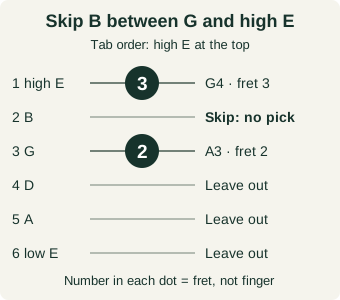
The fret numbers are positions, not finger numbers. You do not need to form a chord or sound both notes together.
Practise the skip without counting
First fret A on the G string with your index finger. Let your ring finger touch the high E string lightly without pressing it to a fret, so that string stays quiet. Pick A once with a downstroke.
For the next note, release the index finger’s fretting pressure while keeping it touching the G string to stop A. Press high E at fret 3 with the ring finger and pick G with an upstroke. Return by releasing the ring finger’s pressure while keeping contact, then fretting and picking A down again. Check that each previous note stops as the next begins. Lifting a finger completely clear can leave its open string ringing.
Move the pick clear of the strings while repositioning it. Pass over B without touching it; then place the pick for the intended stroke on the target string. Avoid dragging the pick across B on the way. Keep the movement comfortable and no larger than you need to reach the next string. No fixed picking angle or anchored hand position is required for this exercise.
Take time between attempts. If B rings, stop it with a light fretting-hand touch, check which string you struck and reset the two target notes. If lightly touching a target string leaves it ringing, adjust the contact until it stops. Stop if playing hurts.
Play four counted notes
Use 4/4, with one quarter note on each numbered beat. At the score’s 60 BPM, each beat lasts one second. Count an empty 1 2 3 4 before you start; the optional player has no count-in. Choose a slower tempo if you need more time for the skip.
| Beat | Note and position | Pick stroke |
|---|---|---|
| 1 | A3: G string, fret 2 | Down |
| 2 | G4: high E string, fret 3 | Up |
| 3 | A3: G string, fret 2 | Down |
| 4 | G4: high E string, fret 3 | Up |
Skip B: A and G with alternate picking: score and practice
One 4/4 bar at quarter-note 60 BPM. Pick G-string fret 2, high-E fret 3, G-string fret 2, high-E fret 3: sounding A3 G4 A3 G4. Down up down up on 1 2 3 4, skipping the B string in both directions. One note at a time; stop the previous string as the next begins. On the following 1, stop G to finish, or stop G and pick A down there to repeat without an extra beat. Four attacks and four beats; no automatic count-in.
The score contains 1 played bar at 60 BPM, without a count-in. Follow the lesson's count-in and stopping instructions when you play. The guitar staff uses the usual octave-transposing treble convention; the tab gives the physical string and fret.
The static score is available without loading the player.
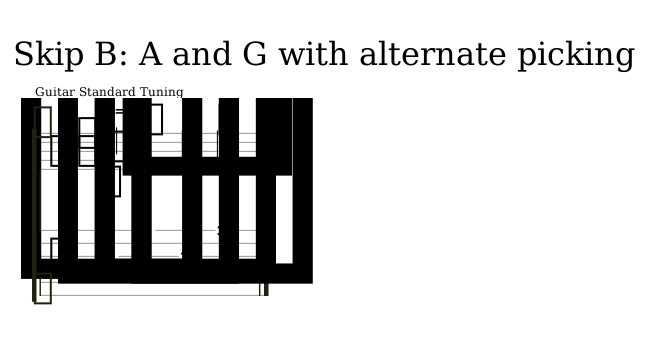
Scroll sideways for the complete score. Interactive notation loads when you ask for it. Practice audio loads separately and starts only after Play. Synthetic audio is a timing reference; it does not check your guitar or replace the instructions for stopping the strings.
The squared inverted-U mark above a score note means downstroke; the V-shaped mark means upstroke. Every note is picked once. The empty B-string line carries no fret number because you do not play it. In tab, an x would ask for a muted attack, which this exercise does not contain.
Keep down, up, down, up through both directions of the skip. In the usual playing position, a downstroke moves towards the high-E side; an upstroke moves towards the low-E side. Those words describe the pick’s motion through a string. They do not describe whether you move to a higher or lower note.
After beat 4, stop G on the following 1 without picking again. That completes one bar: four beats and four attacks, lasting four seconds at quarter-note 60 BPM. To repeat continuously instead, stop G and pick A down on that same following 1, with no extra beat. The player’s Repeat control repeats the whole one-bar score.
Fix a missed string before adding speed
If you catch B, return to a single untimed A-down to G-up change. Find the two strings, clear B and check the next attack. Then practise G-up back to A-down. Practise at a tempo that lets you keep the notes separate and the four beats even.
If you miss high E entirely, pause with the pick ready for its upstroke before trying again. If an open G or E sounds between the fretted targets, check that the released finger keeps contact with its string. If your grip tightens or the count stops, pause and repeat the untimed change.
The adjacent-string alternate-picking lesson is a smaller-distance option. It also shows why a string change does not restart the down-up order. The metronome lesson explains one click per numbered beat. A faster tempo is useful only while you retain the intended notes, strokes and rhythm comfortably.
Check the route
- Which string is skipped between G and high E?
- Where do you fret A3 and G4?
- Does an empty B-string tab line ask for a muted pick attack?
- Which stroke picks the G4 on beat 2?
- What happens on the 1 after beat 4 when you finish or repeat?
Check your answers
- B, string 2. Leave it unpicked in both directions.
- A3 is G-string fret 2; G4 is high-E fret 3.
- No. There is no attack on B. An
xwould indicate a muted attack. - An upstroke, following A’s downstroke on beat 1.
- To finish, stop G without picking. To repeat continuously, stop G and pick A down on that same 1, without adding a beat.
Source notes
Steve Vai’s Skipping strings while playing describes restricting a phrase to G and high E with one string between them. Patrick Brennan’s Making the jump explains clearing the skipped string, stopping the previous note while keeping finger contact, and practising slowly. Robbie Calvo’s Yamaha article Scales, shapes and contours discusses string skipping as a way to widen melodic intervals. The two fretted targets, four-beat pattern, diagram and stopping instructions were prepared for IGDb. No source tab, recording or artwork is reproduced.