In this lesson
To strum in 3/4 time, count three quarter-note beats per bar: 1 2 3 | 1 2 3. Start with a downstrum on each number. Then divide each beat in half, counting 1 & 2 & 3 &, and add an upstrum on every “and”.
These two patterns use E minor (Em) throughout. Keeping one chord lets you work on the three-beat count before adding chord changes. Each score is a separate one-bar exercise, written for this lesson.
Set up the chord and the beat
Use a six-string guitar in standard tuning, E A D G B E from string 6 to string 1, without a capo. String 6 is low E; string 1 is high E. If you need help with the shape, review your first guitar chords.
For Em, put your middle finger on the A string (5) at fret 2 and your ring finger on the D string (4) at fret 2. Leave the other strings open. Read from low E to high E, the frets are 0 2 2 0 0 0.
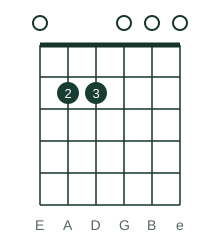
Pick each string separately before adding the strum. The sounding notes, low to high, are E2, B2, E3, G3, B3 and E4. If a note is unclear, check fingertip placement and contact with neighbouring strings before squeezing harder. Stop if playing hurts and take breaks.
In 3/4, the top number tells you there are three beats per bar; the bottom 4 makes each beat a quarter note, also called a crotchet. The count starts again at 1 after 3. Leave the same time between 3 and the next 1 as between the other numbered beats.
If you use the online metronome, select 3 beats per bar. Try 60 BPM, with one click per numbered quarter-note beat. Each beat lasts one second at that tempo, so a complete bar lasts three seconds. The “ands” fall halfway between clicks. Choose a slower setting if it helps; practise the movement without clicks first if needed.
Pattern 1: three downstrums
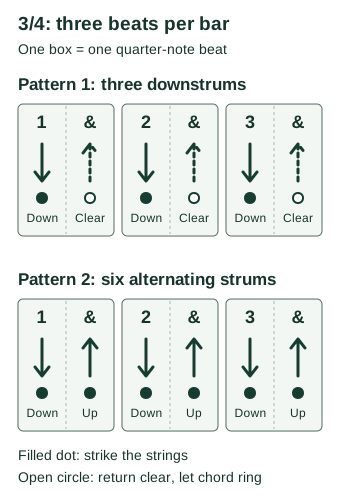
Count 1 & 2 & 3 & evenly. Strum down through all six Em strings on 1, 2 and 3, then return upwards clear of the strings on each “and”. The chord can keep ringing during those clear returns. They are skipped strikes, not rests that require silence.
For these patterns, a downstrum moves towards the floor, from the low-E side towards the high-E side in playing position. An upstrum moves back the other way. The pick-stroke guide explains both directions.
D means downstrum. “Clear” means move up without striking. Scroll the table sideways if needed.
| Count | 1 | & | 2 | & | 3 | & |
|---|---|---|---|---|---|---|
| Action | D | Clear | D | Clear | D | Clear |
| Click | Yes | No | Yes | No | Yes | No |
- Count one full bar aloud without playing:
1 & 2 & 3 &. - Begin on the next 1 and play one bar of pattern 1. That is three downstrums.
- After the strum on 3, make the clear upward return on 3-and. Keep the chord ringing for the rest of that beat.
- On the following 1, gently touch all six strings with your picking hand to stop them, without another strum. That completes the attempt.
To repeat continuously instead, strum down on that following 1 and continue the pattern. The clear upward return on 3-and prepares that downstroke; do not add a fourth beat or a pause between bars. If you stop to adjust, count a new full bar before restarting.
3/4 pattern 1: three Em downstrums: score and practice
One 3/4 bar at quarter-note 60 BPM. Downstrum all six Em strings on 1, 2 and 3: frets 0 2 2 0 0 0 from strings 6 to 1, sounding E2 B2 E3 G3 B3 E4. Return up clear of the strings on each and while the chord rings. Three attacks, three beats, three seconds, excluding your manual count-in. After 3-and, stop all six strings on the following 1 to finish, or downstrum there to repeat without an extra beat. Grouped notes do not specify pick-sweep speed.
The score contains 1 played bar at 60 BPM, without a count-in. Follow the lesson's count-in and stopping instructions when you play. The guitar staff uses the usual octave-transposing treble convention; the tab gives the physical string and fret.
The static score is available without loading the player.
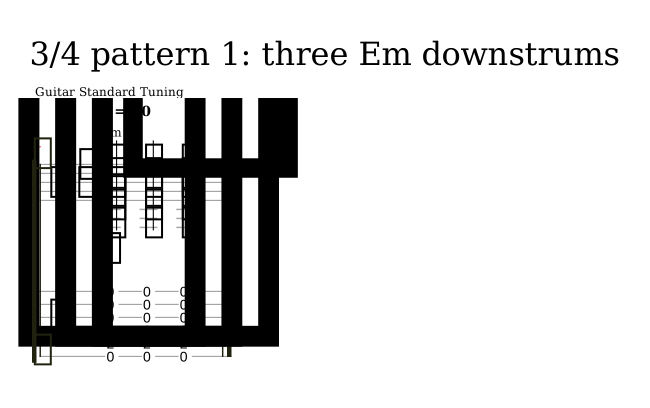
Scroll sideways for the complete score. Interactive notation loads when you ask for it. Practice audio loads separately and starts only after Play. Synthetic audio is a timing reference; it does not check your guitar or replace the instructions for stopping the strings.
The score groups the six chord notes into one attack on each number. It does not specify how quickly the pick travels across the strings. Practice audio is synthetic, so use the written directions for your hand movement.
Pattern 2: six alternating strums
Keep the same three numbered beats. Now strike on each “and” as well: D U D U D U. For this exercise, downstrums use all six Em strings, while upstrums brush only the open high E, B and G strings, in that travel order. Those three open notes are E4, B3 and G3, still notes of Em. After brushing G, continue the upward return clear of the bass strings so the next downstrum can begin from the low-E side. This smaller upstrum gives you a precise target; other strumming patterns can use different string groups.
U means upstrum. Every position now strikes the strings. Scroll the table sideways if needed.
| Count | 1 | & | 2 | & | 3 | & |
|---|---|---|---|---|---|---|
| Action | D | U | D | U | D | U |
| Strings | 6 to 1 | 1 to 3 | 6 to 1 | 1 to 3 | 6 to 1 | 1 to 3 |
Count a full bar before starting, then play the six strums over one bar. The score gives each attack an eighth-note duration, also called a quaver, lasting half a quarter-note beat. At quarter-note 60 BPM, successive strikes are half a second apart. Keep the numbered beats at the same pace as pattern 1.
Let the chord ring between strikes. You do not need to stop the bass strings when the upstrum brushes the thinner strings. After the last upstrum on 3-and, leave another half beat before gently stopping all six strings on the following 1. To repeat instead, make the next downstrum on that 1, with no extra count. Each pass has six strikes across three beats.
3/4 pattern 2: six alternating Em strums: score and practice
One 3/4 bar at quarter-note 60 BPM. Count 1 and 2 and 3 and. Downstrum all six Em strings on each number; upstrum only open high E, B and G on each and. Downstroke sounding pitches E2 B2 E3 G3 B3 E4; upstroke pitches E4 B3 G3 in pick-travel order. Six attacks, three beats, three seconds; no automatic count-in. After the last upstroke, wait half a beat and stop all six strings on the following 1, or downstrum there to repeat. Let the chord ring physically between strikes; synthetic playback represents the scored attacks, not the complete string decay or pick sweep.
The score contains 1 played bar at 60 BPM, without a count-in. Follow the lesson's count-in and stopping instructions when you play. The guitar staff uses the usual octave-transposing treble convention; the tab gives the physical string and fret.
The static score is available without loading the player.
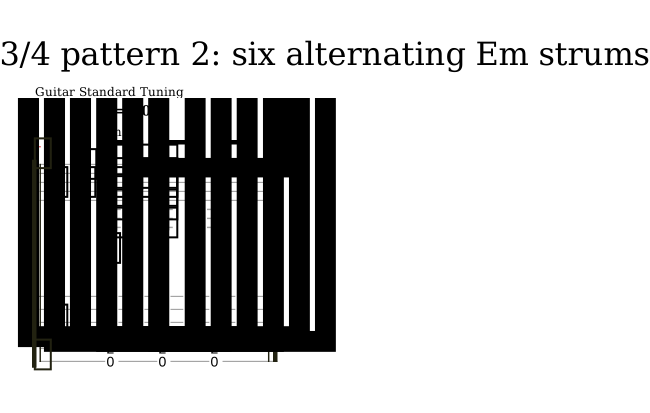
Scroll sideways for the complete score. Interactive notation loads when you ask for it. Practice audio loads separately and starts only after Play. Synthetic audio is a timing reference; it does not check your guitar or replace the instructions for stopping the strings.
The score shows which strings are struck at each position. Its grouped notes and synthetic playback do not reproduce the physical sweep of your pick or the full decay of strings left ringing after an earlier strum.
Keep the three-beat grouping
Say ONE and two and three and as you practise. You can give the strum on 1 a little more weight to hear where the bar begins, while keeping the gaps even and the movement comfortable. The exercise scores do not add a special accent mark or change the note lengths on 1.
If you keep adding a beat 4, put the guitar aside and count three metronome clicks per bar first. If the “ands” rush, return to pattern 1, then speak all six positions before bringing back the upstrums. If the pick catches, reduce the movement and check whether you are gripping too tightly.
Six eighth notes do not turn the second pattern into 6/8. Here they form three pairs, 2 + 2 + 2. In the usual compound grouping, 6/8 has two main beats, each containing three eighths: 3 + 3. The time-signature lesson gives a visual comparison. Neither time signature specifies a speed by itself; check which note value a tempo marking uses.
Check your count
Before opening the answers, count the strikes in each pattern. Which positions get a metronome click? What happens on the 1 after a single played bar?
Show the count and stopping answers
Pattern 1 has three strikes, down on 1, 2 and 3. Pattern 2 has six strikes: down on 1, up on 1-and, down on 2, up on 2-and, down on 3 and up on 3-and. Both use three quarter-note beats. The clicks mark 1, 2 and 3, with no click on the “ands”.
For a single attempt, stop all six strings on the following 1 without another strike. When repeating continuously, play the next downstrum there instead. After a pause or a lost count, stop the strings, count a fresh full bar and begin on the next 1.
Once the three-beat count is comfortable, compare it with the four-beat beginner strumming patterns. These are original practice tasks; use a song’s own time signature, rhythm and chord-change instructions when learning its strumming.
Source notes
The Open University’s time-signature guide explains beat groups and stronger first beats. Open Music Theory’s simple-metre chapter, by Mark Gotham, Chelsey Hamm and Kris Shaffer, supports the three-beat grouping and equal subdivisions; its compound-metre chapter, by Gotham and Hamm, explains 6/8’s usual grouping. Fender’s Em lesson, by Kristin Bigness, supplies the open fingering, and Nick Stoubis’s eighth-note lesson describes down-up strumming between beats. The 3/4 tasks, string targets and diagram here were written for this page; they are not transcriptions of those sources’ recordings or exercises.