In this lesson
To strum in 6/8, count two main beats, each divided into three: 1 la li 2 la li. Start with a downstrum on each number. Then try six downstrums, one on every syllable, keeping the two groups of three clear.
Both patterns below use E minor (Em) throughout. They are original one-bar practice tasks, so you can concentrate on counting before adding chord changes.
Set up Em
Use a six-string guitar in standard tuning, E A D G B E from string 6 to string 1, without a capo. String 6 is low E; string 1 is high E. Review your first guitar chords if the shape is new.
Put your middle finger on string 5 at fret 2 and your ring finger on string 4 at fret 2. Leave the other strings open. From strings 6 to 1, Em is 0 2 2 0 0 0.
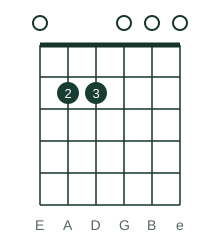
Pick the strings separately first. Low to high, the sounding notes are E2, B2, E3, G3, B3 and E4. Check fingertip placement if a note buzzes or a neighbouring string is blocked. Keep your grip comfortable, take breaks and stop if playing hurts.
Count two beats, with three divisions in each
The usual 6/8 grouping is 3 + 3: six eighth-note values, also called quavers, grouped into two main beats. Each main beat lasts a dotted quarter note (dotted crotchet), equal to three eighths. The 8 names the eighth-note division; it does not make each eighth a main beat. The time-signature guide compares this with 3/4.
Say ONE la li TWO la li, giving every syllable the same amount of time. Tap your foot on ONE and TWO only. You might also hear someone count six positions as 1 2 3 4 5 6. In that count, positions 1 and 4 mark the two main beats. The table maps the counts; use one system consistently while practising.
| Position | 1 | 2 | 3 | 4 | 5 | 6 |
|---|---|---|---|---|---|---|
| Main-beat count | 1 | la | li | 2 | la | li |
| Foot tap / click | Yes | No | No | Yes | No | No |
On the online metronome, choose 2 beats per bar and try 60 BPM, with each click representing one dotted-quarter main beat. Divide the space between clicks into three equal syllables. At this setting, a bar takes two seconds and each eighth-note division takes one-third of a second. Start without clicks or choose a slower pace if the hand movement feels rushed.
The scores below mark quarter note = 90, which gives the same speed as dotted quarter = 60. Their speed-menu BPM numbers count quarter notes: 100% is quarter-note 90, 75% is quarter-note 67.5 and 50% is quarter-note 45. At 50%, your two-click metronome equivalent is dotted-quarter 30 BPM. Check the note unit whenever you compare tempo markings.
Pattern 1: two downstrums
Count 1 la li 2 la li. Downstrum all six Em strings on 1 and 2, letting each chord ring through its “la li”. Do not strike again on those syllables. After each downstrum, bring the hand upwards clear of the strings, ready above the low-E side for the next number. The clear return can happen during the held sound; it is not a rest requiring silence.
For these exercises, down means travel from the low-E side towards the high-E side in playing position. Up is the return direction. See guitar pick strokes for the directions.
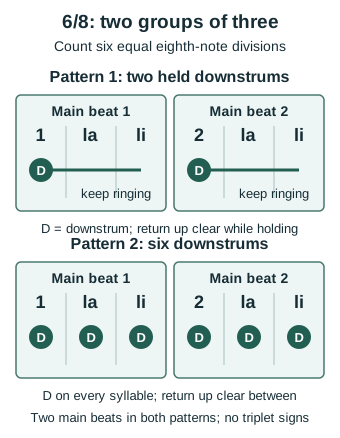
- Count one complete bar without playing:
1 la li 2 la li. - Start on the next 1. Downstrum on 1 and again on 2, keeping all six syllables even.
- After the strum on 2, keep ringing through
2 la li. Return upwards clear of the strings before the next 1. - On that following 1, gently touch all six strings with your picking hand to stop them, without another strike. That finishes one played bar.
To repeat continuously, downstrum on that following 1 instead of stopping. Keep the same gap from the final “li” to the next 1 as between every other pair of syllables. After a pause or a lost count, stop the strings, count a new full bar and begin on the next 1.
6/8 pattern 1: two held Em downstrums: score and practice
One 6/8 bar at quarter-note 90 BPM, equivalent to dotted-quarter 60 BPM. Count 1 la li 2 la li. Downstrum all six Em strings on 1 and 2, frets 0 2 2 0 0 0 from strings 6 to 1, sounding E2 B2 E3 G3 B3 E4. Each dotted-quarter chord lasts three ordinary eighth divisions. Return up clear while holding. Two attacks, two main beats, two seconds excluding a manual full-bar count-in. Let 2 la li finish, then stop all six strings on the following 1 without another attack, or downstrum there to repeat. No extra beat; grouped notes do not prescribe pick-sweep speed.
The score contains 1 played bar at 90 quarter-note BPM, without a count-in. Follow the lesson's count-in and stopping instructions when you play. The guitar staff uses the usual octave-transposing treble convention; the tab gives the physical string and fret.
The static score is available without loading the player.
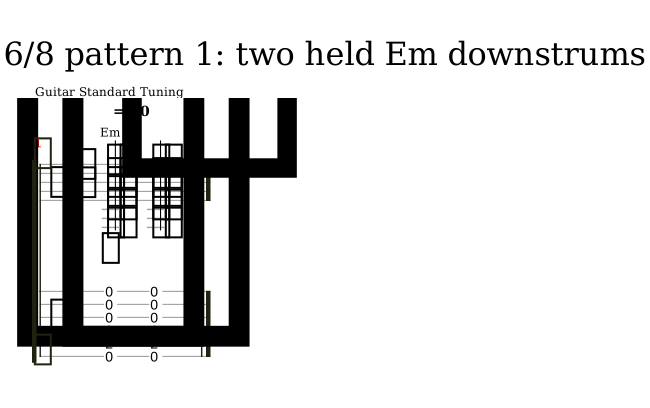
Scroll sideways for the complete score. Interactive notation loads when you ask for it. Practice audio loads separately and starts only after Play. Synthetic audio is a timing reference; it does not check your guitar or replace the instructions for stopping the strings.
Each dotted-quarter chord in this score is one attack held for three eighth-note divisions. The grouped notes do not prescribe how quickly your pick sweeps across the six strings. Synthetic playback is a timing reference; use the written directions for your hand movement.
Pattern 2: six downstrums, grouped 3 + 3
Keep the same two main beats. Now downstrum all six Em strings on every syllable: 1 la li 2 la li. There are six attacks in the bar. Each lasts an ordinary eighth-note value in the score. These are not triplets needing a small 3 above the notes; three ordinary eighths already fill each dotted-quarter beat in 6/8.
After every downstrum, return upwards clear of the strings before the next syllable. These clear returns fall between the spoken syllables, halfway from one strike to the next. They do not add six more counts. Practise slowly enough to fit the return without rushing the next downstrum, keeping the movement small and relaxed.
| Count | 1 | la | li | 2 | la | li |
|---|---|---|---|---|---|---|
| Strike | Down | Down | Down | Down | Down | Down |
| Click | Yes | No | No | Yes | No | No |
Count a full bar before playing one bar of this pattern. Give the strokes on 1 and 2 a little more weight if that helps you hear the grouping, with 1 marking the start of the bar. Keep all six gaps equal. The score shows downstroke marks, without adding accent signs or lengthening the numbered strokes.
6/8 pattern 2: six Em downstrums: score and practice
One 6/8 bar at quarter-note 90 BPM, equivalent to dotted-quarter 60 BPM. Count 1 la li 2 la li and downstrum all six Em strings on every syllable. Frets 0 2 2 0 0 0 from strings 6 to 1; sounding E2 B2 E3 G3 B3 E4. Return up clear between successive strikes. Six ordinary eighth-note attacks, grouped 3 plus 3, two main beats, two seconds excluding a manual full-bar count-in. After the final 2-li strike, let its eighth duration finish and stop all six strings on the following 1 without another attack, or downstrum there to repeat. No extra beat. Synthetic sound represents scored attacks, not the physical sweep or full string decay.
The score contains 1 played bar at 90 quarter-note BPM, without a count-in. Follow the lesson's count-in and stopping instructions when you play. The guitar staff uses the usual octave-transposing treble convention; the tab gives the physical string and fret.
The static score is available without loading the player.
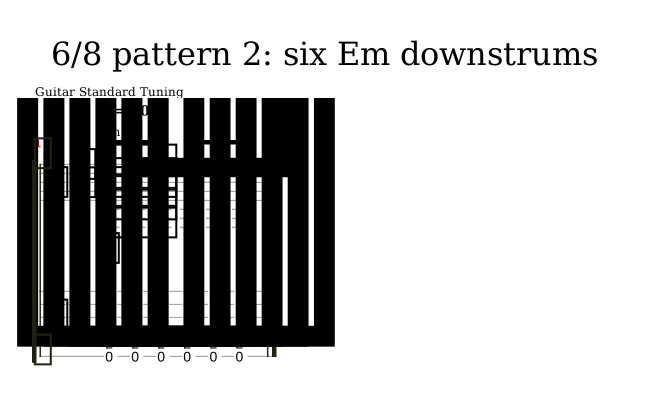
Scroll sideways for the complete score. Interactive notation loads when you ask for it. Practice audio loads separately and starts only after Play. Synthetic audio is a timing reference; it does not check your guitar or replace the instructions for stopping the strings.
After the last downstrum on 2-li, make its clear upward return and let the chord ring until the following 1. Stop all strings there without another strike, or downstrum there to repeat. There is still a full eighth-note division between that last strike and the next bar. At the starting tempo, that gap is one-third of a second.
The practice audio represents the scored chord attacks. It does not reproduce your pick’s sweep or the full decay of strings left ringing between physical strums.
Keep 6/8 separate from 3/4 and triplets
Both 6/8 and 3/4 can contain six eighth notes, but their usual grouping differs. In 6/8, feel two main beats with three divisions each: 3 + 3. In 3/4 strumming, feel three quarter-note beats with two divisions each: 2 + 2 + 2. Neither time signature fixes the speed on its own.
In 4/4 eighth-note triplets, three triplet eighths fit inside one quarter-note beat. Here, three ordinary eighths fill a dotted-quarter beat. Both give you three attacks per main beat, but the written values and beat units differ.
If you keep hearing three pairs, put the guitar aside. Count 1 la li 2 la li while tapping only the numbers, then return to pattern 1. If six downstrums make you tense or lose the clicks, slow down or practise two downstrums again. If the next bar starts late, check that you finish 2 la li and go directly to 1, without adding a third main beat.
These are starting patterns for learning the count. A song may use different strokes, rests, accents and chord changes; follow its own rhythm rather than applying one pattern to every 6/8 song.
Check your count
How many main beats and attacks does each pattern have? Where do the two metronome clicks fall? What happens after the last “li” of a single attempt?
Show the 6/8 count and stopping answers
Both patterns have two dotted-quarter main beats, counted 1 and 2. Each main beat contains three eighth-note divisions. Pattern 1 has two downstrums, on 1 and 2; pattern 2 has six downstrums, on every syllable of 1 la li 2 la li. The two clicks fall on 1 and 2, which are positions 1 and 4 when counting all six divisions as 1 2 3 4 5 6.
The final li lasts one full eighth-note division before the next 1. Stop all six strings on that next 1 without another attack to finish, or downstrum there to repeat. After stopping to adjust, count a fresh full bar before starting. Dotted-quarter 60 BPM and quarter-note 90 BPM give the same two-second bar here.
For more on the held value in pattern 1, see augmentation dots and ties. When these counts are comfortable, compare the four-beat beginner patterns with the two-beat feel here.
Source notes
Mark Gotham and Chelsey Hamm’s compound-metre chapter in Open Music Theory supports the two dotted-quarter beats, three equal eighth-note divisions and la li counting. The Open University’s compound-time explanation compares 6/8’s 3 + 3 with 3/4’s 2 + 2 + 2. Open Music Theory is licensed under CC BY-SA 4.0.
Justin Sandercoe’s 6/8 strumming lesson supports starting simply, counting aloud and keeping the hand moving. His six-position count calls positions 1 and 4 beats; this page labels those six positions as divisions and reserves “main beats” for the two dotted-quarter pulses. Kristin Bigness’s Em guide for Fender supplies the open fingering and six-string downstrum. The patterns, diagram and notation here were written for this page. They do not transcribe the sources’ videos, recordings or musical examples.