In this lesson
Add E♭ to A minor pentatonic and you get the A minor blues scale. The new note sits between D and E. On the A string, the three notes are at frets 5, 6 and 7. In the exercise below you’ll play the same phrase twice, changing just the note on the first “and.”
Find the extra note
| Scale | Notes from A |
|---|---|
| A minor pentatonic | A, C, D, E, G |
| A minor blues | A, C, D, E♭, E, G |
E is a perfect fifth above A. E♭ is one semitone lower, so it is the flat fifth, written ♭5. You can also see the same guitar pitch written D♯ when it leads up to E. The two spellings give you A-string fret 6 in standard tuning. Blues players also bend strings to sound pitches between the fretted notes. Here you’ll use the fretted E♭ so you can hear it next to D and E.
If the five-note shape is new, start with C major and A minor pentatonic in one position. You’ll use the same frets for D and E here.
Play two versions of the phrase
Tune to standard tuning with no capo. Set a metronome to 60 BPM and count four clicks before the first note. On beat 1 of the first bar, pick low E at fret 5 to hear A. Let it ring through beat 2. Mute it on beat 3 and rest through beat 4. Both versions start this way.
Repeat D in the pentatonic phrase
On “1 and 2 and” in bar 2, pick A-string frets 5, 5 and 7, then D-string fret 5. Pick the D note twice at fret 5. On beat 3 pick D-string fret 7 and let that A ring through 4.
A minor pentatonic: repeat D: score and practice
Two bars at 60 BPM. Pick low E-string fret 5 on 1 and hold through 2. Mute on 3 and rest through 4. In the next bar, on “1 and 2 and”, pick A-string frets 5, 5, 7 and D-string fret 5. Pick D-string fret 7 on 3 and hold through 4. Stop on the next click.
The score contains 2 played bars at 60 BPM, without a count-in. Follow the lesson's count-in and stopping instructions when you play. The guitar staff uses the usual octave-transposing treble convention; the tab gives the physical string and fret.
The static score is available without loading the player.
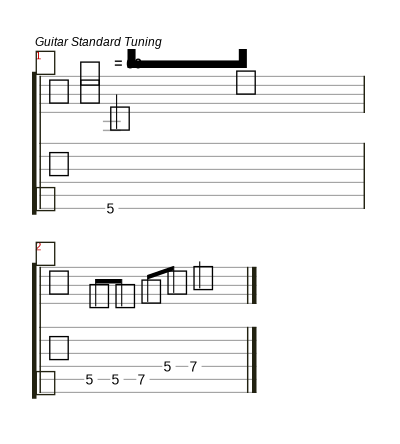
Scroll sideways for the complete score. Interactive notation loads when you ask for it. Practice audio loads separately and starts only after Play. Synthetic audio is a timing reference; it does not check your guitar or replace the instructions for stopping the strings.
Add E♭ in the blues phrase
Keep the count. Play fret 6 on the A string for the “and” of 1. This gives D, E♭, E and G, followed by the same held A. Give D, E♭ and E one pick each. The short E♭ links the same notes on either side by semitone steps.
A minor blues: D, E♭, E: score and practice
Two bars at 60 BPM. Pick low E-string fret 5 on 1 and hold through 2. Mute on 3 and rest through 4. In the next bar, on “1 and 2 and”, pick A-string frets 5, 6, 7 and D-string fret 5. Pick D-string fret 7 on 3 and hold through 4. Stop on the next click.
The score contains 2 played bars at 60 BPM, without a count-in. Follow the lesson's count-in and stopping instructions when you play. The guitar staff uses the usual octave-transposing treble convention; the tab gives the physical string and fret.
The static score is available without loading the player.
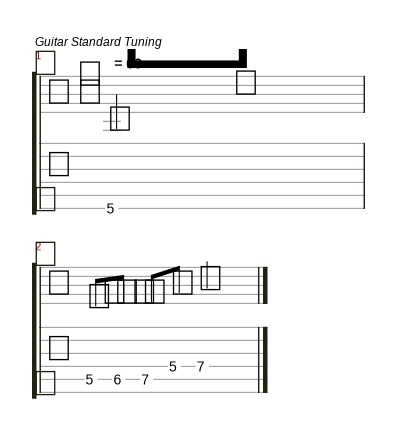
Scroll sideways for the complete score. Interactive notation loads when you ask for it. Practice audio loads separately and starts only after Play. Synthetic audio is a timing reference; it does not check your guitar or replace the instructions for stopping the strings.
When you change from the A string to the D string, stop the old note so both pitches don’t ring together. To finish either version, mute the last A on the following click. To repeat the two bars without a gap, stop that note and pick low E at fret 5 on that same click. The optional player has a “Repeat this 2-bar score” control and plays without a count-in.
Check the changed note
Which fret changes between the two phrases, and which note do both finish on?
On the “and” of 1 in bar 2, the A-string fret goes from 5 to 6. That replaces the second D with E♭. Both phrases finish on A at D-string fret 7.
Use the A minor pentatonic scale player and A blues scale player for the complete runs. Listen for the two short steps from D via E♭ to E when you play the blues scale.
Source notes
Fender lists the six pitches in the A minor blues scale. Megan Lavengood explains the chromatic step to scale degree 5 and the wider use of blue notes in blues melody. The matched phrases and timing were written for IGDb. Fender’s blues scale lesson · Blues Melodies and the Blues Scale