In this lesson
C major pentatonic and A minor pentatonic share five notes. C is the tonic of C major pentatonic, which runs C, D, E, G and A. A is the tonic of A minor pentatonic, which runs A, C, D, E and G. The tonic is the note you hear as home. You can play both scales in the same fretboard position.
Try playing a C chord, then finish a short phrase on C. Play an Am chord and try the phrase again, ending on A. The chords set up a different centre for each example, and the held last note gives you time to hear it.
Find both tonics in one position
Use standard tuning without a capo. The diagram shows frets 5 to 8 and uses the same string order as tab, with high E at the top. The octave numbers in the table name sounding pitches, with middle C written as C4.
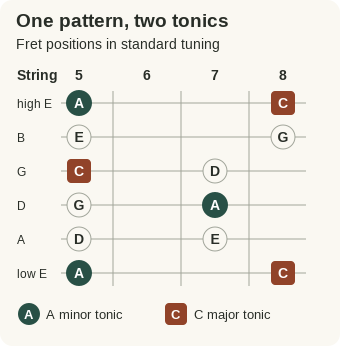
| String | Lower fret | Higher fret |
|---|---|---|
| High E, 1 | 5, A4 | 8, C5 |
| B, 2 | 5, E4 | 8, G4 |
| G, 3 | 5, C4 | 7, D4 |
| D, 4 | 5, G3 | 7, A3 |
| A, 5 | 5, D3 | 7, E3 |
| Low E, 6 | 5, A2 | 8, C3 |
For one octave of A minor pentatonic, play from A on low E fret 5 through A on the D string at fret 7. For one octave of C major pentatonic, play from C on low E fret 8 through C on the G string at fret 5. The final note in each run repeats its tonic one octave higher.
Hear C and A as different centres
Play both phrases at 60 BPM, about one second per beat. The first bar gives you the chord and time to move. The second bar gives you the notes that follow it.
- Count four beats before you start. Play the opening chord on 1 and let it ring through 2. On 3, lightly touch the strings with your picking hand to stop the chord. Use beats 3 and 4 to move your fretting hand to the fifth fret.
- In bar 2, play E, G, A and G on “1 and 2 and”. Use B-string frets 5 and 8, high E fret 5, then B-string fret 8 again. As you cross strings, release enough pressure on the old note to stop it.
- On beat 3, play the final note and hold it through beat 4. Stop the sound on the next 1. On guitar, pause and move back to the opening chord before you count in again. The player can repeat the score without that pause.
Start with C and land on C
Use open C, x 3 2 0 1 0 from the thickest string to the thinnest. Skip low E and play the strings marked 0 open. Finish on high E at fret 8 for C5.
C chord, then land on C: score and practice
Count four beats in. Play the opening chord on 1 and stop it on 3. Use those two silent beats to move up the neck. Play the four shared notes across beats 1 and 2 of the second bar. On 3 play high E at fret 8 for C. Let it ring through 4 and stop on the following 1. Pause to move back to the first chord before another pass.
The score contains 2 played bars at 60 BPM, without a count-in. Follow the lesson's count-in and stopping instructions when you play. The guitar staff uses the usual octave-transposing treble convention; the tab gives the physical string and fret.
The static score is available without loading the player.
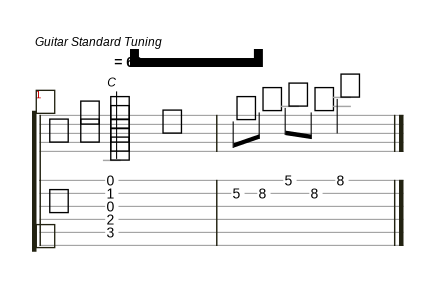
Scroll sideways for the complete score. Interactive notation loads when you ask for it. Practice audio loads separately and starts only after Play. Synthetic audio is a timing reference; it does not check your guitar or replace the instructions for stopping the strings.
Start with Am and land on A
Use open Am, x 0 2 2 1 0 from the thickest string to the thinnest. Skip low E. Finish on high E at fret 5 for A4.
Am chord, then land on A: score and practice
Count four beats in. Play the opening chord on 1 and stop it on 3. Use those two silent beats to move up the neck. Play the four shared notes across beats 1 and 2 of the second bar. On 3 play high E at fret 5 for A. Let it ring through 4 and stop on the following 1. Pause to move back to the first chord before another pass.
The score contains 2 played bars at 60 BPM, without a count-in. Follow the lesson's count-in and stopping instructions when you play. The guitar staff uses the usual octave-transposing treble convention; the tab gives the physical string and fret.
The static score is available without loading the player.
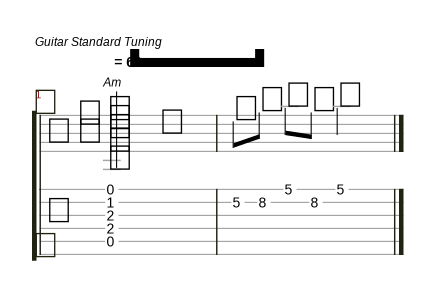
Scroll sideways for the complete score. Interactive notation loads when you ask for it. Practice audio loads separately and starts only after Play. Synthetic audio is a timing reference; it does not check your guitar or replace the instructions for stopping the strings.
Both melodies begin on E. Listen to how the opening chord and the last note cue the centre in each example. In a longer piece, the harmony and where the phrases settle help you hear the centre.
Find the relative pentatonic in another key
C major pentatonic uses degrees 1, 2, 3, 5 and 6 of the seven-note C major scale. A is the sixth degree of the seven-note C major scale and the fifth note in C major pentatonic. From A the same notes sit at degrees 1, ♭3, 4, 5 and ♭7, measured from A. The flat signs describe the intervals from A. The actual notes in this example have natural names.
Try the method in G. Write down G major pentatonic, then find the tonic of the relative minor pentatonic. Keep the same five pitches.
Check your answer
G major pentatonic is G, A, B, D and E. The sixth degree of G major is E. Start the same collection there for E minor pentatonic, E, G, A, B and D.
Use the C major pentatonic and A minor pentatonic pages to practise the individual scales. Both tabs start on low E, at fret 8 for C and fret 5 for A. The C major tab uses some higher frets than the shared shape above. Follow the note names when you compare the fingerings. The relative and parallel minor guide explains how the same tonic or the same note collection can relate two keys.
For the interval patterns, see Berklee’s pentatonic scale handout and Joe Rowley’s A minor pentatonic lesson.