In this lesson
Augmentation dots and ties extend written note values. A tie is the curved line joining notes of the same pitch. A tenuto mark is a separate articulation sign, explained below.
If you need the basic values first, read note duration.
Augmentation dots

A dot immediately to the right of a notehead adds half of the note’s original value. The total is one and a half times the undotted value. Rests can be dotted too.
| Dotted value | Original value plus the dot | Total |
|---|---|---|
| Dotted half note (minim) | Half note + quarter note | 3 quarter notes |
| Dotted quarter note (crotchet) | Quarter note + eighth note | 3 eighth notes |
| Dotted eighth note (quaver) | Eighth note + sixteenth note | 3 sixteenth notes |
With a quarter-note beat, a dotted quarter lasts one and a half beats. In 6/8, a dotted quarter is usually one main beat, divided into three eighth notes. The written duration is the same; the metre changes how you count it.
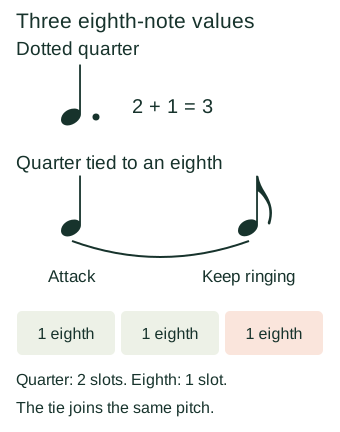
A second dot adds half of the first dot’s addition. A double-dotted quarter therefore lasts a quarter plus an eighth plus a sixteenth: seven sixteenth notes in total. It is 1 + 1/2 + 1/4 = 1 3/4 times the original quarter-note value.
An augmentation dot sits after the notehead. A staccato dot appears above or below the note and asks for a detached articulation. Their position and purpose differ.
Ties

A tie is a curved line joining adjacent notes of the same pitch. Add their durations and play them as one continuous note. Sound the first note, then keep it going through the tied value without striking or plucking it again.
A half note tied to a quarter note lasts for three quarter-note values, just like a dotted half note. A quarter tied to an eighth lasts for three eighth-note values. Ties can also make lengths that a single dot cannot: a quarter tied to a sixteenth lasts for five sixteenth-note values.
Ties may occur within a bar or cross a bar line. A chain of ties can join more than two notes, provided each connected note has the same pitch.
Counting a tie across a bar line
Suppose a quarter note begins on beat 4 of a 4/4 bar and is tied to a half note at the start of the next bar. Play on beat 4, then sustain through beats 1 and 2 of the next bar. The combined duration is three quarter-note beats.
The tie does not change either bar’s capacity. The first quarter occupies one beat in the first bar; the half note occupies two beats in the next. In each complete 4/4 bar, the other notes and rests still fill the remaining beats. Other time signatures have different totals, and pickup bars can be incomplete.
Keep counting through the bar line even though there is no new attack on the next beat 1.
Play that crossing in a complete two-bar phrase in counting rests and ties on guitar. Its action grids show where to pluck, keep ringing and stop, including the return to the first bar.
Ties, tenuto marks and slurs
A tenuto mark is a short horizontal line above or below a note. It generally asks you to hold the note for its full written length. It does not combine two note values or have the fixed arithmetic effect of a dot or tie.
A slur is a curved line that groups notes for connected articulation or phrasing. It often covers notes of different pitches, and its playing technique depends on the instrument. A tie specifically joins the same pitch into one sustained sound. The similarity of their curves makes it useful to check both the pitches and the musical context.
For a counting check, use sixteenth notes as the unit: a dotted quarter contains six, a double-dotted quarter contains seven, and a quarter tied to a sixteenth contains five.
Further reading
Open Music Theory’s rhythmic-values guide covers dots and ties. The Open University’s dots-and-ties lesson explains their use within and across bars. Steinberg’s notation guide distinguishes ties from slurs.