In this lesson
On the D string, play fret 3 and then fret 5. You move from F to G in two frets. Now play fret 4 to fret 5 instead. F♯ is one fret below G. In the phrase below, both versions land on G over C. Here F♯ is a chromatic approach note. It comes from outside the key and leads into G a semitone above it.
Choose where to land
The C major chord contains C, E and G. G is the fifth of that chord. F belongs to the C major scale, though it sits outside the three notes of the chord. F♯ sits outside the scale and is a semitone below the target. Here, it lasts for one eighth note and leads straight into G on the next downbeat.
Pick F–G and F♯–G on the D string again. Give the G the same length and volume each time. Listen to what changes on the way in. Then put those two notes into the count.
Put the pickup on the last “and”
Use standard tuning. The low C is fret 3 on the A string. Use your thumb for the low C and a finger for the higher note. The higher note stays on the D string until the last beat. Start with the top notes alone if you want to learn the count before adding the bass.
| Count | What to play |
|---|---|
| Bar 1, beats 1–3 | Play low C with E, G and E in turn. Use D-string frets 2, 5 and 2. Give each pair one beat. |
| Bar 1, beat 4 | Damp the ringing pair on 4. Pick the single pickup on its “and”. Use D-string fret 3 for F or fret 4 for F♯. |
| Bar 2, beats 1–2 | Play low C with G at D-string fret 5 on 1 and hold both notes through 2. |
| Bar 2, beats 3–4 | Play low C with E at D-string fret 2 on 3. On 4, damp the D string as you play low C with the higher C at G-string fret 5. |
Set the metronome to 60 BPM and four beats per bar. Keep its page visible. Count four clicks and start on the next 1. In both versions, leave the first half of beat 4 silent. Keep the pickup short so G arrives on the next 1. On the 1 after bar 2, damp the G string. To stop, damp the A string too. To repeat, use that same click to play the first A- and D-string pair again.
Approach G from F
Approach G from F: score and practice
At 60 BPM, pair low C with E, G and E on beats 1, 2 and 3. Silence the pair on beat 4, then pick F at fret 3 on string 4 on its “and”. Play low C with G on the next 1 and hold through 2. Pair low C with E on 3. On 4, damp the D string and play both Cs, with the higher C at fret 5 on the G string. Damp the G string on the following 1. Damp the A string too if you stop, or replay the first A- and D-string pair on that click.
The score contains 2 played bars at 60 BPM, without a count-in. Follow the lesson's count-in and stopping instructions when you play. The guitar staff uses the usual octave-transposing treble convention; the tab gives the physical string and fret.
The static score is available without loading the player.
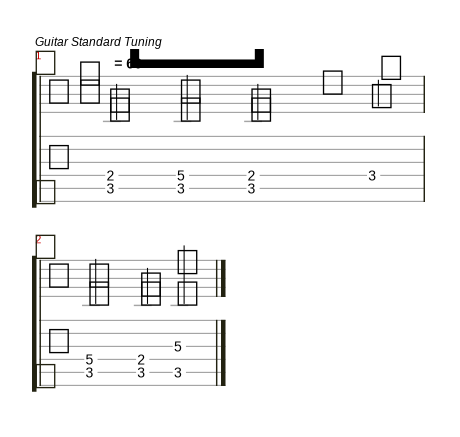
Scroll sideways for the complete score. Interactive notation loads when you ask for it. Practice audio loads separately and starts only after Play. Synthetic audio is a timing reference; it does not check your guitar or replace the instructions for stopping the strings.
Approach G from F sharp
Approach G from F sharp: score and practice
At 60 BPM, pair low C with E, G and E on beats 1, 2 and 3. Silence the pair on beat 4, then pick F sharp at fret 4 on string 4 on its “and”. Play low C with G on the next 1 and hold through 2. Pair low C with E on 3. On 4, damp the D string and play both Cs, with the higher C at fret 5 on the G string. Damp the G string on the following 1. Damp the A string too if you stop, or replay the first A- and D-string pair on that click.
The score contains 2 played bars at 60 BPM, without a count-in. Follow the lesson's count-in and stopping instructions when you play. The guitar staff uses the usual octave-transposing treble convention; the tab gives the physical string and fret.
The static score is available without loading the player.
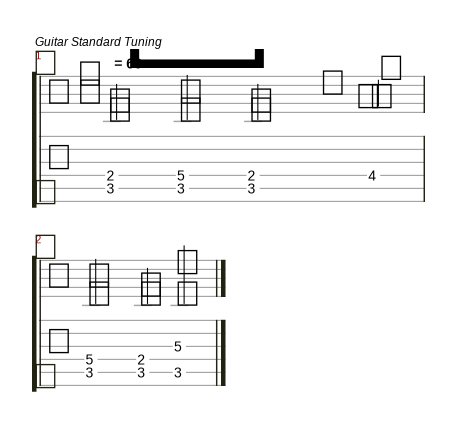
Scroll sideways for the complete score. Interactive notation loads when you ask for it. Practice audio loads separately and starts only after Play. Synthetic audio is a timing reference; it does not check your guitar or replace the instructions for stopping the strings.
Each player starts with the first written pair. Repeat this 2-bar score returns to that pair after bar 2. Use the metronome for a manual click and count-in.
Check the fret and the count
Which fret gives the chromatic pickup, and on which part of beat 4 does it sound?
Play fret 4 on the D string for F♯ on the “and” after 4. G at fret 5 arrives on the next 1.
The chord-tone melody lesson shows how to choose target notes when the chords change.
Sources
Guthrie Govan’s Guitar World lesson describes approaching chord tones from a semitone below and placing the destination on a stronger beat. Peghead Nation’s approach-note lesson explains how a half-step approach can also occur within a scale. The two-bar guitar comparisons here were written for IGDb. Using Chromatic Passing Tones · Approach Notes, Week One