In this lesson
Chord tones are the notes that belong to a chord. C major contains C, E and G. To build a chord-tone melody over a changing progression, choose from the current chord’s notes, then check your choices again when the chord changes.
This lesson gives you an original four-bar phrase for C, Am, F and G, with one chord lasting each bar. You will name the notes, find them on three guitar strings, keep a rest silent and change one note yourself. It is a starting exercise for following harmony; it does not require a full scale pattern or a fast picking technique.
Use standard tuning, E A D G B E from string 6 to string 1, with no capo. You need the fretboard-note guide and tab-reading basics. Read triads if root, third and fifth are unfamiliar, or count rests and ties for the stopping action.
Write the chord notes before choosing a melody
For this exercise, the key is C major and the progression uses these triads:
| Bar | Chord | Root | Third | Fifth |
|---|---|---|---|---|
| 1 | C major, C | C | E | G |
| 2 | A minor, Am | A | C | E |
| 3 | F major, F | F | A | C |
| 4 | G major, G | G | B | D |
The major-key chord lesson explains how these chords come from C major. Here you use each chord’s smaller note set to choose the melody. Being in the same key does not make every scale note part of every chord: E belongs to C major’s scale, but not to the F major triad F, A, C.
A chord-tone melody can repeat a note or leave out some chord tones. Bar 1 below uses E and G without playing C. The underlying chord is still named C; the melody is one part, not a complete statement of every chord note.
Pick a target for the first beat
The first notes of the four bars are E4, E4, F4 and G4. The numbers identify sounding octaves, with middle C called C4. Check each target against its chord:
| Bar | First melody note | Place in the current chord |
|---|---|---|
| 1, C | E4 | Third of C major |
| 2, Am | E4 | Fifth of A minor |
| 3, F | F4 | Root of F major |
| 4, G | G4 | Root of G major |
The same E4 has a different relationship to C and Am. You can keep a pitch across a chord change when it belongs to both chords; you do not always need to move to the new chord’s root. In this written phrase, however, the E is plucked again after a rest. There is no tie between the bars.
Find the phrase on three strings
Use only string 1, high E; string 2, B; and string 3, G. A fret number is not a finger number. 0 means open. The full phrase is:
| Bar and chord | Beat 1 | Beat 2 | Beat 3 | Beat 4 |
|---|---|---|---|---|
| 1, C | E4: string 1, fret 0 | G4: string 1, fret 3 | E4: string 1, fret 0 | Rest |
| 2, Am | E4: string 1, fret 0 | C4: string 2, fret 1 | A3: string 3, fret 2 | Rest |
| 3, F | F4: string 1, fret 1 | C4: string 2, fret 1 | A3: string 3, fret 2 | Rest |
| 4, G | G4: string 1, fret 3 | D4: string 2, fret 3 | B3: string 2, fret 0 | Rest |
Work through one bar without a beat first. Say the note name, find its string and fret, then pluck it. Check that every note is in that bar’s chord-note row. The tab below shows the same positions, with the chord name above the first beat of each bar.
You may use index finger for fret 1, middle for fret 2 and ring for fret 3, moving between strings as needed. There is no need to hold a full chord shape or keep those fingers spread out. In bar 3, release the high-E fret 1 before playing B-string fret 1; you do not need to barre both strings. Adjust your fingering for comfort and stop if playing hurts.
Sound one melody note at a time. Stop the previous string as the next note begins, including when you move to a different string. Gently touching a string with the plucking hand can silence it. Lifting a fretting finger alone can leave an open string ringing. Pluck every written note, including the open B in bar 4; no hammer-on, pull-off or slide is requested.
Play three notes, then leave a rest
Use 4/4: four quarter-note beats in each complete bar. At 60 BPM, each beat lasts one second. Count one empty bar, 1 2 3 4, before starting. The optional player has no count-in.
For every bar, pluck its first note on 1, second on 2 and third on 3. Each note lasts one beat. On 4, stop the third note and keep the melody silent for that whole beat. The quarter rest is time to count and prepare, not an extra beat between bars. Keep the unused strings quiet too.
The next bar starts on the following 1, when its chord label changes. After bar 4’s rest, finish at the next 1 without plucking again. That makes one pass: four bars, sixteen beats, twelve plucks and four quarter rests. For a loop, instead begin bar 1’s E4 on that same next 1, without inserting another beat. The player’s Repeat control repeats the complete four-bar score.
C, Am, F and G: chord-tone melody: score and practice
Melody only, without chord accompaniment. Four bars: C, Am, F, then G. Pluck each bar’s three notes on 1, 2 and 3; stop for a quarter rest on 4. After bar 4’s rest, finish at the next 1, or restart bar 1 there if repeating. The score retains the original F4 target in bar 3.
The score contains 4 played bars at 60 BPM, without a count-in. Follow the lesson's count-in and stopping instructions when you play. The guitar staff uses the usual octave-transposing treble convention; the tab gives the physical string and fret.
The static score is available without loading the player.
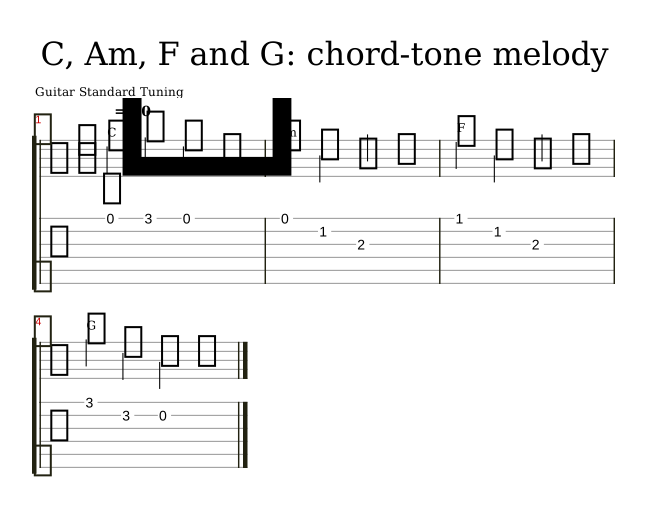
Scroll sideways for the complete score. Interactive notation loads when you ask for it. Practice audio loads separately and starts only after Play. Synthetic audio is a timing reference; it does not check your guitar or replace the instructions for stopping the strings.
The score and player contain the melody only. C, Am, F and G above the bars identify the harmony for checking the notes; the player does not sound chord accompaniment. You can practise naming, finding and timing this part on its own. To hear the melody against chords, a second player can supply C, Am, F and G, one chord per bar, while you play this part. You do not need to strum a chord and play the melody simultaneously.
Use the metronome with four beats per bar and one click per number, or slow the player. If a string change interrupts the count, practise that movement separately, then restart after a complete count-in. Do not hurry through beat 4 to catch up.
Change one target and explain it
Replace only bar 3’s first note, F4, with A3 at string 3, fret 2. Keep that bar’s C4 on beat 2, A3 on beat 3 and rest on beat 4. The altered bar is therefore A3, C4, A3, rest.
A belongs to F major’s F, A, C, so the new target is its third. Both versions meet this chord-tone task. Try the original and altered bars separately, then place either one in the four-bar phrase. The supplied score and player retain the original F4 version.
If you put E4 on that first beat instead, E is outside the stated F triad, so it would not meet this exercise’s chord-tones-only rule. That does not make E automatically wrong in other music. Notes outside a chord can be deliberate; their timing, duration and surrounding notes matter. This lesson limits your choices so that you can check the chord relationship clearly.
Check your choices and count
- Which notes are available in Am? What role does its first E4 have?
- Does bar 1 have to include C to qualify as a chord-tone melody over C?
- What happens on beat 4 of every bar? How many plucks are in one complete pass?
- Does E belong to both the C major scale and the F major triad?
- In the variation, what are all four actions in bar 3? Does the supplied player change to that version?
Show the answers
- Am contains A, C and E. E is its fifth. That same note name is the third of C major in bar 1.
- No. Its E, G, E are all C-major chord tones. This melody part can leave out the root; it does not claim to play the complete chord.
- Stop the third note on 4 and keep the melody silent for one beat. Each bar has three plucks, so four bars have twelve. Finish after the final rest, or restart on the next 1 if you have chosen to loop.
- E belongs to the C major scale, but not to F major's F, A, C. It fails the chord-tone-only rule for that F bar, without establishing a universal rule against E in music using F.
- Pluck A3 on 1, C4 on 2 and A3 again on 3; stop for the rest on 4. The supplied score and player remain the original F4, C4, A3, rest.
Choose the next small change
Pick a different chord tone for just one first beat, leaving the rhythm and other notes unchanged. Write its note name, string and fret, then check it against the current chord before playing. Once you can explain that choice, try changing a second note. The fretboard chart helps you find another position without guessing from a shape.
For chord rhythm instead of melody, return to beginner chord progressions. The slash-chord lesson follows a moving bass line: another way to track a particular note as chords change.
Source notes
Berklee’s Chord-Tone vs. Chord-Scale Soloing, especially its closing practice steps, describes practising individual chords and small chord groups with chord tones. Fender’s How to Solo on Guitar, under “First Steps”, “Make Pauses” and “Play With a Small Number of Notes”, discusses chord-note knowledge, short phrases and space between notes. The note choices, guitar positions, four-bar phrase and variation here were written for this lesson. They are not transcriptions of either source’s examples.