In this lesson
A Dorian has the same notes as A natural minor except for the sixth. A natural minor has F. A Dorian has F♯. The same change turns a D minor chord into D major. On the high E string, those two notes are a fret apart.
Find the sixth above A
In both scales, A is the tonic, the note where the phrase can settle. Count up from A to the sixth note. A natural minor gives A, B, C, D, E, F, G. A Dorian gives A, B, C, D, E, F♯, G. From A3 up to F4 is eight semitones, a minor sixth. From A3 up to F♯4 is nine, a major sixth. The C in both scales is a minor third above A.
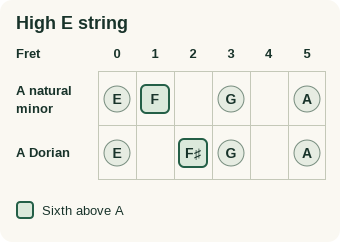
Pick open high E, then frets 1, 3 and 5 for E–F–G–A. Begin on open high E again and replace fret 1 with fret 2 for E–F♯–G–A. Hold the A in both versions. To hear the difference against an A chord, try the next comparison.
Change D minor to D major
Keep the first and last chord the same. The middle chord has D and A in both examples. On the thinnest string, Dm has F at fret 1 and D has F♯ at fret 2. Those notes are the thirds of their D chords and the sixths measured from A.
| Chord | Low E to high E | Sounding notes |
|---|---|---|
| Am | x 0 2 2 1 0 |
A2, E3, A3, C4, E4 |
| Dm | x x 0 2 3 1 |
D3, A3, D4, F4 |
| D | x x 0 2 3 2 |
D3, A3, D4, F♯4 |
0 means play the open string. Skip strings marked x. Set your metronome to 60 BPM and count four clicks before you start. Play Am on 1 and let it ring through 2. Mute the open A string as you switch to Dm or D on 3. Hold the new chord through 4. In the second bar, return to Am on 1 and hold through 2. Lightly touch the strings with your picking hand on 3 to stop them, then rest through 4. If you want another pass, start again on the next 1.
A natural minor: Am–Dm–Am
Am–Dm–Am: F natural: score and practice
Two bars at 60 BPM. Count four clicks before starting. Play Am on 1 and hold through 2. Switch on 3 and listen for F natural at high E fret 1. Hold through 4, then play Am on the next 1. Mute it on 3 and rest through 4. Stop there or pick Am on the following 1 to repeat.
The score contains 2 played bars at 60 BPM, without a count-in. Follow the lesson's count-in and stopping instructions when you play. The guitar staff uses the usual octave-transposing treble convention; the tab gives the physical string and fret.
The static score is available without loading the player.
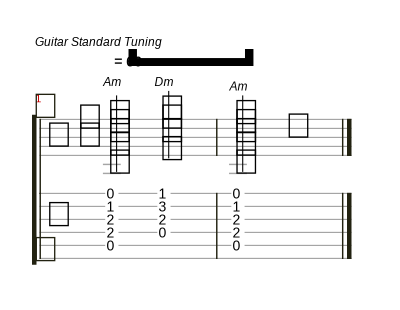
Scroll sideways for the complete score. Interactive notation loads when you ask for it. Practice audio loads separately and starts only after Play. Synthetic audio is a timing reference; it does not check your guitar or replace the instructions for stopping the strings.
A Dorian: Am–D–Am
Am–D–Am: F sharp: score and practice
Two bars at 60 BPM. Count four clicks before starting. Play Am on 1 and hold through 2. Switch on 3 and listen for F sharp at high E fret 2. Hold through 4, then play Am on the next 1. Mute it on 3 and rest through 4. Stop there or pick Am on the following 1 to repeat.
The score contains 2 played bars at 60 BPM, without a count-in. Follow the lesson's count-in and stopping instructions when you play. The guitar staff uses the usual octave-transposing treble convention; the tab gives the physical string and fret.
The static score is available without loading the player.
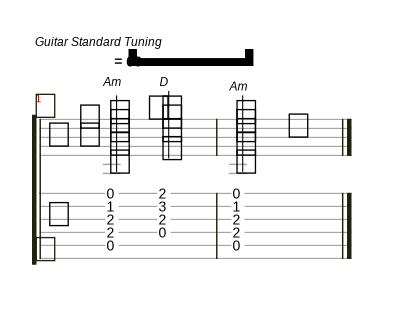
Scroll sideways for the complete score. Interactive notation loads when you ask for it. Practice audio loads separately and starts only after Play. Synthetic audio is a timing reference; it does not check your guitar or replace the instructions for stopping the strings.
Since D is degree 4 above A, Dm is iv and D major is IV. A major IV against a minor tonic is a common Dorian sound. One chord can give a passage that sound even if the rest of the song uses other notes or chords.
Try it from D
D natural minor has B♭. Raise that note one fret to get the sixth of D Dorian. Which pitch do you get, and which chord on G does it give you?
Check your answer
B♭ becomes B natural. With G and D, B makes G major. That gives D Dorian a major IV. G minor would use B♭ for iv in D natural minor. Both scales keep C natural as degree 7.
A Dorian also shares its notes with G major. In these phrases, listen for Am as the point of rest. The guide to relative and parallel keys explains the difference between sharing notes and sharing a tonic.
Practise the A natural minor scale on its own, or compare natural, harmonic and melodic minor to hear what happens when degree 7 changes too.
For the scale and chord explanations, see Open Music Theory’s Introduction to Diatonic Modes and Dorian examples in Modal Schemas.