In this lesson
Relative major and minor keys share a key signature. Parallel major and minor keys share a tonic. C major and A minor are relative; A major and A minor are parallel. The tonic is the note that acts as a key’s centre.
On guitar, those relationships help you explain why two scales use the same note names, or why a major chord changes to minor while keeping its root. They do not mean that two keys, chords or scale patterns are interchangeable.
This lesson compares natural minor with major. A minor key can also use raised sixth or seventh degrees, as the minor-scale forms lesson explains. Use standard tuning, E A D G B E from string 6 to string 1, without a capo. Review scale degrees and the first chord shapes if those are unfamiliar.
Relative: the same note names, a different tonic
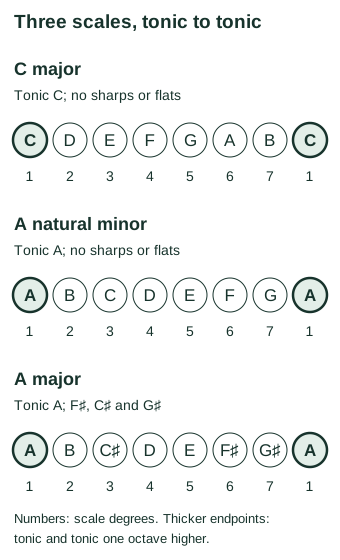
C major uses C, D, E, F, G, A and B. A natural minor uses A, B, C, D, E, F and G. They share seven note names and a key signature with no sharps or flats, but C is the major tonic and A is the minor tonic.
| Scale | Tonic | Notes from tonic to tonic above |
|---|---|---|
| C major | C | C D E F G A B C |
| A natural minor | A | A B C D E F G A |
| A major | A | A B C♯ D E F♯ G♯ A |
A repeated tonic an octave higher makes eight notes in each row, with seven different note names. Starting the same collection on another note changes its order. Starting on A alone does not prove that a piece is in A minor. Listen to its melody and harmony, including where phrases settle; the key signature alone does not choose the tonic. Modal music can use the same signature too.
For complete playable patterns, compare the C major and A minor scale pages. Their guitar positions need not be identical for their note-name collections to match. The relationship describes the notes and tonic, not a requirement to reuse one fingering.
Find a relative minor on one string
A major key’s relative minor tonic is its sixth scale degree. Count C D E F G A to find A minor from C major. G major gives G A B C D E, so its relative minor is E minor.
You can also go three semitones down from a major tonic, or three semitones up from a minor tonic to find its relative major. Each fret step on one string is one semitone.
Try the rule on string 5, the A string:
| Action | Sounding note | Position |
|---|---|---|
| Find C | C3 | String 5, fret 3 |
| Move one fret towards the nut | B2 | String 5, fret 2 |
| Move one more fret | B♭2 | String 5, fret 1 |
| Move one more step to the open string | A2 | String 5, open |
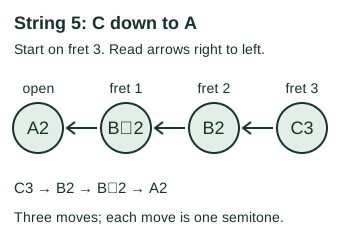
Play these separately, with a pause to move your finger. Count the three moves, not the four positions. B♭ is an intervening chromatic note in this calculation; it is not a member of C major. Going back up from open A to fret 3 finds C, A minor’s relative major. Octave numbers here name sounding pitches, with middle C called C4.
Check the spelling and key signature as well as the fret distance. D♭ major’s relative minor is B♭ minor, not A♯ minor, even though B♭ and A♯ share a fret in equal temperament. The key-signature reference lists the conventional pairs.
Parallel: keep A, change the scale pattern
A major and A natural minor both have A as tonic. Compare their note rows above:
| Degree from A | A major | A natural minor | Change from major |
|---|---|---|---|
| 3 | C♯ | C | Down one semitone |
| 6 | F♯ | F | Down one semitone |
| 7 | G♯ | G | Down one semitone |
Degrees 1, 2, 4 and 5 stay A, B, D and E. A major has three sharps in its key signature; A minor has none. They share a tonic and have different signatures. C major and C minor are another parallel pair, but C major and A minor are not: their tonics differ.
The third also distinguishes a major tonic triad from its parallel minor triad. A major contains A, C♯ and E; Am contains A, C and E. Only the third changes in this chord comparison. The scale comparison changes degrees 3, 6 and 7 because it includes all seven scale notes.
Check the difference with open chords
Use these existing open shapes. The compact patterns run from low E, string 6, to high E, string 1. x means leave that string out; 0 means open. Small diagram numbers identify fretting fingers.
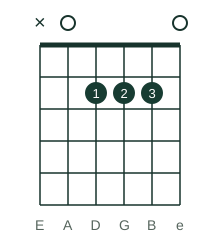
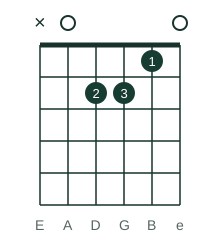
Play A major’s strings separately, then stop them. Form Am and check its strings separately. Take as much time as needed between shapes; this is an untimed comparison. The B-string note moves down from C♯ at fret 2 to C at fret 1. The other sounding positions stay the same, although the fretting fingers can change. The root remains A.
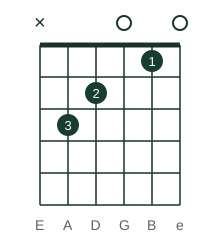
For a relative comparison, use C major, x 3 2 0 1 0, from the first-chords lesson. Its sounding notes are C3 E3 G3 C4 E4, giving the three different note names C, E and G. Am gives A, C and E. These chords share C and E. Their remaining note names differ: G in C major, A in Am. Their roots also differ. A relative key pair sharing seven scale-note names does not make its tonic chords contain the same notes.
If you want to turn the separate shape checks into a playing task, use the chord-change method. Its worked pair is Am and C. Practise the shape changes before adding a steady count. The diagrams here do not prescribe a rhythm or strumming pattern, and these isolated chords do not establish a whole piece’s key.
Check your understanding
- Is E minor relative or parallel to G major?
- What is A major’s parallel minor?
- Which three scale degrees change from A major to A natural minor?
- Does playing A first prove that music using only natural notes is in A minor?
- Which note changes between the stated A-major and Am chord shapes?
Check your answers
- Relative. Both use the one-sharp signature, F♯, and have different tonics.
- A minor. Both have A as tonic.
- Degrees 3, 6 and 7: C♯, F♯ and G♯ become C, F and G.
- No. The melody and harmony need to establish the tonic; a starting note or signature alone is insufficient.
- The B-string note, C♯4 at fret 2, becomes C4 at fret 1. The root remains A.
Continue with major-key chords and Roman numerals to see how the same chord can have a different degree number in another key. For minor-scale variations beyond natural minor, return to the minor-scale forms.
Source notes
The Open University’s Relative minor and relative major derives the C/A and G/E relationships. Chelsey Hamm and Bryn Hughes’s Minor Scales, Scale Degrees, and Key Signatures, especially “The Parallel and Relative Relationships”, distinguishes the two relationships and explains the spelling requirement. Its natural-minor comparison supplies the lowered third, sixth and seventh. The guitar pitch derivations, comparison task and note-row diagram were written for this lesson. No source music or artwork is reproduced.