Play fret 4 on the D string, then fret 2. That is F♯ down to E. Now play fret 3 to fret 2 on the same string. F natural goes back to E in one fret. This is the change from E natural minor to E Phrygian. You can hear it in a short phrase with the same low E under both versions.
Find the second note
In E natural minor, the notes are E, F♯, G, A, B, C and D. In E Phrygian they are E, F, G, A, B, C and D. Both have G a minor third above E. Phrygian lowers the second note, F♯, by a semitone. That is why you will see F called the flattened second, or ♭2, when E is the tonic.
E Phrygian uses the notes of C major. In this exercise the low E repeats under the melody, which starts and finishes on E. That gives your ear an E to listen back to through both bars.
Play it over a low E
Use standard tuning. Play the top notes on string 4, the D string. First run through the two bars on that string alone. Then add open string 6 to each attack. Pluck the low E with your thumb and the D string with a finger to leave the A string quiet.
| Beat | Bar 1, E natural minor | Bar 2, E Phrygian |
|---|---|---|
| 1 | E, D-string fret 2 | E, D-string fret 2 |
| 2 | G, D-string fret 5 | G, D-string fret 5 |
| 3 | F♯, D-string fret 4 | F, D-string fret 3 |
| 4 | E, D-string fret 2 | E, D-string fret 2 |
Set the metronome to 60 BPM and four beats per bar. Keep its page visible. Count four clicks and start on the next 1. Play both notes together on each beat and let them ring until the next click. After the final pair, damp both strings on the following 1. In the score player, Repeat this 2-bar score takes you straight back to the first pair. Use the metronome when you want a click and count-in for playing on your own.
Compare E natural minor and E Phrygian: score and practice
At 60 BPM, play open string 6 with each note on string 4. In bar 1 use D-string frets 2, 5, 4 and 2. In bar 2 use frets 2, 5, 3 and 2. The upper F sharp in bar 1 becomes F natural in bar 2. Both phrases return to E on beat 4.
The score contains 2 played bars at 60 BPM, without a count-in. Follow the lesson's count-in and stopping instructions when you play. The guitar staff uses the usual octave-transposing treble convention; the tab gives the physical string and fret.
The static score is available without loading the player.
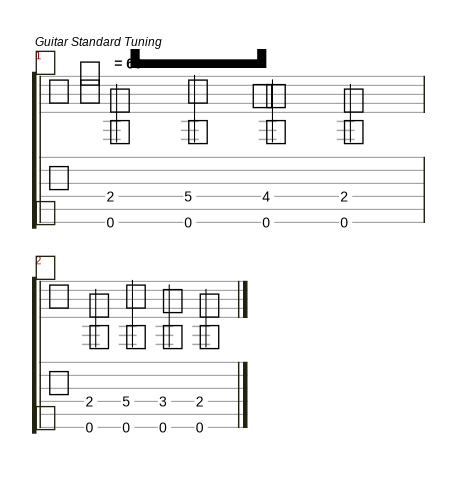
Scroll sideways for the complete score. Interactive notation loads when you ask for it. Practice audio loads separately and starts only after Play. Synthetic audio is a timing reference; it does not check your guitar or replace the instructions for stopping the strings.
Listen to beat 3 going into beat 4. In bar 1, F♯ is two frets above the E you return to. In bar 2, F is one fret above the same E. The open low E under that F is an octave below the E you play on the D string. Keep that bass note steady and try each return again.
Check which fret gives Phrygian
Which fret should you play on the D string on beat 3 of the Phrygian bar?
Play fret 3 for F natural. It sits one fret above the E at fret 2. F♯ at fret 4 gives the natural-minor version.
For a different change to natural minor, try Dorian on guitar and listen to what happens when the sixth moves instead.
Sources
Open Music Theory compares the notes of the modes and describes how a repeated bass note can reinforce the tonic. The chapter Mode in Twentieth- and Twenty-First-Century Music describes Phrygian as natural minor with a lowered second. The two-bar guitar comparison was written for IGDb. Diatonic Modes · Mode