On the thinnest string, high E, pick the open string, then fret 3, then the open string again. That plays E–G–E. C major and E minor both contain E and G, so the same melody can sit on top of either chord.
Why both chords fit
C major and E minor are triads with two notes in common. C major contains C, E and G. E minor contains E, G and B. In the key of C major, these are chords I and iii.
| Melody note | In C major | In E minor |
|---|---|---|
| E | Major third | Root |
| G | Perfect fifth | Minor third |
You play the same E and G at the same frets in both bars. E is the third of C and the root of Em. G is the fifth of C and the minor third of Em. To hear that change, pick the lowest note of C and then G on high E. Do the same with the lowest note of Em and the same G.
Keep the melody on high E
Use standard tuning without a capo. Start with the open C and Em shapes. The positions run from low to high in string order E, A, D, G, B, E. An x means skip the string and a 0 means play it open.
| Chord | Top note | Frets |
|---|---|---|
| C | E | x 3 2 0 1 0 |
| C | G | x 3 2 0 1 3 |
| Em | E | 0 2 2 0 0 0 |
| Em | G | 0 2 2 0 0 3 |
On C, use ring on A at fret 3, middle on D at fret 2 and index on B at fret 1. On Em, use middle on A and ring on D, both at fret 2. Try open–3–open over C without a beat first. Keep the lower part of the chord held and place your little finger just behind fret 3 on high E. Use enough pressure for G to sound on the downstroke. Lift the finger without flicking the string. The next downstroke sounds open E. Pick B and high E separately if either is muffled. If the reach feels tight, practise the melody and open chords separately.
Play both versions at the same tempo
Set the metronome to 60 BPM and four beats per bar. Press Start metronome, then count 1, 2, 3, 4 from a higher click and start on the next 1. Keep the metronome visible in a separate window or on another device, or count aloud at a steady pace.
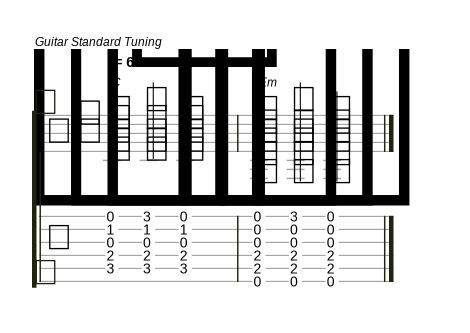
- Bar 1, C. Downstrum from A through high E on beats 1, 2 and 3. High E is open on 1, fretted at 3 on 2 and open on 3. Let the last chord ring through beat 4.
- Bar 2, Em. Downstrum all six strings on beats 1, 2 and 3. Use the same top notes and let the last chord ring through beat 4.
To stop, touch all the strings on the following 1. To repeat, let beat 4 finish, mute low E as you change to C and downstrum from A on the following 1.
E–G–E over C and Em: score and practice
In 4/4 at 60 BPM, start on C in bar 1 and Em in bar 2. Downstrum on beats 1, 2 and 3. In both bars, the high E string is open on beat 1, fretted at 3 on beat 2 and open again on beat 3. Let each last strum ring through beat 4. Start the C strums on the A string and the Em strums on low E. Damp all the strings on the next 1 to stop. To repeat, let beat 4 finish. Mute low E as you change to C, then downstrum from A on the next 1.
The score contains 2 played bars at 60 BPM, without a count-in. Follow the lesson's count-in and stopping instructions when you play. The guitar staff uses the usual octave-transposing treble convention; the tab gives the physical string and fret.
The static score is available without loading the player.
If part of the score is off screen, scroll sideways within the score.
Interactive notation loads when you ask for it. Practice audio loads separately and starts only after Play. Synthetic audio is a timing reference; it does not check your guitar or replace the instructions for stopping the strings.
Pick the melody by itself again. Play each bar and listen for the lowest note. What changes in the bass, and does the top line change?
Check the bass and top line
The C version has C at fret 3 on A as its lowest note. Em has open low E. The top line stays E–G–E. To hear the difference, pick each bass note and follow it with G at fret 3 on high E, then return to the full chords.
For a melody with the chord changes supplied as labels, try chord-tone melody on guitar.
The melody harmonisation tutorial in Comprehensive Musicianship explains how chord choices support a phrase. Wayne Naus’s melody-driven harmony lesson shows several ways to harmonise the same line. The short exercise here is IGDb’s.