Natural minor, harmonic minor and melodic minor are three common forms used to teach minor scales. This lesson compares them on the same tonic, D. Each has seven note names, followed by D again an octave above.
The numbers below are scale degrees, counted from D. A tone (T) spans two semitones; a semitone (S) is a half step. You can review steps, tones and accidentals or the major-scale pattern first.
| Scale degree | D natural minor | D harmonic minor | D melodic minor, ascending |
|---|---|---|---|
| 1, tonic | D | D | D |
| 2 | E | E | E |
| 3 | F | F | F |
| 4 | G | G | G |
| 5 | A | A | A |
| 6 | B flat | B flat | B |
| 7 | C | C sharp | C sharp |
| 1, an octave higher | D | D | D |
The first five degrees stay the same. The differences here concern degrees 6 and 7, and how melodic minor is used on the way down.
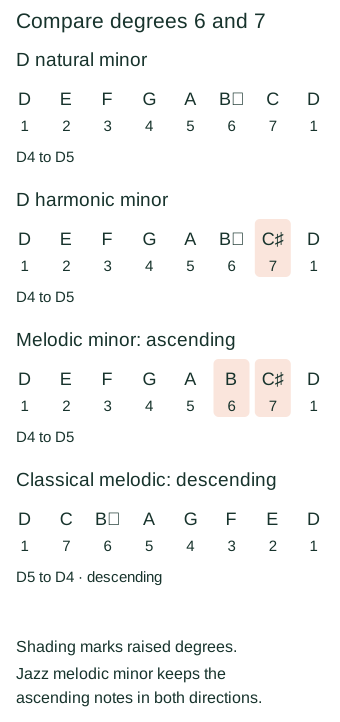
The diagram uses D4 to D5 for the ascending rows, then D5 to D4 for the descent. The numbers below the notes identify degrees from D. As the sections below explain, jazz melodic minor uses the ascending notes in both directions.
The natural minor scale
D natural minor is D, E, F, G, A, B flat, C, D. Its ascending step pattern is T S T T S T T, or 2, 1, 2, 2, 1, 2 and 2 semitones.
 The D natural minor scale
The half steps are E to F and A to B flat. On the way down, use the same notes in reverse order. The D minor guitar-scale exercise uses the natural-minor form.
The harmonic minor scale
Raise degree 7 of natural minor by one semitone. In D minor, C becomes C sharp, giving D, E, F, G, A, B flat, C sharp, D. Keep those notes when descending too.
 The D harmonic minor scale
Its ascending steps span 2, 1, 2, 2, 1, 3 and 1 semitones. Notice the three-semitone gap from B flat to C sharp: it is an augmented second because the letters B and C still form a second. C sharp then sits one semitone below the tonic D.
The melodic minor scale
For ascending melodic minor, raise both degrees 6 and 7 of natural minor by one semitone. B flat becomes B and C becomes C sharp: D, E, F, G, A, B, C sharp, D. The ascending pattern is T S T T T T S.
 The D melodic minor scale
In the usual classical scale exercise, descend using the natural-minor notes: D, C, B flat, A, G, F, E, D. Degrees 6 and 7 return to B flat and C.
Jazz melodic minor keeps the ascending form’s notes in both directions. That is the convention used by the D melodic minor guitar exercise. These are scale-practice conventions; a piece in a minor key can use different versions of degrees 6 and 7 according to its melody and harmony.
For the relationship between a major key and its relative or parallel minor, try the guitar comparison of relative and parallel minor. It separates the three changed natural-minor scale degrees from the single changed third in an A-major/Am triad pair.
References: Robert Hutchinson’s Minor scales, the Open University’s melodic and harmonic forms and Brown and Lee’s discussion of minor-scale practice.