In this lesson
A Mixolydian has the same notes as A major except for the seventh. Lower G♯ to G natural and keep A as the home note. In standard tuning with no capo, play fret 4 then fret 5 on your high E string. Now play fret 3 then fret 5. The first climb to A is one semitone. The second is two.
Find the note that changes
| Scale | Notes from A to A |
|---|---|
| A major | A B C♯ D E F♯ G♯ A |
| A Mixolydian | A B C♯ D E F♯ G A |
The third note is C♯ in both scales, so the A major triad, A–C♯–E, fits both. These scales are parallel because A is home in both. The symbol ♭7 lowers the seventh of the major scale by one semitone. Here that gives G natural.
D major uses D, E, F♯, G, A, B and C♯. Those are also the notes of A Mixolydian. In this exercise, start and land on A so you can hear the change against the same home note. In a song, listen for the notes and chords the music keeps returning to when you decide which note sounds like home.
Play the same phrase twice
Set the metronome to 60 BPM with four beats per bar. Keep the metronome page visible if you use it beside the lesson. Count four clicks before your first note.
| Bar and beat | String and fret | Note |
|---|---|---|
| 1, beat 1 | G string, fret 2 | A |
| 1, beat 2 | B string, fret 2 | C♯ |
| 1, beat 3 | High E, open | E |
| 1, beat 4 | High E, fret 2 | F♯ |
| 2, beat 1 | High E, open | E |
| 2, beat 2 | High E, fret 4 in A major or fret 3 in A Mixolydian | G♯ or G |
| 2, beats 3–4 | High E, fret 5 | A |
Pluck on each click through beat 2 of bar 2. Pluck the final A on beat 3 and let it ring through beat 4. Stop it on the next 1. To repeat without a gap, start the next pass on that click, back at fret 2 on the G string.
A major, with G♯
A major phrase with G sharp: score and practice
Count four at 60 BPM. Bar 1: play G-string fret 2, B-string fret 2, open high E, then high E fret 2. Bar 2: play open high E, high E fret 4 for G sharp, then high E fret 5 on beat 3. Hold through beat 4. Stop on the next click or start again.
The score contains 2 played bars at 60 BPM, without a count-in. Follow the lesson's count-in and stopping instructions when you play. The guitar staff uses the usual octave-transposing treble convention; the tab gives the physical string and fret.
The static score is available without loading the player.
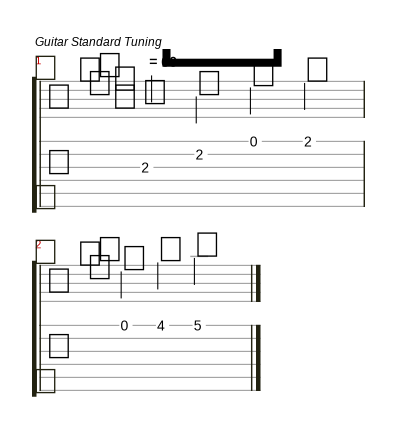
Scroll sideways for the complete score. Interactive notation loads when you ask for it. Practice audio loads separately and starts only after Play. Synthetic audio is a timing reference; it does not check your guitar or replace the instructions for stopping the strings.
A Mixolydian, with G
A Mixolydian phrase with G natural: score and practice
Count four at 60 BPM. Bar 1: play G-string fret 2, B-string fret 2, open high E, then high E fret 2. Bar 2: play open high E, high E fret 3 for G natural, then high E fret 5 on beat 3. Hold through beat 4. Stop on the next click or start again.
The score contains 2 played bars at 60 BPM, without a count-in. Follow the lesson's count-in and stopping instructions when you play. The guitar staff uses the usual octave-transposing treble convention; the tab gives the physical string and fret.
The static score is available without loading the player.
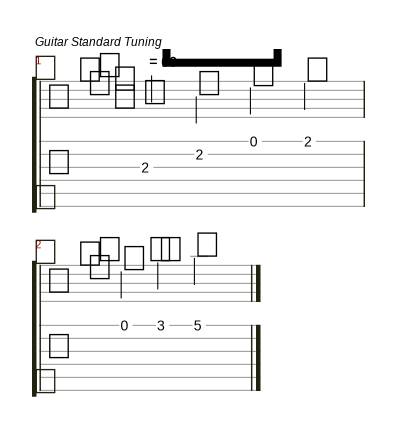
Scroll sideways for the complete score. Interactive notation loads when you ask for it. Practice audio loads separately and starts only after Play. Synthetic audio is a timing reference; it does not check your guitar or replace the instructions for stopping the strings.
Both scores use the A major key signature so the change stands out. At bar 2, beat 2, the natural sign cancels the key signature’s G♯, so play G natural. Play each version once at the same tempo and listen to the last step back to A. In the player, a fresh pass begins on the first written beat. Select Repeat this 2-bar score to return to beat 1 after the final A. The player adds no count-in.
Hear G in the harmony
G–B–D all belong to A Mixolydian. G major is ♭VII because it is a major chord built on the lowered seventh. Play A major, G major and A major, then let the last chord ring. Listen for the return to A. Use the guitar chord charts to find both shapes.
Check the high E string
On your way to A at fret 5, which fret gives the seventh of A Mixolydian?
Fret 3 gives G natural, two semitones below A. Fret 4 gives G♯, the seventh of A major.
Try the A Dorian comparison to hear a different note change with a minor tonic.
Sources
Chelsey Hamm’s Open Music Theory chapter explains how Mixolydian changes the seventh degree of a parallel major scale. “Modal Schemas” describes the ♭VII–I progression. The two guitar phrases were composed for this lesson. Introduction to Diatonic Modes and the Chromatic Scale · Modal Schemas