Play open G and open B together. You can keep the B at exactly the same pitch and put the G an octave higher. The two notes are now B below G, a minor sixth. Before the move they were G below B, a major third. That change is called interval inversion.
Play G and B both ways
In standard tuning, play strings 3 and 2 open. You hear G3 below B3. For the inversion, play fret 4 on the G string to get the same B3 that was on the open B string. Then play fret 3 on the high E string for G4. Pluck strings 3 and 1 together with your thumb and middle finger. Leave the B string quiet.
Counting G, A, B gives three letter names. G3 to B3 spans four semitones, so it is a major third. Counting up from B to the higher G gives six letter names (B, C, D, E, F, G). B3 to G4 spans eight semitones, so it is a minor sixth. Four plus eight gives the twelve semitones of the octave you moved G through. A minor third spans three semitones, leaving nine for its inverse, a major sixth.
Keep the same notes in G major
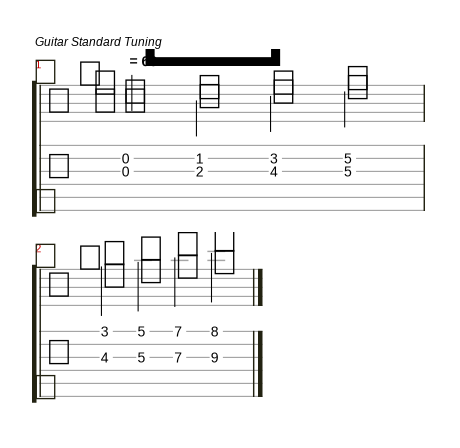
Read each fret pair from the lower-sounding string to the higher one. Use G and B in the first bar, then G and high E in the second. Pluck both notes together. On beats 2 and 3 of bar 2, put separate fingers on the two strings at the same fret.
| Beat | Bar 1, on strings 3 and 2 | Bar 2, on strings 3 and 1 |
|---|---|---|
| 1 | G3–B3, frets 0 and 0, major third | B3–G4, frets 4 and 3, minor sixth |
| 2 | A3–C4, frets 2 and 1, minor third | C4–A4, frets 5 and 5, major sixth |
| 3 | B3–D4, frets 4 and 3, minor third | D4–B4, frets 7 and 7, major sixth |
| 4 | C4–E4, frets 5 and 5, major third | E4–C5, frets 9 and 8, minor sixth |
When you practise on your own, set the metronome to 60 BPM and four beats per bar. Keep its page visible. Count four clicks, then pluck one pair per click. As bar 2 begins, damp the B string to stop the E from bar 1 ringing. After the last sixth, silence the G and high E strings on the next 1.
The score player starts with the first two written notes on bar 1, beat 1. Repeat returns straight to that beat after bar 2. Use the metronome drill above when you want clicks and a count-in.
Compare thirds and sixths in G major: score and practice
At 60 BPM, play a two-note pair on each beat. In bar 1 the G- and B-string frets are 0 and 0, 2 and 1, 4 and 3, then 5 and 5. In bar 2 the G- and high-E-string frets are 4 and 3, 5 and 5, 7 and 7, then 9 and 8. Keep the B string quiet in bar 2 and mute on the following 1.
The score contains 2 played bars at 60 BPM, without a count-in. Follow the lesson's count-in and stopping instructions when you play. The guitar staff uses the usual octave-transposing treble convention; the tab gives the physical string and fret.
The static score is available without loading the player.
Scroll sideways for the complete score. Interactive notation loads when you ask for it. Practice audio loads separately and starts only after Play. Synthetic audio is a timing reference; it does not check your guitar or replace the instructions for stopping the strings.
Play just the G string of bar 1, then just the high E string of bar 2. Both give G, A, B and C, an octave apart. When you add the second note again, listen for that line at the bottom of the thirds and the top of the sixths. If the first bar needs work, practise it in the double-stop thirds lesson before adding the string skip.
Check A and C
A3 to C4 is a minor third. Which note moves for its inversion, and how many semitones will the new interval have?
Move A3 up to A4 and keep C4 below it. C4 to A4 is a major sixth of nine semitones.
Sources
Open Music Theory explains how to count an interval and how its size and quality change under inversion. Tom Kolb’s Guitar Player lesson shows sixths on the G and high E strings and demonstrates ways to leave the string between them quiet. The G-major comparison and timing here were written for IGDb. Intervals and dyads · Tom Kolb’s lesson on thirds and sixths