A double-stop sounds two notes together. Pluck the open G and B strings at the same time and you hear a major third. Now play fret 2 on G with fret 1 on B. That gives A and C, a minor third. Both pairs fit the G major scale.
Find the two shapes
Use standard tuning with no capo. On this string pair, open G to open B is four semitones. When both strings are at the same fret, each note rises by the same amount and the gap stays four semitones. Use a fret number one lower on the B string and the gap drops to three semitones. Keep this fingering rule on these two strings. The other adjacent open-string pairs in standard tuning are a fourth apart.
To check why both are thirds, count the letter names, including both ends. G to B gives G, A, B. A to C gives A, B, C. The letter count gives a third in both cases. The semitone count tells you whether it is major or minor. Major and minor intervals explains how to count both.
Try sounding each string separately first. Then pluck G with your thumb and B with your index finger at the same time. If you use a pick, make one small stroke from G through B and stop before high E. When you change pairs, stop the old notes as the new pair begins. Lightly touch an open string to stop it when lifting a fretting finger leaves it ringing.
Play the G major scale in thirds
The G string plays the scale. For each of its notes, skip the next note of the G major scale and sound the one after it on the B string. Keep counting into the next octave where needed. E pairs with G, F♯ with A, and the upper G with B.
| Pair | G-string fret | B-string fret | Interval |
|---|---|---|---|
| G and B | 0 | 0 | Major third |
| A and C | 2 | 1 | Minor third |
| B and D | 4 | 3 | Minor third |
| C and E | 5 | 5 | Major third |
| D and F♯ | 7 | 7 | Major third |
| E and G | 9 | 8 | Minor third |
| F♯ and A | 11 | 10 | Minor third |
| G and B, one octave higher | 12 | 12 | Major third |
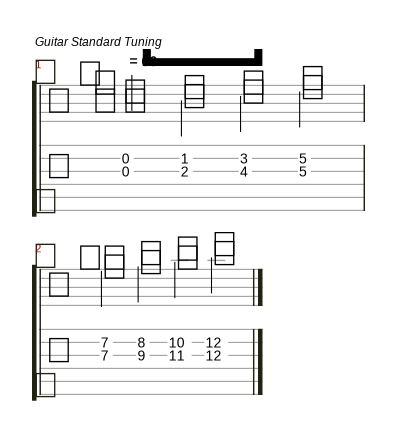
Set the metronome to 60 BPM with four beats per bar. Count four clicks before starting. Play the first four pairs in bar 1 and the last four in bar 2. Sound each pair on its numbered beat and let it ring until the next click. Listen for both notes in each pair.
G-major thirds on two strings: score and practice
Count four beats at 60 BPM, then sound one pair per click. The G and B fret pairs in bar 1 are 0 and 0, 2 and 1, 4 and 3, then 5 and 5. In bar 2 they are 7 and 7, 9 and 8, 11 and 10, then 12 and 12. Mute on the next click.
The score contains 2 played bars at 60 BPM, without a count-in. Follow the lesson's count-in and stopping instructions when you play. The guitar staff uses the usual octave-transposing treble convention; the tab gives the physical string and fret.
The static score is available without loading the player.
Scroll sideways for the complete score. Interactive notation loads when you ask for it. Practice audio loads separately and starts only after Play. Synthetic audio is a timing reference; it does not check your guitar or replace the instructions for stopping the strings.
After playing fret 12 on both strings on beat 4, mute both on the following 1. Take time to return to the open position before you count in again. The player starts at the first written beat. Its repeat control can loop the two written bars without a pause.
Turn the scale into a phrase
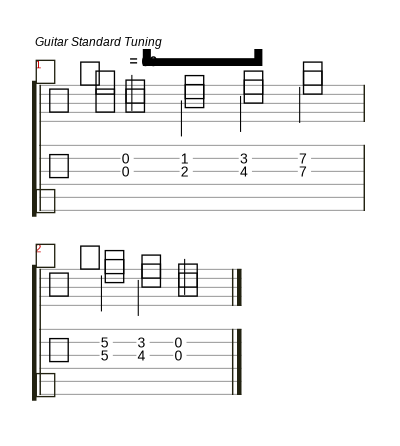
Play just the G string first. Use frets 0, 2, 4 and 7 in bar 1. In bar 2 use fret 5 on beat 1, fret 4 on 2 and the open string on 3. Hold the open G through beat 4. Now add the matching B-string note at every attack. Finish on open G and B together, then mute both on the following click.
A short phrase in G-major thirds: score and practice
Count four beats at 60 BPM. In bar 1, play G and B frets 0 and 0, 2 and 1, 4 and 3, then 7 and 7. In bar 2, play 5 and 5 on 1, 4 and 3 on 2, then open G and B on 3. Hold that last pair through 4. Mute on the next click.
The score contains 2 played bars at 60 BPM, without a count-in. Follow the lesson's count-in and stopping instructions when you play. The guitar staff uses the usual octave-transposing treble convention; the tab gives the physical string and fret.
The static score is available without loading the player.
Scroll sideways for the complete score. Interactive notation loads when you ask for it. Practice audio loads separately and starts only after Play. Synthetic audio is a timing reference; it does not check your guitar or replace the instructions for stopping the strings.
If the shift from fret 4 to fret 7 makes you rush, practise that change between the two pairs with the metronome off. Listen for the two notes at fret 7. Once both are clear, put the shift back between beats 3 and 4.
Check the third above D
When the lower note is D at G-string fret 7, which note does G major put a third above it, and where do you fret it?
Count D, E and F♯. Play F♯ at B-string fret 7. Both strings are at the same fret, so the pair is a major third.
Use the major-scale lesson to spell the notes of another key. For a different way to choose notes as the harmony changes, try the chord-tone melody exercise.
Source notes
Yamaha discusses the special spacing of G and B, the major and minor thirds in a major scale, and playing pairs with the thumb and index finger. Open Music Theory explains letter counts and semitone distances. The two arrangements and practice counts were prepared for IGDb. How to Play Guitar Double-Stops · Intervals and Dyads