A blues turnaround is a lick or chord change that leads back to the start of the form. In this twelve-bar blues in E, bar 11 is E7 and bar 12 is B7. The next chorus begins on E7. This exercise plays those two bars and the first bar of the next chorus so you can hear where the lick lands.
Start with the twelve-bar blues chart in E if you are still learning the chord order. It uses the same changes. Other versions can end bar 12 on E7 or use a different set of closing chords. Follow the chart you are playing from.
Count bars 11, 12 and 1
Tune to standard tuning, E A D G B E from the thickest string to the thinnest, with no capo. Set the metronome to 60 BPM with four beats per bar. Count four clicks before you start. The first written bar is bar 11 of the blues. Count through 4 in bar 12, then play the landing on the very next 1.
The chord above each bar shows the harmony underneath the line. Pick the individual notes in the tab. If another guitarist is playing the chords, ask them for one strum on each bar’s first beat. The example playback plays the single-note line on its own.
Blues turnaround in E: bars 11, 12 and 1: score and practice
Count four clicks at 60 BPM before starting. In bar 11 over E7, pick D-string fret 2 on 1, mute on 2, pick open D on 3 and A-string fret 4 on 4. In bar 12 over B7, pick A-string fret 2 on 1, D-string fret 4 on 2, G-string fret 2 on 3 and D-string fret 1 on 4. On bar 1, pick D-string fret 2 and hold it for all four beats. Stop on the next click. Play one note at a time. The score plays the single-note part.
The score contains 3 played bars at 60 BPM, without a count-in. Follow the lesson's count-in and stopping instructions when you play. The guitar staff uses the usual octave-transposing treble convention; the tab gives the physical string and fret.
The static score is available without loading the player.
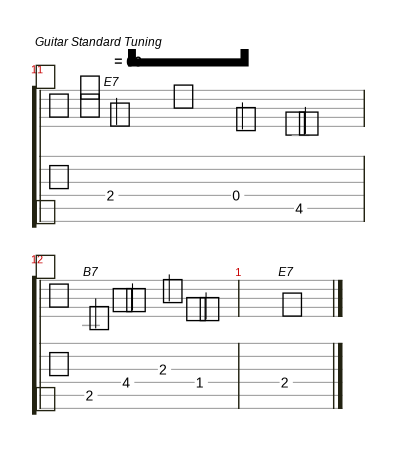
Scroll sideways for the complete score. Interactive notation loads when you ask for it. Practice audio loads separately and starts only after Play. Synthetic audio is a timing reference; it does not check your guitar or replace the instructions for stopping the strings.
Play the notes one at a time
Each picked note before the landing lasts one beat. Stop the old note as the next one starts. On beat 2 of bar 11, stop the first E and leave the lead part silent for one beat. A light touch from the picking hand will stop a string that is still ringing after a change.
| Bar and chord | Beat 1 | Beat 2 | Beat 3 | Beat 4 |
|---|---|---|---|---|
| 11, E7 | E, D string fret 2 | Rest | D, open D string | C♯, A string fret 4 |
| 12, B7 | B, A string fret 2 | F♯, D string fret 4 | A, G string fret 2 | D♯, D string fret 1 |
| 1 of the next chorus, E7 | E, D string fret 2 | Hold | Hold | Hold |
For one pass, mute the last E on the click after beat 4. To loop the drill, pick that same fret again on that click. It starts bar 11, with no extra count-in. Select “Repeat this 3-bar score” in the optional player to loop the same three bars.
Hear D♯ rise to E
Practise just the join first. On beat 4 of bar 12, pick fret 1 on the D string. On the next 1, pick fret 2 on that same string and let it ring. D♯ belongs to B7. E is the home note and the root of the chord in bar 1. Listen for that half-step rise as the chord changes.
Bar 12 gives you the four notes of B7 one at a time, in the order B, F♯, A and D♯. In bar 11, E and D belong to E7. C♯ sits outside the chord and moves down a whole step to B. When the join feels steady, play all three bars again. Try it against the chords if you can, or play the note line by itself while counting every click.
Check where you land
Which two frets carry you across the barline, and where does the E fall in the count?
Pick D-string fret 1 on beat 4 of bar 12. Pick fret 2 on beat 1 of the next chorus and let it ring through beat 4.
To play this on one guitar within the whole twelve-bar form, strum through bar 10. Play the lick in bars 11 and 12 and hold the E through bar 1 of the next chorus. Resume strumming on bar 2. For another way to aim a melody at a chord, try the chord-tone melody lesson.
Source notes
Fred Sokolow explains how a turnaround brings a blues back to its home chord and uses B7 to set up the next E or E7. Robert Hutchinson’s twelve-bar chart shows an example with tonic in bar 12. The picked line and count here were written for IGDb. Exploring Blues Turnarounds · The 12-Bar Blues