In this lesson
- Read both sides of the slash
- Work through C/E one string at a time
- Three more shapes with a checked bass
- G/B: start on the A string
- D/F♯: use four strings
- C/G: keep G below the C chord
- When is a slash chord an inversion?
- Play C, G/B, Am and C/G in four bars
- Check your reading
- Where to use this next
- Source notes
A slash chord names a chord before the slash and its lowest sounding note after it. C/E means C major with E in the bass. Read it as “C over E”. The C major notes are C, E and G; the slash asks you to put an E below the other sounding notes.
This lesson uses standard tuning, E A D G B E from string 6 to string 1, without a capo. You will check five slash-chord shapes, then play a four-bar exercise whose bass descends C, B, A, G. Start with the first-chord shapes and chord-diagram guide if those are new to you. You can work through the note questions before playing the shapes.
Read both sides of the slash
| Symbol | Chord before the slash | Required bass note |
|---|---|---|
| C/E | C major: C, E, G | E |
| G/B | G major: G, B, D | B |
| D/F♯ | D major: D, F♯, A | F♯ |
| Am/C | A minor: A, C, E | C |
The chord’s root is the note that names it. The bass is the lowest note you actually sound. In G/B, the root is G and the bass is B. Keep any quality marking before the slash: Am/C has an A minor chord above C.
The symbol gives note names, without specifying an octave, one exact guitar shape or a rhythm. A chord can also repeat its notes on several strings. The examples below state all the strings and frets so you can check one complete voicing, or arrangement of those notes.
Work through C/E one string at a time
Read each compact shape from low E to high E. A number is the fret, 0 means open, and x means leave that string out. An x is not a note to strike. The fretboard-note lesson explains how to find a pitch from its open string.
For C/E, use 0 3 2 0 1 0. It is the familiar open C shape with the open low E included:
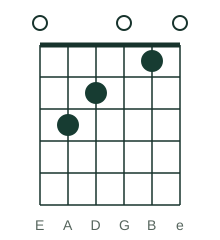
0 3 2 0 1 0. The open sixth string supplies the E bass.| String | Position | Sounding pitch |
|---|---|---|
| 6, low E | Open | E2 |
| 5, A | Fret 3 | C3 |
| 4, D | Fret 2 | E3 |
| 3, G | Open | G3 |
| 2, B | Fret 1 | C4 |
| 1, high E | Open | E4 |
The octave numbers identify these sounding pitches; middle C is C4. E2 is lower than all the others, and every note belongs to C major. You have therefore met both parts of C/E. The E on string 4 is an octave above the bass; it does not replace the low E in this particular voicing.
Pick the strings separately, then strum all six gently. Compare this with x 3 2 0 1 0, starting your strum on string 5. That second shape has C3 in the bass and is C major in root position. Adding or removing a low string can change the bass instruction even when the other fingers stay put.
Three more shapes with a checked bass
G/B: start on the A string
Use x 2 0 0 3 3. Play strings 5 through 1. Their pitches, from lowest to highest, are B2, D3, G3, D4 and G4. These supply G, B and D with B lowest.
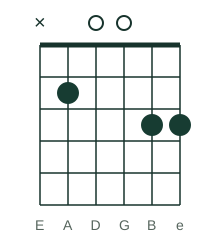
x 2 0 0 3 3. Leave out string 6; start the strum from B on string 5.An open low E would put E2 below B2 and add a note outside this G major triad. A low E fretted at 3 would put G2 below B2. Neither gives the B bass requested here. Check the starting string as well as your fretting fingers.
D/F♯: use four strings
Use x x 4 2 3 2. Play strings 4 through 1: F♯3, A3, D4 and F♯4. F♯3 is lowest, so this is D major over F♯.
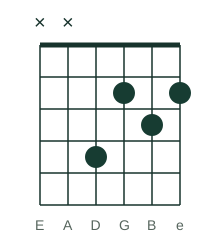
x x 4 2 3 2. The D string at fret 4 supplies F♯3.The higher F♯ bass here still meets the symbol. Compare it with open D, x x 0 2 3 2, whose bass is D3. Leave both lower strings out of the D/F♯ shape. Work on it separately if you cannot yet hold it comfortably; it is not needed for the timed exercise below.
C/G: keep G below the C chord
Use 3 3 2 0 1 0. All six strings sound: G2, C3, E3, G3, C4 and E4.
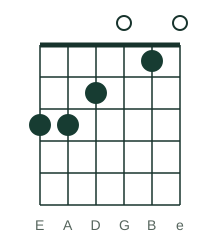
3 3 2 0 1 0. String 6 at fret 3 gives the G2 bass.You need both low strings at fret 3. Try your ring finger on string 6 at fret 3, little finger on string 5 at fret 3, middle finger on string 4 at fret 2 and index finger on string 2 at fret 1. Adjust the fingering if needed, and check that the open G and high E can still ring. Stop if playing hurts.
When is a slash chord an inversion?
For a triad, classify the bass by its place in that chord:
| C major arrangement | Lowest note | Position |
|---|---|---|
| C, with C lowest | Root, C | Root position |
| C/E | Third, E | First inversion |
| C/G | Fifth, G | Second inversion |
This classification concerns the lowest note. It does not require the other notes to stay in one fixed order. See triads for the root, third and fifth of major and minor chords.
A slash can also name a bass outside the chord before it. For C/D, keep C, E and G above a lower D. One guitar voicing is x x 0 0 1 0, giving D3, G3, C4 and E4:
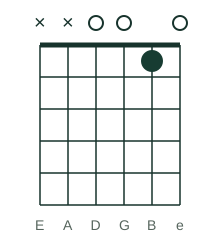
x x 0 0 1 0. D is below the C major notes and is not one of that triad's notes.C/D is therefore not an inversion of the C major triad. Its complete pitch set contains D as well as C, E and G. This lesson uses the slash symbol to state that bass arrangement; other harmonic names can depend on the musical context.
Play C, G/B, Am and C/G in four bars
This original practice progression makes the lowest notes descend C3, B2, A2, G2. First play only those bass notes: A-string fret 3, A-string fret 2, open A, then low-E fret 3. Check the full shapes without a beat before joining them.
| Bar | Chord | Low E to high E | Bass |
|---|---|---|---|
| 1 | C | x 3 2 0 1 0 |
C3 |
| 2 | G/B | x 2 0 0 3 3 |
B2 |
| 3 | Am | x 0 2 2 1 0 |
A2 |
| 4 | C/G | 3 3 2 0 1 0 |
G2 |
The Am voicing sounds A2, E3, A3, C4 and E4. The C and Am fingerings are in the first-chord lesson. The G/B and C/G diagrams above supply the two less familiar shapes.
Use 4/4 and count 1 2 3 4 evenly. At 60 BPM, each number lasts one second. Count one empty bar before starting; the optional player has no count-in. For each chord, strum down once on 1, hold through 2, strum down again on 3, and hold through 4. Each written half-note chord lasts two beats. The score groups a chord’s notes at one attack and leaves the speed of your strum unspecified.
Change to the next chord on the following 1. Stop or damp strings from the previous shape that should no longer sound, especially the low G when returning from C/G to C. After bar 4, stop all strings on the next 1. That completes one pass. For a loop, return to C on that same next 1 without adding a beat; choose either the stop or the repeat before starting. The player’s Repeat control repeats the complete four-bar score.
C, G/B, Am and C/G: score and practice
Four bars: C, G/B, Am, then C/G. Play each chord on 1 and 3, holding through 2 and 4. The bass notes are C3, B2, A2 and G2. Stop after bar 4 on the next 1. The score groups each chord attack; it does not prescribe strum speed.
The score contains 4 played bars at 60 BPM, without a count-in. Follow the lesson's count-in and stopping instructions when you play. The guitar staff uses the usual octave-transposing treble convention; the tab gives the physical string and fret.
The static score is available without loading the player.
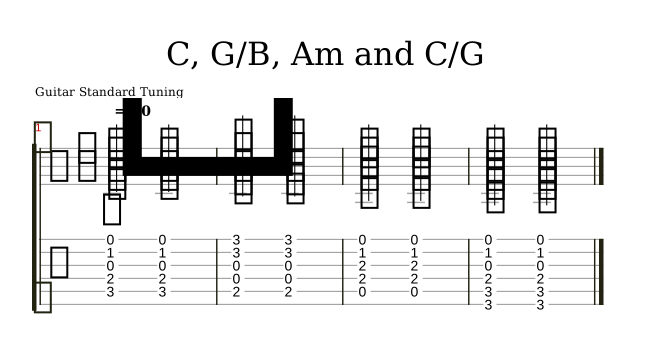
Scroll sideways for the complete score. Interactive notation loads when you ask for it. Practice audio loads separately and starts only after Play. Synthetic audio is a timing reference; it does not check your guitar or replace the instructions for stopping the strings.
If a change interrupts the count, pause and practise those two shapes without timing. Then slow the metronome or player. You can also play just the four bass notes, one on beat 1 of each bar, holding through 2, 3 and 4. That is a preparation exercise; it leaves out the chord tones shown in the full score. The chord-change lesson gives a longer drill for joining shapes.
Check your reading
Try answering these before opening the answers.
- In Am/C, what is the root, what is the bass, and which notes belong to the named chord?
- Does
x 3 2 0 1 0satisfy C/E? What changes if you include the open low E? - Is C/G first or second inversion? Is C/D an inversion of C major?
- Suppose a G/B shape contains B3 but its lowest sounding note is G2. Does it meet the slash instruction?
- In bar 3 of the exercise, on which beats do you strike Am? When does C/G begin?
Show the answers
- Am/C has root A, bass C, and the A minor notes A, C and E. C is the third, so this is first inversion of A minor.
- The five-string shape has C3 lowest, so it does not give C/E. Including open low E adds E2 below it and produces the C/E voicing taught here.
- C/G is second inversion because G is the fifth of C major. C/D is not an inversion of that triad because D is outside C, E and G.
- No. The requested B must be lowest. A B somewhere above a lower G does not give G/B.
- Strike Am on beats 1 and 3, holding through 2 and 4. C/G begins on beat 1 of bar 4, without an extra beat for the change.
Where to use this next
When a chord chart gives a slash chord, identify its chord notes and bass before choosing a shape. If you simplify it to a familiar root-position shape, you have changed the written bass. That can be an arrangement choice, but check what the music needs.
Use chords in a major key to work out the chord family behind a progression, or return to beginner chord progressions to practise steady changes. Keep the chord name, bass note and number of beats as separate things to check.
Source notes
Robert Hutchinson’s Inverted Triads, sections 6.3 and 6.3.1, explains root versus bass, triad inversions and the slash-symbol convention. Robbie Calvo’s A Guitarist’s Guide to Playing Bass, under “A Word About Slash Chords”, also gives examples whose bass lies outside the named triad. The guitar voicings, note checks and four-bar exercise here were authored for this lesson; they are not a transcription of either source’s music.