Crosspicking uses a flatpick to play individual notes across strings in a rolling pattern. Start with open D, G and B in standard tuning without a capo. For this drill, alternate downstrokes and upstrokes. Pick D down, G up and B down. Let the notes ring together. Now go back to D with an upstroke. That return is the move to practise.
Fit the roll into four beats
Set the metronome to 60 BPM and count “1 and 2 and 3 and 4 and.” Keep the metronome page visible if you use it beside the lesson. Pick one note on each syllable.
| Count | Strings | Pick strokes |
|---|---|---|
1 & |
D, G | Down, up |
2 & |
B, D | Down, up |
3 & |
G, B | Down, up |
4 & |
G, B | Down, up |
Keep the eighth notes even where the roll returns to D. The two three-note groups start on opposite pick strokes, and neither needs an extra gap. Finish with G and B on beat 4 and its “and.” That makes eight notes in the bar.
If the return from B to D is awkward, practise the first four notes slowly. Move the pick clear of the strings on the way back and land on D with an upstroke. The alternate-picking lesson gives you another way to practise moving the pick without catching a string.
Play the open-string roll
Count four clicks, then begin on the next 1. Use only strings 4, 3 and 2. Let the notes ring as you pick the next string. Open D, G and B spell a G major triad with D lowest, so the score calls this shape G/D. The slash-chord lesson explains how the bass note is written.
Three-string roll with open G chord tones: score and practice
One bar of even eighth notes in 4/4 at 60 BPM. Use open D, G and B. Pick strings 4, 3, 2, 4, 3, 2, 3, 2 with alternating down and up strokes. Let notes ring, then stop on the next 1 or restart with a downstroke.
The score contains 1 played bar at 60 BPM, without a count-in. Follow the lesson's count-in and stopping instructions when you play. The guitar staff uses the usual octave-transposing treble convention; the tab gives the physical string and fret.
The static score is available without loading the player.
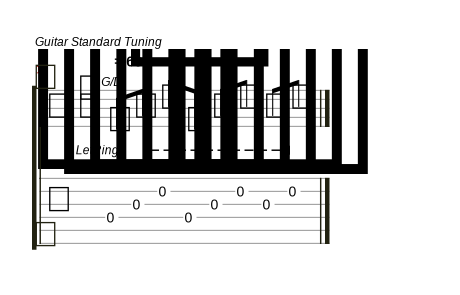
Scroll sideways for the complete score. Interactive notation loads when you ask for it. Practice audio loads separately and starts only after Play. Synthetic audio is a timing reference; it does not check your guitar or replace the instructions for stopping the strings.
For a single pass, damp all three strings on the 1 after the last “and.” To repeat, damp G and B as you downpick the D string on that same 1. Use the same ending or restart with either shape.
Keep the roll and change the shape
Hold fret 2 on D, fret 2 on G and fret 1 on B. These are the middle strings of the open A minor shape. They give E, A and C with E lowest. That is Am/E. Leave your fretting fingers down while you pick the same string order and let the notes overlap.
Three-string roll with A minor chord tones: score and practice
One bar of even eighth notes in 4/4 at 60 BPM. Hold fret 2 on D and G and fret 1 on B. Pick strings 4, 3, 2, 4, 3, 2, 3, 2 with alternating down and up strokes. Let notes ring, then stop on the next 1 or restart with a downstroke.
The score contains 1 played bar at 60 BPM, without a count-in. Follow the lesson's count-in and stopping instructions when you play. The guitar staff uses the usual octave-transposing treble convention; the tab gives the physical string and fret.
The static score is available without loading the player.
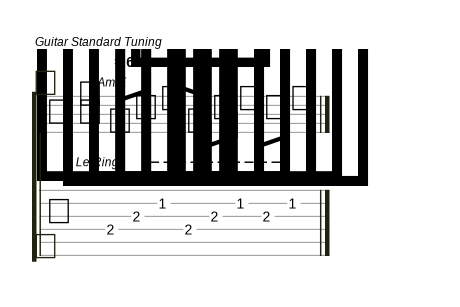
Scroll sideways for the complete score. Interactive notation loads when you ask for it. Practice audio loads separately and starts only after Play. Synthetic audio is a timing reference; it does not check your guitar or replace the instructions for stopping the strings.
Both scores are one bar. There is no count-in in the player. Repeat this 1-bar score starts the same roll again after the last eighth note. Once both rolls feel even, try one bar of each by hand. Stop the old notes as you change shapes, then pick the D string down on the next 1.
Check the restart in the middle
Which stroke starts the second D–G–B group, and when do you play it?
Pick D up on the “and” after 2. The first group has three notes, so its last stroke was down.
Sources
Molly Tuttle’s lesson in Acoustic Guitar explains three-string rolls, even eighth notes and letting the strings ring. Mickey Abraham’s Flatpicking Guitar Magazine lesson gives examples of alternating strokes across three-string chord shapes. The written rolls and chord choices here were prepared for IGDb. Cross Picking 101 with Molly Tuttle · April Crosspicking Exercises