In this lesson
Guitar tablature, usually called tab, shows which string and fret to play. You can use it before learning standard notation, though you will still need to know the rhythm of the music.
Guidance source-checked on 2 November 2026.
The six lines are the strings
For a six-string guitar in standard tuning, the top line is the high E string: the thinnest string, also called the first string. The bottom line is the low E: the thickest, or sixth string. The order on the page is:
| Tab line, from top to bottom | String | Open note |
|---|---|---|
| 1 | First, thinnest | High E |
| 2 | Second | B |
| 3 | Third | G |
| 4 | Fourth | D |
| 5 | Fifth | A |
| 6 | Sixth, thickest | Low E |
Some text tabs use a small e for the high E and a capital E for the low E. Read any tuning or capo instructions before starting. Other tunings and instruments with a different number of strings change how you interpret the tab. You can check standard tuning with the guitar tuner.
Numbers tell you which fret to play
A number on a line is a fret number, not a finger number. For example, 2 on the A-string line means play that string at the second fret. A 0 means play the open string without fretting it. Read from left to right. Numbers stacked directly above one another are played together.
To work out the note names at those positions, use the guitar fretboard note chart and exercises.
This short exercise was written for this lesson. Play one event on each count; the final event contains three notes together. Stop each event before starting the next, so you can hear them separately.
e|-----------0--|
B|-----------1--|
G|-----------0--|
D|--------2-----|
A|-----2--------|
E|--0-----------|
    1  2  3  4
The complete playing instructions are:
- On count one, play the open low E string.
- On count two, play the A string at the second fret.
- On count three, play the D string at the second fret.
- On count four, play the open G string, the B string at the first fret and the open high E string together. Leave the other strings out of this final event.
Read four tab events: score and practice
One bar: open low E on 1, A-string fret 2 on 2, D-string fret 2 on 3, then open G, B-string fret 1 and open high E together on 4. Stop the final event on the next 1.
The score contains 1 played bar at 60 BPM, without a count-in. Follow the lesson's count-in and stopping instructions when you play. The guitar staff uses the usual octave-transposing treble convention; the tab gives the physical string and fret.
The static score is available without loading the player.
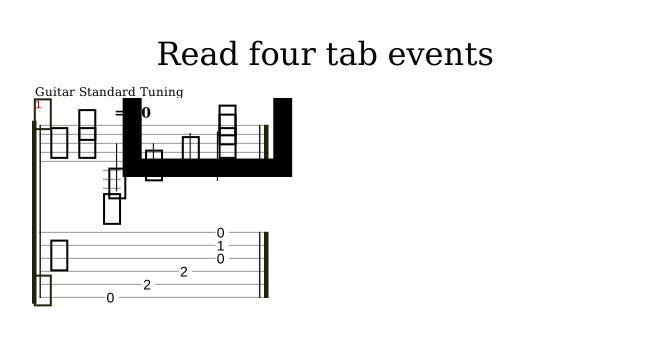
Scroll sideways for the complete score. Interactive notation loads when you ask for it. Practice audio loads separately and starts only after Play. Synthetic audio is a timing reference; it does not check your guitar or replace the instructions for stopping the strings.
Stop the final event on the next 1. The score gives this exercise quarter-note timing in 4/4; 60 BPM is a practice starting point. Count four evenly spaced beats as you play. Start slowly enough to place each note comfortably; the metronome can help you keep the spacing even.
How tab shows rhythm
Plain text tab often gives you string and fret positions without note durations. The spaces between its numbers are not a dependable timing system unless the author supplies counts or another clear explanation, as in the exercise above. A recording can help you learn the rhythm when the transcription leaves it out.
Tab can also include rhythmic notation: stems, beams, rests and time signatures. It may appear beneath standard notation so you can read the rhythm above and the string/fret positions below. Check what the particular score provides before assuming its timing is missing.
Accuracy depends on the transcription. Either tab or standard notation can contain mistakes. If a passage sounds wrong, check the tuning and instructions, then compare it with a reliable recording or another published score.
Common technique symbols
Symbols vary between publishers and software, so check the score’s legend. These are common examples:
| Symbol or example | Usual meaning |
|---|---|
5h7 |
Hammer-on from fret five to fret seven on the same string. |
7p5 |
Pull-off from fret seven to fret five on the same string. |
5/7 or 7\5 |
Slide up or down between the shown frets. |
b |
A bend; check the score for its target pitch or bend amount. |
~ |
Vibrato. |
x |
A muted or dead note. |
P.M. |
Palm muting; a line may show how long it lasts. |
Parentheses, arrows and other markings can have different meanings in different scores. Use their accompanying instructions rather than guessing from the symbol alone.
Software for reading and practising
Tab editors can play a score, slow it down and repeat a passage. These official projects are options to compare:
- Guitar Pro is commercial notation and tab software with playback and practice controls.
- TuxGuitar is a free multitrack tab editor and player.
- MuseScore Studio is a free notation editor that supports tablature with optional rhythmic notation.
Playback follows the notes entered into the file, so it cannot establish that a transcription matches the original performance.
Further reading
The Guitar Pro tab-reading guide explains string order and fret numbers. The MuseScore Studio staff-properties handbook documents the different ways rhythmic values can be displayed in tablature.