In this lesson
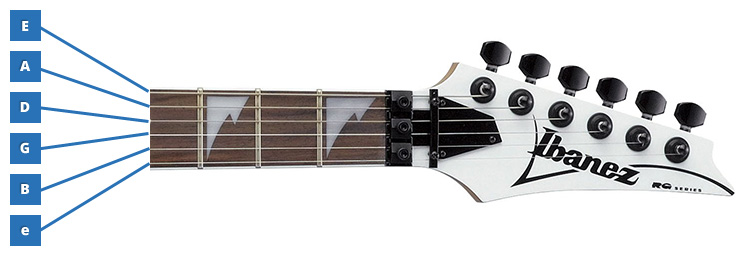
Standard tuning for an ordinary six-string guitar is E A D G B E, from the lowest-pitched string to the highest. Start with an electronic tuner if you are still learning to recognise the notes. You can then use the string-to-string checks below to practise listening.
Guidance source-checked on 2 November 2026.
Know which string you are tuning
| String number | Open note in standard tuning | Approximate frequency at A = 440 Hz |
|---|---|---|
| 6, lowest-pitched | E | 82.4 Hz |
| 5 | A | 110.0 Hz |
| 4 | D | 146.8 Hz |
| 3 | G | 196.0 Hz |
| 2 | B | 246.9 Hz |
| 1, highest-pitched | E | 329.6 Hz |
The two E strings share a letter name, but the first string sounds two octaves above the sixth. A tuner showing the letter E alone does not tell you that the string is in the right register. If a string is very slack or far from its target, compare it with a known reference for that string before tightening further.
Once the open strings are in tune, find notes on the fretboard by counting semitones from them.
Set up the tuner
Use the tuner in its guitar or chromatic tuning mode, following its instructions. Check that you have not selected a bass/ukulele mode, a flat-tuning setting or a capo offset by mistake. A = 440 Hz is a common reference setting; match the reference required by your teacher, recording or other instruments.
A plug-in tuner reads the guitar’s electrical signal, a microphone tuner listens to sound, and a clip-on tuner senses vibration through the instrument. Fit a clip-on only where the tuner and guitar makers permit, and remove it after use if its instructions require that to protect the finish.
For microphone tuning, work somewhere quiet. For an amplified signal, use a clean sound without distortion. The online guitar tuner is another option; follow its microphone controls and instructions when you choose to use it.
Tune one open string at a time
These steps describe ordinary tuning-machine adjustment. If your guitar has a locking nut or a system with separate bridge fine tuners, use its specific tuning sequence. Do not try to force a tuning key against a locked string clamp.
- Hold the guitar in your usual playing position and remove a capo. Identify the string and trace it to the correct tuning key.
- Play that string open. Keep the other strings quiet and allow the note to ring long enough for a stable reading.
- Check the displayed note name, including any sharp or flat sign, before reading the meter. A centred meter beside F does not mean that an E string is in tune.
- Turn the correct key a small amount while listening and watching the tuner. Increasing string tension raises pitch; reducing it lowers pitch. The knob’s clockwise direction depends on the tuner layout and your viewpoint, so do not use a universal “away from you” rule.
- Bring the string slowly to the target note and the tuner’s in-tune indication. If you overshoot, lower it a little below the target and approach from below again, where your instrument’s instructions allow.
- Repeat for all six strings, then recheck them. On a floating tremolo, changing one string’s tension can move the bridge and alter the others, so several passes may be needed.
If you are unsure of the note/register, the pitch does not respond as expected, or turning meets unusual resistance, stop and check the string, control and manual. More tightening is not a way to fix a missing tuner reading.
Tune by ear from a reference
First bring one string to a known, correct reference pitch. The following checks work from a correctly tuned low E string in standard tuning. Fret lightly enough to keep the note clear without bending it sideways.
| Reference note to play | Open string to match |
|---|---|
| Sixth string, fifth fret: A | Fifth string: A |
| Fifth string, fifth fret: D | Fourth string: D |
| Fourth string, fifth fret: G | Third string: G |
| Third string, fourth fret: B | Second string: B |
| Second string, fifth fret: E | First string: E |
Listen to the two notes alternately and adjust the open string towards the fretted reference. The G-to-B pair uses the fourth fret; the other pairs use the fifth. Recheck the reference string and then the others, since small errors can accumulate. Without a reliable starting pitch you are tuning the guitar to itself, which may not match a recording or another instrument.
Try Drop D from standard tuning
For Drop D, lower only the sixth string from E to D, a whole tone. The open notes become D A D G B E, low to high. Use a tuner that can read D for the sixth string; a fixed standard-guitar mode may need changing to chromatic mode.
As an ear check, the sixth string at the seventh fret should now match the open A string. Recheck all the open strings afterwards. Changing tuning can affect a floating bridge’s balance; follow the instrument’s guidance and do not adjust springs just to force a new tuning. For larger tuning or string changes, read the string-gauge guide.
When the pitch still seems wrong
Newly fitted strings can need repeated tuning while they settle; use the installation method in how to change strings for the relevant hardware. If the same open string repeatedly drifts, record when it changes and use the tuning-stability checks.
If the open strings stay in tune but fretted notes sound wrong, check fretting pressure and intonation. An unstable open-string reading alone does not establish an intonation fault.
Source notes
The frequency table follows Korg’s AW-OTG/AW-OTB manual, English page 3. Taylor’s beginner tuning article describes the fretted-note comparisons. Fender’s tuning advice covers listening conditions. Follow your instrument and tuner’s own manuals for their controls.