Palm muting shortens and muffles a note or chord while allowing its pitch to remain audible. The picking hand touches the strings near the bridge as you pick them.
Find the contact point
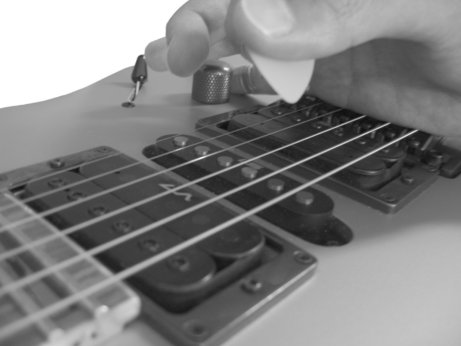
Rest the heel or little-finger edge of the picking hand lightly across the strings on the vibrating side of the bridge saddles, towards the neck. Keep the pick free to strike the strings. This applies to either handedness.
Start close to the bridge. Change the contact position and pressure a little at a time while playing one note. More damping gives a shorter, duller sound; too much can stop the pitched note almost completely. Contact only behind the saddles will not damp the vibrating string length in the same way.
The photograph shows the hand edge near the bridge, but you will need to adjust the contact by listening on your own guitar. Aim first for a recognisable pitch with less sustain. The power-chord lesson gives the shape used below.
Read the palm-mute bracket
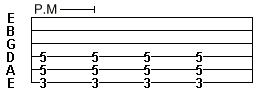
In standard tuning, these are four identical G power chords. Each uses low E fret 3, A fret 5 and D fret 5, with the other three strings unplayed. The pitches are G, D and the upper G.
The P.M marking and its horizontal bracket cover only the first two chord stacks. Palm-mute those two. Release the picking-hand contact for chords 3 and 4 so they can ring without palm muting.
Keep the fretting-hand chord in place while changing the picking-hand contact. Continue to damp the unused strings, as explained in fretting-hand muting.
Practise the change in sound
The image leaves the rhythm unspecified. For this practice, count four slow beats and play one downstroke on each beat:
- Palm-mute the G power chord on beats 1 and 2.
- Lift the hand edge just clear of the strings and play the same chord without palm muting on beats 3 and 4.
- Stop, reset and repeat. Listen for the same pitches with a clear change in sustain.
Begin with light contact. If the first two strokes are only clicks, reduce the pressure or move the hand slightly closer to the saddles. If all four ring alike, check that the hand touches the vibrating string length on the first two strokes.
Audio example
Further reading: Fender’s palm-muting definition and Arobas Music’s palm-mute technique and marking.