In this lesson
For sixteenth-note strumming in 4/4, divide each quarter-note beat into four equal parts: 1 e & a. In the alternating pattern here, strum down on the number, up on “e”, down on “&” and up on “a”. Repeat that movement for beats 2, 3 and 4: sixteen strums in one bar.
Keep the numbered beats at the same speed when comparing eighths with sixteenths. You will make twice as many attacks in each four-beat bar. The two original Em exercises below let you practise each pattern separately before switching between them.
Count four equal parts of one beat
Say one ee and uh. The “e” sounds like the vowel in “see”; the “a” sounds like “uh”. Written & means “and”. Give all four syllables equal time:
1 e & a  2 e & a  3 e & a  4 e & a
D U D U  D U D U  D U D U  D U D U
Each numbered beat contains four sixteenth notes, also called semiquavers. Two sixteenths last as long as one eighth note (quaver). Four last as long as one quarter note (crotchet). See note duration for the symbols and relative values.
The count 1 & divides a quarter-note beat into two. The count 1 e & a divides it into four. In both counts, “&” lands halfway through the beat. Its hand direction changes in these two alternating patterns: up for eighths, down for sixteenths.
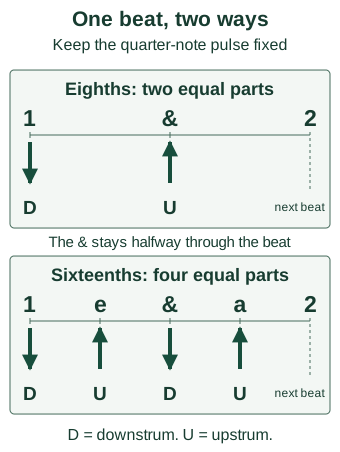
This down-up arrangement is the method used for these tasks. A sixteenth-note value tells you a duration; other techniques or musical phrases can use other picking directions. If the basic movement is unfamiliar, start with easier eighth-note strumming patterns.
Set up one E minor chord
Use standard tuning, E A D G B E from string 6 to string 1, with no capo. String 6 is low E and string 1 is high E. Place your middle finger on string 5 at fret 2 and your ring finger on string 4 at fret 2. Leave the other strings open: Em is 0 2 2 0 0 0, reading strings 6 to 1.
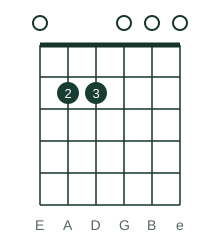
Check each string separately. Low to high, the notes are E2, B2, E3, G3, B3 and E4. For these exercises, downstrum all six strings, travelling from the low-E side towards the high-E side. Upstrum only the three thinner strings, travelling from high E through B to G. Those upward attacks contain E4, B3 and G3; they remain part of Em. Leave the lower strings ringing rather than trying to silence them on each upstrum.
Keep the movement small and comfortable, with enough control to reach the intended strings. Take breaks and stop if playing hurts. You can first practise the hand movement just clear of the strings.
Set four clicks per bar
On the online metronome, select 4 beats per bar and try 60 BPM. Each click is one quarter-note beat, landing on 1, 2, 3 or 4. Tap your foot on those numbers if that helps; the foot does not have to follow every strum.
At quarter note = 60, a beat lasts one second. Each eighth lasts half a second; each sixteenth lasts a quarter of a second. Both one-bar exercises last four seconds, excluding your manual count-in. Choose a slower tempo or work without clicks if sixteen attacks feel rushed. Speed is not a prerequisite for completing the task.
The optional score players also start at quarter note = 60. Their 75% speed is 45 BPM and 50% is 30 BPM. Synthetic playback is a timing and pitch reference, with no automatic count-in. Its lower notes end at the next upstrum; on your guitar, let those lower strings keep ringing. The grouped chord notes and pick symbols show each attack, without prescribing how fast your pick sweeps across the strings.
Pattern 1: eight eighth-note strums
Count 1 & 2 & 3 & 4 &. Downstrum on each number and upstrum on each “&”, giving eight evenly spaced attacks. Use all six strings on downs and the top three on ups, as described above.
- Count one whole bar without playing:
1 & 2 & 3 & 4 &. - On the next 1, begin the pattern. Keep the numbered beats aligned with the clicks.
- After the final upstrum on
4 &, let that half-beat finish. - On the following 1, gently touch all six strings with your picking hand to stop them, without another strike. You have played one complete bar.
To repeat continuously, downstrum on that following 1 instead of stopping. Leave the same half-beat gap from the last “&” to the next 1 as between the other attacks.
Eighth-note reference: eight Em strums: score and practice
One 4/4 bar at quarter note = 60 BPM. Count 1 & 2 & 3 & 4 &: down on numbers, up on &. Eight attacks, half a second apart. All downs use Em frets 0 2 2 0 0 0 from strings 6 to 1, sounding E2 B2 E3 G3 B3 E4. Ups catch only open G B high E, sounding G3 B3 E4; leave the lower strings ringing. Four beats and four seconds, excluding a manual full-bar count-in. Let the final 4-and half-beat finish, then stop all six strings on the following 1 without another attack, or downstrum there to repeat. Reset with a fresh full-bar count-in after pausing. Grouped notes do not prescribe pick-sweep speed; synthetic playback is a pitch/timing reference. Its lower notes end at the next upstrum; on guitar let the lower strings keep ringing.
The score contains 1 played bar at 60 quarter-note BPM, without a count-in. Follow the lesson's count-in and stopping instructions when you play. The guitar staff uses the usual octave-transposing treble convention; the tab gives the physical string and fret.
The static score is available without loading the player.
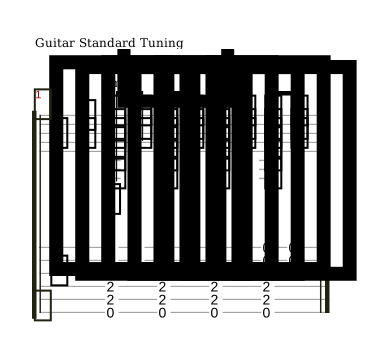
Scroll sideways for the complete score. Interactive notation loads when you ask for it. Practice audio loads separately and starts only after Play. Synthetic audio is a timing reference; it does not check your guitar or replace the instructions for stopping the strings.
Pattern 2: sixteen sixteenth-note strums
Count 1 e & a 2 e & a 3 e & a 4 e & a. Play D U D U in each beat, giving sixteen evenly spaced attacks. Every number and every “&” gets a downstrum; every “e” and “a” gets an upstrum. Keep using all six strings on downs and the top three on ups.
- Count one complete bar without playing, including all sixteen syllables.
- Start strumming on the next 1. Make the four parts of each beat equal, with no extra gap before the next number.
- After the last upstrum on
4 a, let its final quarter-beat finish. - Stop all six strings on the following 1 without another strike. At 60 BPM, that stop is one quarter-second after the last attack, four seconds after the first attack.
For a continuous repeat, downstrum on the following 1 instead. The last movement was up on “a”, so the hand is ready to travel down. After a pause or lost count, stop the strings, count a fresh full bar and start on the next 1. Practise the two patterns separately when changing between them interrupts the pulse.
Sixteenth-note pattern: sixteen Em strums: score and practice
One 4/4 bar at quarter note = 60 BPM. Count 1 e & a 2 e & a 3 e & a 4 e & a: down on numbers and &, up on e and a. Sixteen attacks, a quarter-second apart. All downs use Em frets 0 2 2 0 0 0 from strings 6 to 1, sounding E2 B2 E3 G3 B3 E4. Ups catch only open G B high E, sounding G3 B3 E4; leave the lower strings ringing. Four beats and four seconds, excluding a manual full-bar count-in. Let the final 4-a quarter-beat finish, then stop all six strings on the following 1 without another attack, or downstrum there to repeat. Reset with a fresh full-bar count-in after pausing. Grouped notes do not prescribe pick-sweep speed; synthetic playback is a pitch/timing reference. Its lower notes end at the next upstrum; on guitar let the lower strings keep ringing.
The score contains 1 played bar at 60 quarter-note BPM, without a count-in. Follow the lesson's count-in and stopping instructions when you play. The guitar staff uses the usual octave-transposing treble convention; the tab gives the physical string and fret.
The static score is available without loading the player.
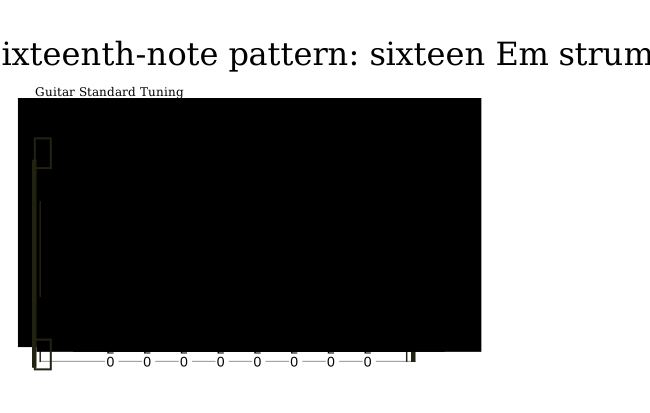
Scroll sideways for the complete score. Interactive notation loads when you ask for it. Practice audio loads separately and starts only after Play. Synthetic audio is a timing reference; it does not check your guitar or replace the instructions for stopping the strings.
Begin without deliberate accents, aiming for an even count and a controlled sound. Downstrums and upstrums can naturally sound different because they catch different strings. You do not need to force identical volume or strike harder to keep time.
Check where the beat is going
If the clicks seem to speed up when you add sixteenths, stop and say the four numbered beats with the metronome first. Then fit e & a between them without changing the clicks. The extra syllables divide the existing time.
If the “&” keeps getting an upstrum in pattern 2, isolate one beat: 1 e & a, D U D U. Practise that slowly, pause, then count in again for a full bar. Check the same movement on each numbered beat.
Four equal sixteenths are different from three equal eighth-note triplets. They are also different from 6/8 strumming, where the usual two main beats each divide into three. Keep the note unit and grouping clear before comparing tempos.
At 60 BPM, does pattern 2 take twice as long as pattern 1?
No. With the quarter note at 60 BPM, each 4/4 bar lasts four seconds. Pattern 1 fits eight attacks into it; pattern 2 fits sixteen. The interval between attacks changes from half a second to a quarter of a second.
Which direction lands on the “&” in each pattern?
Pattern 1 uses an upstrum on “&”. Pattern 2 uses a downstrum there, with an upstrum on “e” before it and another on “a” after it. Both place “&” halfway between numbered beats.
Once you can repeat one bar without losing the count, try the same rhythm on another comfortable chord. First check which strings that chord allows; the all-six-string downstrum used for Em does not suit every shape. The easy chord progressions lesson gives exact bar lengths when you are ready to add changes.
Source notes
Mark Gotham, Chelsey Hamm and Kris Shaffer’s written Open Music Theory chapter on simple metre explains quarter-note beats, divisions and sixteenth-counting syllables. Its written text is CC BY-SA 4.0, with separate exceptions for media. Justin Sandercoe’s written introduction to sixteenth-note strumming explains the change of direction on “&” and steady hand movement. Andy Guitar’s introduction also discusses even hand movement and keeping the beat audible.
The diagram and two counted Em exercises were written for this page. No source song, tab, artwork, video or recording is reproduced. These are starting practice patterns; a particular song may use omitted strikes, accents or different directions.