In this lesson
An eighth-note triplet puts three evenly spaced notes in the time normally occupied by two eighth notes. In these 4/4 exercises, that is three notes inside one quarter-note beat. Count 1 la li 2 la li 3 la li 4 la li, with each number landing on a metronome click.
Keep the numbered beats at the same speed when changing from two notes per beat to three. You will play more notes between clicks, without adding beats to the bar.
Set up one string and four beats
Use a six-string guitar in standard tuning, E A D G B E from string 6 to string 1, without a capo. Play only open string 1, the thin high E. Its sounding pitch is E4, with middle C called C4. A 0 on the top tab line means this open string, without a fretting finger. Keep the other five strings quiet.
Use a pick and alternate down, up, down, up on successive notes. In playing position, down moves towards the high-E side of the strings; up moves towards the low-E side. On this one string the pick passes through it in those directions. Review pick strokes and reading guitar tab if either is new.
At the online metronome, select four beats per bar and 60 BPM. Each click marks a quarter-note beat, one second apart. Count a complete silent bar, 1 2 3 4, then start on the next 1. The optional exercise players have no count-in bar. Work without clicks or choose a slower tempo if you need time to control the movement. Keep it comfortable, take breaks and stop if playing hurts.
Compare two notes with three
With ordinary eighth notes, divide each beat into two equal parts: 1 & 2 & 3 & 4 &. Say “and” for &. With eighth-note triplets, divide each beat into three equal parts: 1 la li 2 la li 3 la li 4 la li. Each syllable marks a new picked note. These are two alternative divisions of the same beat; do not fit an “and” between “la” and “li”.
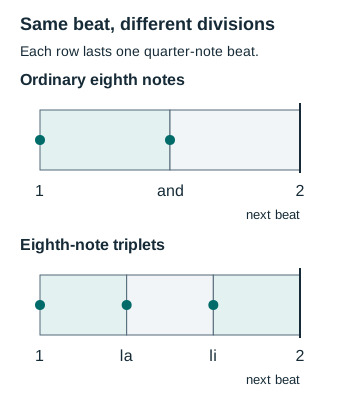
At quarter-note 60 BPM, ordinary eighth-note starts are half a second apart. Triplet starts are one-third of a second apart. In both cases, four numbered beats make a four-second bar. Those timings exclude the manual count-in.
In notation, a 3 above or below the relevant group marks a triplet. The exercise score groups three eighth notes under each 3, taking one quarter-note beat. Eighth note is also called quaver. Other kinds of triplet can span different durations; read the note values and group boundary rather than assuming every 3 means one beat. Note duration explains the ordinary values.
Exercise 1: ordinary eighth notes
Count the full silent bar, then pick the open high E eight times:
Each row lasts one numbered beat. D means downstroke and U means upstroke. The click coincides with the number, not the “and”.
| Beat | Count | Strokes |
|---|---|---|
| 1 | 1 & | D U |
| 2 | 2 & | D U |
| 3 | 3 & | D U |
| 4 | 4 & | D U |
Ordinary eighth notes: two per beat: score and practice
One 4/4 bar at quarter-note 60 BPM. Open high E, string 1 fret 0, sounding E4 throughout. Count 1 and 2 and 3 and 4 and, picking down on each number and up on each and. Eight attacks, four beats, four seconds; no count-in bar. Squared inverted-U means downstroke; V means upstroke. After 4-and, wait half a beat and stop the string on the following 1 to finish, or pick down there to repeat without an extra beat. Count a fresh silent bar after a pause.
The score contains 1 played bar at 60 BPM, without a count-in. Follow the lesson's count-in and stopping instructions when you play. The guitar staff uses the usual octave-transposing treble convention; the tab gives the physical string and fret.
The static score is available without loading the player.
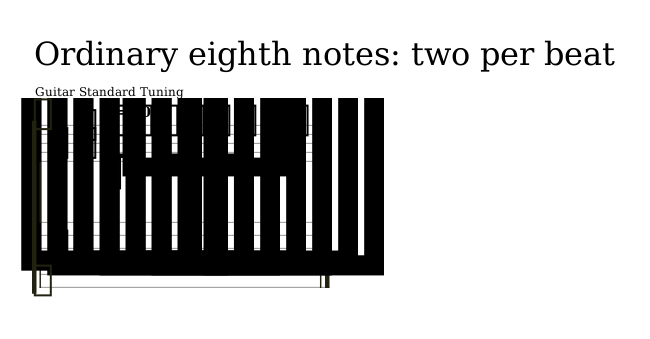
Scroll sideways for the complete score. Interactive notation loads when you ask for it. Practice audio loads separately and starts only after Play. Synthetic audio is a timing reference; it does not check your guitar or replace the instructions for stopping the strings.
Pick once on every number and “and”. Let each note ring until the next pick; there are no rests or tied notes. After the final upstroke on 4-and, wait the remaining half beat, then gently touch the high E with your picking hand on the following 1 to stop it, without another pick. That finishes one bar: eight attacks over four beats.
To repeat continuously instead, pick the next downstroke on that following 1. After eight alternating attacks, the next stroke is down. Keep the same spacing across the bar line, with no extra beat. After a pause, stop the string and count a fresh silent bar before restarting.
Exercise 2: eighth-note triplets
Stop exercise 1, then count a fresh silent bar before this separate one-bar exercise. Say all twelve positions evenly. Keep one metronome click per number, with “la” and “li” between clicks.
Every syllable gets one pick. Only the number gets a click. The down-up order continues through each beat boundary.
| Beat | Count | Strokes |
|---|---|---|
| 1 | 1 la li | D U D |
| 2 | 2 la li | U D U |
| 3 | 3 la li | D U D |
| 4 | 4 la li | U D U |
Eighth-note triplets: three per beat: score and practice
One 4/4 bar at quarter-note 60 BPM. Open high E, string 1 fret 0, sounding E4 throughout. Count 1 la li 2 la li 3 la li 4 la li. Pick D U D on beat 1, U D U on 2, D U D on 3 and U D U on 4. Four groups of three eighth-note triplets, twelve attacks, four beats, four seconds; no count-in bar. Squared inverted-U means downstroke; V means upstroke. After 4-li, wait one-third of a beat and stop on the following 1 to finish, or pick down there to repeat. After a pause, count a fresh silent bar.
The score contains 1 played bar at 60 BPM, without a count-in. Follow the lesson's count-in and stopping instructions when you play. The guitar staff uses the usual octave-transposing treble convention; the tab gives the physical string and fret.
The static score is available without loading the player.
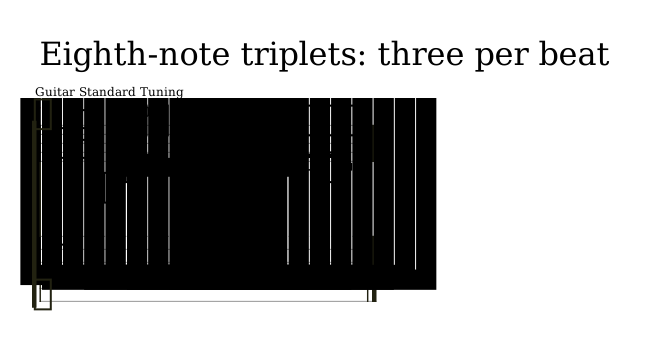
Scroll sideways for the complete score. Interactive notation loads when you ask for it. Practice audio loads separately and starts only after Play. Synthetic audio is a timing reference; it does not check your guitar or replace the instructions for stopping the strings.
Each beat has an odd number of picks, so its first stroke changes: down on 1, up on 2, down on 3, up on 4. If you restart down on every number, you will make consecutive downstrokes between the groups. That breaks this exercise’s strict alternation. Other picking patterns can choose different directions.
Play only the open high E, once per syllable. Each note lasts one-third of a quarter-note beat. Let it ring until the next pick. After the last upstroke on 4-li, wait the remaining third of a beat, then stop the string on the following 1 without picking again. This completes twelve attacks over four beats.
To repeat continuously, pick down on that following 1 instead. Twelve alternating picks end up, so the next bar starts down. The player’s Repeat control repeats its entire one-bar score. Practice sound is synthetic; it does not demonstrate your pick movement or establish how cleanly your guitar is sounding.
Keep the groups even
Speak the triplet count with the clicks before adding the guitar. Give 1, la and li equal space; do not squeeze the last two syllables just before the next click. The number stays aligned with the click even on beats 2 and 4, where the pick starts up.
If the direction gets lost, put the guitar aside and say the twelve strokes while following the table. Then try one D U D group followed immediately by one U D U group at an untimed comfortable pace. Return to the four-beat exercise with a fresh count-in. Keep your picking movement small enough to control; a missed note is a reason to slow down or isolate the problem.
Triplets divide a beat; they do not change this exercise to 3/4 time. Here there are still four quarter-note beats per bar. Swing and shuffle can use unequal note spacing, so this evenly spaced three-note exercise is not a complete swing or shuffle lesson.
Check the rhythm
- How many picked notes fit between successive quarter-note clicks in each exercise?
- At quarter-note 60 BPM, how long is a complete bar in either exercise?
- Which stroke plays the first note of beat 2 in the triplet exercise?
- How many attacks does a complete triplet bar contain?
- When do you stop after 4-li, and which stroke begins a continuous repeat?
Show the count and stroke answers
- Two ordinary eighth notes or three eighth-note triplets per quarter-note beat. A note starts with the first click; the next numbered click starts the following beat.
- Four seconds. Both bars contain four one-second quarter-note beats, excluding the count-in.
- An upstroke, after beat 1’s D U D. Beats 1 and 3 start down; 2 and 4 start up.
- Twelve: four groups of three, all on open string 1, sounding E4.
- Wait the remaining third of a beat and stop on the following 1 without another pick. For a continuous repeat, pick down on that 1 instead. After stopping to adjust, count a fresh full bar before restarting.
When the spacing is steady, try alternate picking across strings to work on a new target while preserving down-up order. For passages with silence or sustained notes, the rest-and-tie exercises explain when to stop or avoid another attack; the continuous-note stroke pattern here does not supply a universal rule across rests.
Source notes
The Open University’s triplet introduction and Robert Hutchinson’s tuplets chapter support three equal subdivisions in the time of two. Open Music Theory’s Other rhythmic essentials, by Mark Gotham, Chelsey Hamm and Bryn Hughes (CC BY-SA 4.0), explains triplet notation, durations at different levels and the 1 la li count. Jeff Owens’s Fender picking-styles guide describes alternate up/down strokes; Mark Wingfield’s alternate-picking article supports small controlled movements and isolating a problem at a manageable tempo. Its posture and speed claims are not requirements here. The one-string exercises, timing diagram, counts and stop/reset instructions were written for IGDb; no source score, recording or artwork is reproduced.