In this lesson
- Keep the root separate from the bass
- C in root position: frets 5, 5, 3
- C/E in first inversion: frets 9, 8, 8
- C/G in second inversion: frets 0, 1, 0
- Check the three shapes without a beat
- Move the first-inversion shape to G/B
- Test your inversion reading
- Is chord inversion the same as interval inversion?
- Source notes
A triad’s inversion depends on its lowest sounding note: root lowest means root position, third lowest means first inversion, and fifth lowest means second inversion. For C major, those bass notes are C, E and G. The chord keeps the notes C, E and G in every case.
Read all six-position patterns from low E to high E. x means leave the string out; 0 means sound it open. Numbers are frets, not finger numbers.
On the top three guitar strings, try C: x x x 5 5 3, C/E: x x x 9 8 8 and C/G: x x x 0 1 0. This lesson checks every note, shows where the root sits, and gives you a shape to move to G major. You can answer the note questions without a guitar.
Use standard tuning, E A D G B E from string 6 to string 1, without a capo. The top three strings are string 3 (G), string 2 (B) and string 1 (high E). Here, “top” means the higher-pitched strings. Leave strings 6, 5 and 4 out of every shape in this lesson.
The three open strings sound G3, B3 and E4. Count one semitone up per fret, starting from the open pitch. The octave number changes at C: one semitone above B3 is C4.
Start with triads if root, third and fifth are new. The chord-diagram guide explains fret labels and open strings, while fretboard notes shows how to count pitches from the open strings.
Keep the root separate from the bass
The root names the chord. C major has root C, third E and fifth G. The bass is whichever note sounds lowest in the voicing you play. A voicing is a particular arrangement of a chord’s notes.
| C major position | Bass | Symbol |
|---|---|---|
| Root position | C, the root | C |
| First inversion | E, the third | C/E |
| Second inversion | G, the fifth | C/G |
Read C/E as “C over E”: C major with E in the bass. E is still the third of C major when it is lowest. The slash-chord lesson explains that notation and gives fuller open-chord shapes.
These are three isolated guitar voicings in different registers. They are not the same three pitches rearranged within one fixed octave, and the order below is a comparison task rather than a smooth chord-change exercise. In a group, a lower note from a bass player or another instrument can change the inversion of the complete sound.
C in root position: frets 5, 5, 3
For x x x 5 5 3, play G-string fret 5, B-string fret 5 and high-E fret 3.
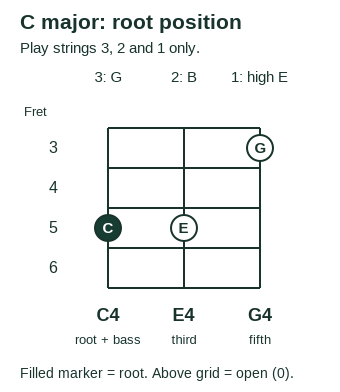
x x x 5 5 3. The filled marker identifies the root. Fret labels are absolute; this diagram starts at fret 3. Play only the three labelled strings.| String | Fret | Sounding pitch | Chord role |
|---|---|---|---|
| 3, G | 5 | C4 | Root and bass |
| 2, B | 5 | E4 | Third |
| 1, high E | 3 | G4 | Fifth |
The octave numbers identify sounding pitches; middle C is C4. C4 is lower than E4 and G4, so this is root position. To check C4 from open G3, count five semitones: G♯, A, A♯, B, C.
One possible fingering is index on high-E fret 3, ring on G-string fret 5 and little finger on B-string fret 5. Set up slowly and pick the three strings separately. Adjust the fingers if another arrangement is more comfortable; stop if playing hurts.
C/E in first inversion: frets 9, 8, 8
For x x x 9 8 8, the lowest pitch is E4. The root C is now on string 1.
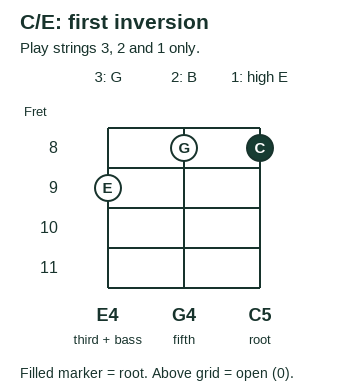
x x x 9 8 8. The first displayed fret is 8. C still names the chord, although E is lowest.| String | Fret | Sounding pitch | Chord role |
|---|---|---|---|
| 3, G | 9 | E4 | Third and bass |
| 2, B | 8 | G4 | Fifth |
| 1, high E | 8 | C5 | Root |
Try a small index-finger barre across strings 2 and 1 at fret 8, with the middle finger on string 3 at fret 9. For a separate-finger option, try ring on G-string fret 9, middle on B-string fret 8 and index on high-E fret 8. Use a comfortable fingering that lets all three intended notes sound; neither choice is compulsory.
E, G and C are still the C major notes. The third being lowest makes this first inversion. The smallest fret number alone does not identify the bass: here, fret 9 on G sounds lower than fret 8 on either thinner string.
C/G in second inversion: frets 0, 1, 0
For x x x 0 1 0, use the open G, B-string fret 1 and open high E. Try your index finger on B-string fret 1, leaving both neighbouring strings clear.
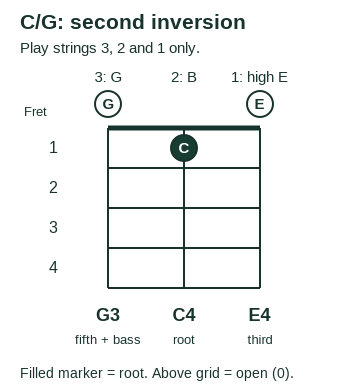
x x x 0 1 0. Circles above the grid are open strings. The filled C marker is the root, while the lower open G is the bass.| String | Fret | Sounding pitch | Chord role |
|---|---|---|---|
| 3, G | 0, open | G3 | Fifth and bass |
| 2, B | 1 | C4 | Root |
| 1, high E | 0, open | E4 | Third |
G3 is below C4 and E4. G is C major’s fifth, so this is second inversion. The C on string 2 has the same sounding pitch as the C on string 3 at fret 5 in the root-position shape, despite using a different string.
Check the three shapes without a beat
Work with one shape at a time. There is no required tempo or hold length.
- Form the shape and say its three note names in string order, 3, 2, 1.
- Pick those strings separately, allowing them to ring together. Check that each intended note sounds and that the lower three strings stay quiet.
- Name the chord root, then identify the lowest pitch. Use the root-and-bass table near the start to label root position, first inversion or second inversion.
- Gently brush strings 3 through 1 once. Keep the same three notes and starting string. If a lower string rings, damp the strings and restart from string 3. If a note buzzes or goes quiet, pick the three strings separately again; check that your fingertip is just behind the fret wire and clear of its neighbouring strings.
- Stop all sounding strings with a light touch from your plucking hand before releasing or moving the fretting hand. Lifting a fretting finger alone can leave an open string sounding.
Compare C, C/E and C/G, stopping completely between them. After C/G, stop before returning to C for another pass. You can practise the open C/G first if the other grips are unfamiliar. This task asks you to connect note names, bass and shape; it does not require a fast move between frets 1 and 9.
Move the first-inversion shape to G/B
The C/E shape uses only fretted notes. Lower each of its three fret numbers by five, keeping strings 3, 2 and 1 in that order: 9 8 8 becomes 4 3 3.
Stop the old chord, move the shape, then pick the new notes. Moving five frets towards the nut lowers each pitch by five semitones. E4 becomes B3, G4 becomes D4 and C5 becomes G4.
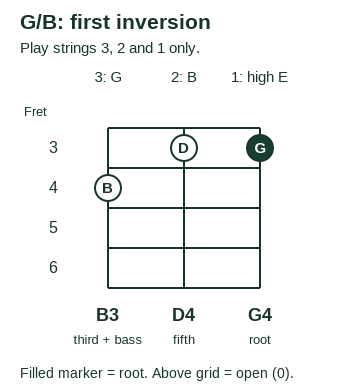
x x x 4 3 3. The first displayed fret is 3. This is the fretted C/E shape moved five frets lower.The new chord has G, B and D, with B3 lowest. It is G/B, first inversion of G major. Its root is G; the third B remains the bass. Try the same small-barre arrangement at fret 3. For separate fingers, try ring on G-string fret 4, middle on B-string fret 3 and index on high-E fret 3. Use a comfortable option, then stop the strings after checking them.
Keeping the same strings and moving every note by the same number of frets preserves the intervals. Open strings need separate handling: sliding the finger in 0 1 0 leaves its two open notes unchanged. The transposing-chords lesson explains the note calculation in more detail.
Test your inversion reading
- Where is the root C in each of the three C-major shapes? Give the string and fret.
- Why is
x x x 9 8 8C/E rather than E major? - What makes
x x x 0 1 0second inversion? - Start with
x x x 9 8 8. Move each fretted note five frets towards the nut. Write the new pattern, then name its pitches, root, bass and chord symbol. - If another instrument sounds C3 below the guitar’s E4, G4 and C5, what is the inversion of the combined C-major chord?
Show the worked answers
- Root-position C: string 3, fret 5. C/E: string 1, fret 8. C/G: string 2, fret 1. The roots are C4, C5 and C4 respectively.
- Its notes are E, G and C, which belong to C major. E is the lowest note, so it names the bass after the slash. E major would need E, G♯ and B.
- G3 is lowest, and G is the fifth of C major. The C root is above it on string 2.
- Subtract five from 9, 8 and 8 to get
x x x 4 3 3. The pitches are B3, D4 and G4. The root is G, the bass is B, and the symbol is G/B: first inversion of G major. - Root position: C3 is now the lowest pitch of the complete sound. The guitar's own three-note voicing still has E4 lowest.
Is chord inversion the same as interval inversion?
Chord inversion classifies which chord member is lowest. For a concrete interval-inversion example, start with C4 below E4: a major third. Move C4 up an octave to C5, above E4. E4 up to C5 is a minor sixth. This two-note calculation is a different task from naming the bass of a complete C-major triad.
Once you can find the root and bass in these shapes, use the slash-chord bass-line exercise to follow a bass across a timed progression. To work out which triads belong to a key, continue with chords in a major key.
Source notes
Robert Hutchinson’s Inverted Triads, sections 6.3 and 6.3.1, supports the root/bass distinction, inversion names and slash notation. Open Music Theory’s triad reference explains triad root, quality and bass. The guitar voicings, diagrams, note checks and practice questions here were authored for IGDb; no source score or recording is reproduced.