A pedal point is a note that stays in place while the harmony changes. On guitar, try letting the open A string ring while you change the notes on the D, G and B strings. The bass stays on A through Am, G/A and Am.
Find the notes above A
Use standard tuning without a capo. Play only strings 5, 4, 3 and 2. Rest your picking thumb on the open A and put your index, middle and ring fingers on D, G and B, one finger per string. Check each string on its own before you play the group.
| Bar | Chord | A-string fret | D-string fret | G-string fret | B-string fret |
|---|---|---|---|---|---|
| 1 | Am | 0 | 2 | 2 | 1 |
| 2 | G/A | 0, held | 0 | 0 | 0 |
| 3 | Am | 0, held | 2 | 2 | 1 |
The upper three strings give E, A and C over the bass in bar 1. Those notes make an A minor triad. In bar 2, the open D, G and B strings give the three notes of G major. The low A keeps ringing underneath, so write the chord as G/A and read it as “G over A.” The slash-chord lesson explains how to read the chord above the bass.
Hold the bass through two chord changes
Set a metronome to 72 BPM with four beats in a bar. Count four clicks before you start. On beat 1 of the first bar, pluck the open A with your thumb and the three fretted notes with your fingers together. Let all four notes ring through beat 4.
On the next 1, release the fretted shape and pluck the open D, G and B strings together. Keep your thumb clear of the ringing A. On beat 1 of bar 3, fret the Am shape again and pluck those same three upper strings. Leave the open A ringing through the last bar as it fades.
Am, G/A and Am with a held A pedal: score and practice
One bass attack across three bars at 72 BPM. On bar 1 beat 1, pluck open A and frets 2 on D, 2 on G and 1 on B. On bar 2 beat 1, pluck open D, G and B and let A keep ringing. On bar 3 beat 1, pluck D, G and B at frets 2, 2 and 1 again while A continues to ring. Each bar lasts four beats. Mute everything on the following click.
The score contains 3 played bars at 72 BPM, without a count-in. Follow the lesson's count-in and stopping instructions when you play. The guitar staff uses the usual octave-transposing treble convention; the tab gives the physical string and fret.
The static score is available without loading the player.
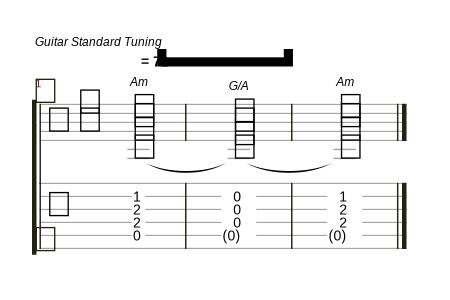
Scroll sideways for the complete score. Interactive notation loads when you ask for it. Practice audio loads separately and starts only after Play. Synthetic audio is a timing reference; it does not check your guitar or replace the instructions for stopping the strings.
The curves joining the open A notes in the score are ties. The open A at the start of bars 2 and 3 is the continuing note from bar 1. The upper three notes get a fresh attack in each bar. If the curved marks are new to you, see how to count tied notes.
On the click after bar 3, damp the four strings to finish. To loop, use that click to play bar 1 again, including a fresh A. The player begins at the first written beat and its repeat setting loops the three written bars.
Listen for the change above the pedal
Play all three bars on D, G and B alone. Your lowest note moves from E to D and back to E. Now play the written version and listen for the A that stays below all three chords. If you hit A again by habit, try the switch from fretted to open and back without the metronome. Keep your thumb away from the A for both changes.
Check the bass in bar 2
Is the open A part of the G major triad in the middle bar?
G major contains G, B and D. The low A sits underneath that triad and continues the pedal from bar 1. When Am returns, the same A is part of the chord again.
Both upper triads come from A natural minor. The chords in a minor key lesson shows where each one fits.
Source notes
Robert Hutchinson explains how a pedal can start as a chord tone and continue as the harmony changes. Hudson and Wang discuss how the term is used in popular music. The three-bar example was written for IGDb. Pedal Point · Hearing Pedals in Popular Music