In this lesson
Tremolo picking repeats a note rapidly with alternating downstrokes and upstrokes of a plectrum. Work towards an even stream of attacks before trying to increase the speed. Try the two counted drills on open G.
If holding or controlling the pick is unfamiliar, start with the plectrum lesson.
Start with alternate picking
Fret one note and pick down, up, down, up on the same string. Use a small, comfortable motion and a grip that keeps the pick secure without unnecessary tension. Keep the attacks even in spacing and volume.
Choose a pace you can control, then increase it gradually. Pause and reset when the movement becomes tense or uneven.
If a string change interrupts the alternating order, first try the slower alternate-picking string-change exercises. Their two one-bar patterns mark every stroke before you add faster repeated picking.
Keep the beat while the pick speeds up
Use the open G string in standard tuning, without a capo. Count about one beat a second or keep a metronome visible at 60 BPM with four beats per bar. Count one bar before you start. Let your downstrokes and upstrokes sound equally clear.
Two picks per beat
Pick down on each number and up on the “and”. The eight attacks should sound evenly spaced. Let the last “and” finish. Touch the G string with your picking hand on the next 1 to stop it, or pick down on that 1 to repeat.
Open G: two picks per beat: score and practice
One 4/4 bar at 60 BPM. Pick open G on the beat with a downstroke and on each and with an upstroke. Eight even attacks total. Let the last and finish, then mute on the next 1 for a single pass or restart with a downstroke there to repeat.
The score contains 1 played bar at 60 quarter-note BPM, without a count-in. Follow the lesson's count-in and stopping instructions when you play. The guitar staff uses the usual octave-transposing treble convention; the tab gives the physical string and fret.
The static score is available without loading the player.
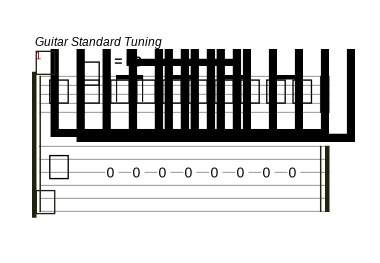
Scroll sideways for the complete score. Interactive notation loads when you ask for it. Practice audio loads separately and starts only after Play. Synthetic audio is a timing reference; it does not check your guitar or replace the instructions for stopping the strings.
Four picks on beat 3
Keep the same pulse. Play two picks on beats 1 and 2. On beat 3, fit four even attacks into the space of one beat, then stop the string as beat 4 starts. The silence on 4 gives your hand time to reset for a fresh downstroke.
| Beat | Count | Pick direction |
|---|---|---|
| 1 | 1 and | Down, up |
| 2 | 2 and | Down, up |
| 3 | 3 e and a | Down, up, down, up |
| 4 | 4 | Touch the string to mute. Rest for the full beat. |
Open G: four picks on beat 3: score and practice
Same pulse, one 4/4 bar. Pick down and up on beats 1 and 2. On beat 3, count 3 e and a and pick down up down up. Touch the G string to stop the sound when beat 4 begins. Rest for that full beat. Start the next 1 down if repeating.
The score contains 1 played bar at 60 quarter-note BPM, without a count-in. Follow the lesson's count-in and stopping instructions when you play. The guitar staff uses the usual octave-transposing treble convention; the tab gives the physical string and fret.
The static score is available without loading the player.
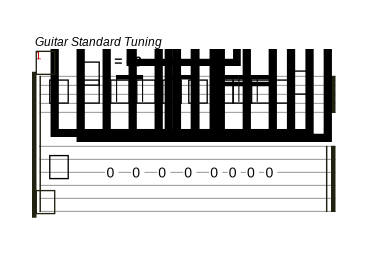
Scroll sideways for the complete score. Interactive notation loads when you ask for it. Practice audio loads separately and starts only after Play. Synthetic audio is a timing reference; it does not check your guitar or replace the instructions for stopping the strings.
If beat 3 rushes, say “3 e and a, 4” out loud before playing. Keep the numbers the same distance apart as in the eighth-note drill. If the downstrokes come out louder, slow down and listen to each upstroke. Try another bar when the attacks are even and your hand feels comfortable. Stop if you feel pain.
Check when the picking stops
The last attack of the burst is an upstroke on “a” of beat 3. Stop the sound exactly on beat 4, without a pick attack. If you repeat, the next sound is a downstroke on 1.
Read the tab example
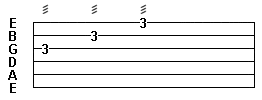
The original tab shows fret 3 on G, then B, then high E. The three diagonal strokes above each number mark repeated picking. The tab leaves the number of attacks open.
In measured notation, tremolo strokes work with the written note duration to specify a subdivision. This tab has no note values, time signature or tempo, so it does not give an exact picking count. The tablature lesson explains the string lines and fret numbers.
A short practice sequence
Try the two-pick count on the three fret positions in the original tab. The count below is a separate IGDb exercise.
- Settle into the first drill’s count. Start at fret 3 on the G string. Pick down on each number and up on each “and”.
- Play one bar on G, one on B and one on high E, all at fret 3. Pick the first note of each bar down. Lift enough fretting pressure to stop the old string as you move to the new one.
- Mute the high E on the following 1. If the string change breaks the count, slow the pulse and repeat. Listen for missed strings and uneven volume.
Each string has eight attacks, and the three bars have 24 altogether. Once the changes stay even, try the four-pick burst on one of the fretted notes.
Audio example
Further reading: Trinity College London’s tremolo-picking practice guidance and Steinberg’s measured and unmeasured tremolos.