In this lesson
Vibrato is a repeated variation in pitch while a note rings. On a steel-string guitar, one approach is a series of small bends and returns. The width is how far the pitch changes; the rate is how quickly the changes repeat.
Begin with the bending lesson if you cannot yet control a single bend and release. Vibrato is easier to judge when you can first play the note steadily without it.
Start with a small bend and return
In standard tuning, fret the eighth fret on the B string, G. Pick it and let it ring for a moment. Then move the string a little sideways and let it return, keeping it in contact with the fret. Listen for the starting G each time the string returns. This version rises above the starting pitch and comes back to it.
Choose a movement towards the centre of the fingerboard if an outside edge is close. Keep the hand supported without gripping hard. You can use another finger behind the sounding finger to help move the string. There is no single thumb position or index-finger pivot that every finger and musical phrase requires.
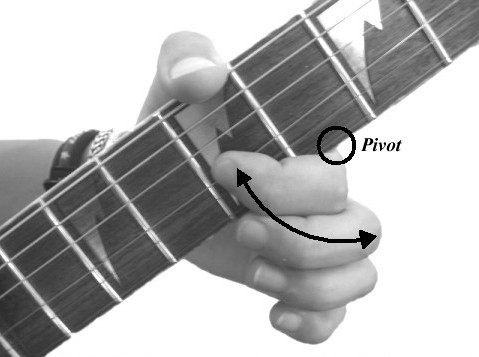
Separate width from rate
Start slowly enough to hear each rise and return. Keep the width small and try to make successive movements similar. Then keep that width while changing the rate. Next, return to the slower rate and try a slightly wider movement. Slow vibrato can be narrow; fast vibrato can be wide. Neither pair has to travel together.
For a counted drill, use the metronome and place one small bend-and-return cycle between each pair of clicks. This is an exercise for control, not a requirement to synchronise every musical vibrato to the beat. Pause when the note fades and pick again. Stop if you feel pain or begin squeezing the neck.
There are other approaches, including rocking along the string, often used on nylon-string guitars. A guitar fitted with a suitable vibrato bridge can also vary pitch with its arm. These movements behave differently from the sideways bend exercise. Follow the instrument’s instructions and do not force the hardware. Yamaha’s playing guide introduces finger and bridge-arm vibrato; Hub Guitar’s vibrato overview discusses width and rate.
Original recordings
The original lesson provides these two recordings for comparison.
Slower example
Faster example
Open strings and notation
A fretting-hand bend cannot be applied to an unfretted string in the same way. Pressing behind an accessible nut is a separate, hardware-dependent effect; a locking nut changes the coupling. Do not loosen a lock or press on an unfamiliar headstock to imitate the fretted exercise. Plucking behind the nut is another effect and has its own explanation.
A wavy line above a note commonly asks for vibrato. Plain-text tabs may use v or ~; check the author’s legend. The shape alone does not specify an exact rate or width.
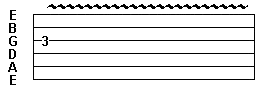
The original tab shows G-string fret 3, B flat in standard tuning, beneath a wavy line. It asks for vibrato on that note without specifying its width, rate or exact duration.