Fret the B string at fret 7 and the G string at fret 9. Play both. The B string gives you F♯. The G string starts at E, a whole step lower. Keep the B-string note steady and bend the G string up until the pitches match. That is a unison bend.
Hear the target first
In standard tuning, play string 2 at fret 7 on its own. Then play string 3 at fret 9. Bend that E up to the F♯ you just heard. An unbent F♯ is at fret 11 on the G string, two frets above your starting note. You stay at fret 9 while you bend. Use the single-string bending lesson if you need more practice matching a bend to a pitch.
Keep the B string ringing
Use your index finger on B at fret 7 and your ring finger on G at fret 9. Place your middle finger behind the ring finger on G for support. Start the two strings with one short pick stroke, or use the pick on G and your middle finger on B as in hybrid picking. Push the G string toward the D string so you have room to keep B sounding. Listen as the lower note approaches the higher one. Hold the bend when the pitches meet. If the G string goes higher, ease the bend back.
Count the bend and hold
Set the metronome to 60 BPM and four beats per bar. Keep its page visible. Count four clicks and start on the next 1.
| Bar | What to play |
|---|---|
| 1 | Play F♯ on the B string on 1. On 2, mute B and pick E on the G string, then start the bend. Reach F♯ by 3 and hold it through that beat. Mute G on 4, then bring it back down silently. |
| 2 | Play both strings together on 1, then bend the G string. Match the B string by 2 and hold both notes through that beat. Mute both on 3 before lowering G. Rest through 4. |
The player starts with the first written note. Repeat this 2-bar score returns to that note after the rests at the end. For the manual count-in, use the metronome drill above. To repeat by hand, play the B-string F♯ on the next 1.
Meet F sharp with a unison bend: score and practice
At 60 BPM, play fret 7 on string 2 on beat 1. Mute string 2 on beat 2 and pick fret 9 on string 3, then bend to F sharp by beat 3. Mute on 4 before releasing. In bar 2, play both fretted notes on beat 1, then bend string 3 to match string 2 by beat 2. Mute both on 3 before lowering string 3. Rest through beat 4.
The score contains 2 played bars at 60 BPM, without a count-in. Follow the lesson's count-in and stopping instructions when you play. The guitar staff uses the usual octave-transposing treble convention; the tab gives the physical string and fret.
The static score is available without loading the player.
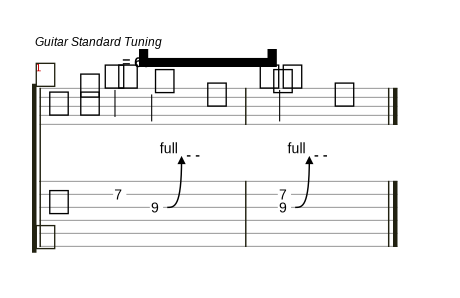
Scroll sideways for the complete score. Interactive notation loads when you ask for it. Practice audio loads separately and starts only after Play. Synthetic audio is a timing reference; it does not check your guitar or replace the instructions for stopping the strings.
Check which note moves
In bar 2, which string keeps the same pitch while the other note bends?
Keep the F♯ at fret 7 on the B string steady. The G string stays fretted at 9 as its E rises to F♯.
For another way to practise sounding two strings at once, try double-stop thirds. Those shapes move both notes along the neck.
Sources
Andy Guitar explains how to match a bent note to a steady higher note and support the bending finger. Andy Aledort’s Guitar World lesson demonstrates a unison bend with the G and B strings. The fret pair and counted exercise here were prepared for IGDb. Unison Bends · How to get more from oblique bends