In this lesson
Pickup height is the clearance between a pickup and the strings. For magnetic electric-guitar pickups, moving closer usually increases output and changes the response. Moving farther away usually reduces output. Too close can interfere with string vibration, or leave so little clearance that a string hits the pickup.
This guide covers magnetic pickups. Other systems, such as an acoustic guitar’s undersaddle pickup, need their own instructions. The guitar pickups lesson explains the main types.
Guidance source-checked on 2 November 2026. The photograph is retained from the original lesson.
When height matters
Height adjustment can help balance the volume when switching pickups, or the balance between the bass and treble strings. A louder setting is not automatically better: a pickup’s magnetic pull can disturb the note when it is too close.
Unwanted distortion does not by itself prove the height is wrong. For example, an active pickup with a low battery can produce a distorted or weak signal. Check the pickup’s troubleshooting guidance before changing its position.
Measure before making a change
Find the guidance for both the guitar and the fitted pickups, especially if the pickups have been replaced. There is no single clearance that suits every model.
Follow the specified tuning, fret position and measuring points. Fender’s Stratocaster guide measures from the bottom of the outer strings to the pole pieces while the strings are held at the last fret. PRS’s guide also uses the last fret, but specifies the pickup cover or bobbin as the reference surface. A measurement taken to a different surface may not be comparable.
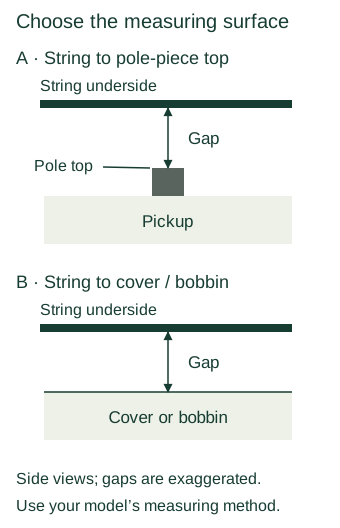
Record both outer-string clearances for each pickup so you have a starting reference. Complete any necessary neck-relief and action work using your model’s setup sequence; those changes can alter the clearance.
Identify the mounting system

A pickup suspended from a mounting ring or pickguard can respond differently to a screw turn from one mounted directly into the body. Other designs use foam, springs or spacers. The number and position of adjustment screws also vary.
Use the model’s instructions to identify the correct controls and turning direction. Screws holding a ring or cover in place are not necessarily height controls. Individual pole-piece adjustment, where supported, is a separate operation; do not turn or push a pole piece simply because it resembles an adjuster.
Adjust and compare
If the manufacturer’s procedure permits an owner adjustment, use the correct tool and make a small change within its stated range. Recheck the clearance using the same method, then compare the sound at consistent guitar and amplifier settings. A clean sound makes volume differences easier to hear. Check that strings remain clear of the pickup when fretted and played, including bends.
Stop if a screw resists, slips or turns without moving the pickup as expected. Avoid winding a pickup beyond its mounting range: on suspended designs it can detach and drop into the cavity. Ask a repairer for help if the mounting is loose, access requires unfamiliar disassembly, or you cannot identify the control.