In this lesson
Add9 keeps the chord’s third and adds a ninth. Sus2 replaces the third with a major second. Cadd9 contains C, E, G and D. Csus2 contains C, D and G, with no E. Both have D; check whether the third, E, is still present.
On guitar, compare Cadd9: x 3 2 0 3 3 with Csus2: x 3 0 0 3 3. In these exact shapes, only the D string changes: fret 2 becomes open. This lesson explains that change and gives an untimed picking task to check every note.
Use standard tuning, E A D G B E from string 6 to string 1, without a capo. Start with triads if root, third and fifth are new. The chord-diagram guide explains the string order and symbols.
Compare the notes in Cadd9 and Csus2
Use C major as the reference: C, D, E, F, G, A, B. Count C as 1. The major third is E, the perfect fifth is G, and the major second is D. A major ninth is a major second plus an octave, so its letter name above C is also D.
| Symbol | Formula | Different chord notes | What happens to the third? |
|---|---|---|---|
| C, major triad | 1, 3, 5 | C, E, G | E stays |
| Cadd9 | 1, 3, 5, 9 | C, E, G, D | E stays; D is added |
| Csus2 | 1, 2, 5 | C, D, G | D replaces E |
| C9, dominant ninth | 1, 3, 5, ♭7, 9 | C, E, G, B♭, D | E stays; B♭ and D are added |
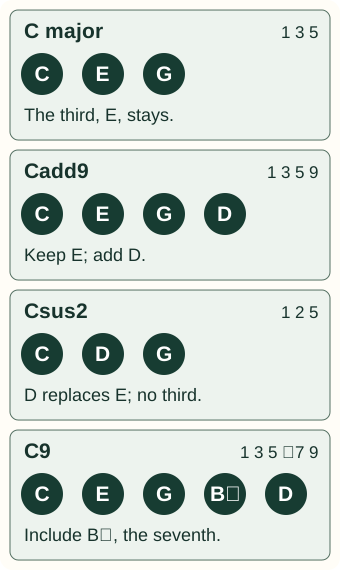
The formula numbers describe intervals above the root. They are not fret or finger numbers. A flat in ♭7 lowers the major scale’s seventh by one semitone: B becomes B♭ in the C example.
Play two open shapes
Read each compact pattern from low E to high E, strings 6 to 1. x means leave out that string, 0 means play it open, and the other numbers are frets. For both shapes, play A, D, G, B and high E, keeping low E silent.
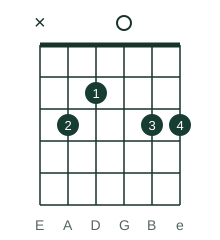
x 3 2 0 3 3. D-string fret 2 supplies E, the major third.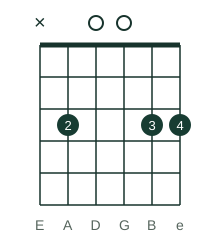
x 3 0 0 3 3. The open D string replaces that E with D.For Cadd9, place middle finger on A-string fret 3, index on D-string fret 2, ring on B-string fret 3 and little finger on high-E fret 3. Leave G open. The small numbers inside the diagram’s dots are fingers: index 1, middle 2, ring 3 and little 4.
To form Csus2, lift index completely clear of the D string so it can sound open. Keep middle, ring and little in place if comfortable. Both D and G are now open. To return to Cadd9, put index back on D-string fret 2. Pick again to hear the changed note; moving the finger alone is not the requested attack.
These are suggested fingerings. Settle each grip without forcing your hand, release unnecessary pressure between attempts and stop if playing hurts. If an open string is muffled, check whether a neighbouring finger is touching it.
Check the one-string change
| String | Cadd9: fret and sounding pitch | Csus2: fret and sounding pitch |
|---|---|---|
| 6, low E | Do not play | Do not play |
| 5, A | Fret 3: C3 | Fret 3: C3 |
| 4, D | Fret 2: E3 | Open: D3 |
| 3, G | Open: G3 | Open: G3 |
| 2, B | Fret 3: D4 | Fret 3: D4 |
| 1, high E | Fret 3: G4 | Fret 3: G4 |
The octave numbers name sounding pitches, with middle C called C4. In Cadd9, the notes from low to high are C3, E3, G3, D4 and G4. In Csus2, they are C3, D3, G3, D4 and G4. The E on string 4 is the only third in the first shape; removing it leaves no E anywhere in the second.
Each shape uses five strings. Cadd9 has four different chord tones, with G doubled. Csus2 has three, with D and G doubled. Count different note names separately from the number of strings you play.
Try an untimed comparison
- Form Cadd9. Pick strings 5, 4, 3, 2 and 1 once each, from A through high E. Let the notes overlap so you can check the whole shape, then gently touch all five strings to stop them.
- Lift index clear for Csus2. Pick the same five strings once each and stop them again. Check that the open D sounds, and that low E stays quiet.
- Put index back on D-string fret 2 for Cadd9. Pick the five strings once each, then silence them to finish.
Take as much time as you need between shapes. This comparison has fifteen separate picked attacks, with no prescribed tempo, beat length or automatic repeat. To start another pass, stop the last notes, settle the first Cadd9 grip and begin again on the A string.
Listen for the E3, D3, E3 change on string 4. The higher D4 on the B string stays in all three grips. That is why finding a D somewhere in the shape cannot, by itself, tell you whether the chord is add9 or sus2.
Why Cadd9 is different from C9
The word add tells you to add the named note without implying a seventh. Cadd9 has C, E, G and D. Plain C9 describes a dominant ninth chord whose full construction includes B♭: C, E, G, B♭ and D.
The two shapes taught here contain no B♭, so neither is the complete C9 chord in the table. Chord voicings can omit some members in musical context; the formula gives the full construction, not a demand to use one string for every member. If sevenths are unfamiliar, compare maj7, 7 and m7 before learning extended shapes.
Both 2 and 9 can identify a D above C in chord formulas. They name related intervals in different octaves; add and sus tell you what happens to the third. For the chosen Cadd9 shape, D4 is a major ninth above the lowest C3. The Csus2 shape includes D3 a major second above C3, as well as a doubled D4. A sus2 voicing can double its notes in other octaves too.
Check your understanding
- Which different notes belong to Cadd9, and which belong to Csus2?
- Which string and fret change between the two shapes here? Which note is removed?
- Both shapes contain D4 on the B string. Why are their chord names different?
- What extra note belongs to the full C9 construction? Does add9 imply it?
- How many attacks are in one complete untimed comparison, and how do you finish or restart it?
Check your answers
- Cadd9 has C, E, G and D. Csus2 has C, D and G, with no third.
- String 4, D, changes from fret 2 to open. E3 is removed and D3 takes its place.
- Cadd9 still has E, its major third, on string 4. Csus2 has no E on any sounding string. D alone does not settle the name.
- B♭, the minor seventh above C. Add9 does not imply a seventh.
- Fifteen: five picks for Cadd9, five for Csus2 and five for Cadd9 again. Silence the last notes. For another pass, settle the first Cadd9 grip, then start picking on A again.
For another replacement of the third, compare sus2 and sus4. Its open D examples change a different string. Use the whole note set when naming a chord; a similar grip does not make two symbols interchangeable in a song.
Source notes
Megan Lavengood’s chord-symbol chapter in Open Music Theory explains added notes, suspensions and the seventh implied by C9. Dillon Wallace’s Fender Cadd9 lesson gives the Cadd9 notes and x 3 2 0 3 3 fingering. The Csus2 voicing, string-by-string comparison, diagram and untimed task were prepared for this lesson. No source artwork, song or recording is reproduced.