In this lesson
A basic sus2 chord replaces the third with a major second. A basic sus4 chord replaces the third with a perfect fourth. Sus is short for suspended. Both keep the root and perfect fifth. For Dsus2, the notes are D, E and A; for Dsus4, they are D, G and A.
On guitar, you can compare these with open D major by changing the note on the high E string. The other three sounding strings stay the same in the shapes below. The numbers in sus2 and sus4 describe intervals above the root, not fret numbers, string numbers or fingers.
Use standard tuning, E A D G B E from string 6 to string 1, without a capo. Review major and minor triads and open D major if those are new. This lesson covers basic three-note sus chords, not every extended chord that can contain a suspension.
Replace the third in a D chord
Use the major scale on the chord’s root as the reference: D, E, F♯, G, A, B, C♯. Its first five degrees are D, E, F♯, G and A. A degree number counts from the root as 1.
| Chord | Formula | Different chord notes | Semitones above D |
|---|---|---|---|
| D major, written D | 1, 3, 5 | D, F♯, A | 0, 4, 7 |
| Dsus2 | 1, 2, 5 | D, E, A | 0, 2, 7 |
| Dsus4 | 1, 4, 5 | D, G, A | 0, 5, 7 |
| D minor, written Dm | 1, ♭3, 5 | D, F, A | 0, 3, 7 |
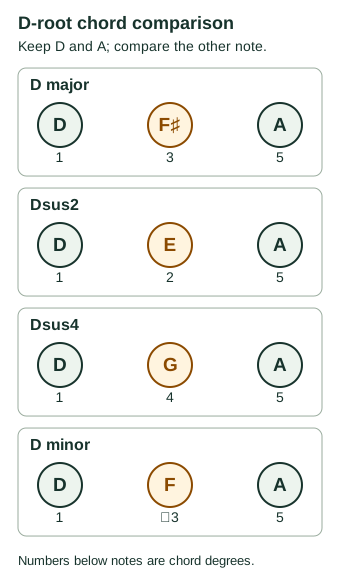
The third tells major and minor apart: F♯ gives D major, while F gives D minor. The basic Dsus2 and Dsus4 chords omit both of those thirds. Their three-note sets are therefore neither major nor minor by triad quality. That does not decide the key of a song.
When a chart writes Dsus without a number, it commonly means Dsus4. The complete symbol or an accompanying voicing can make the intended notes clearer.
Play three open shapes
Read each compact pattern from string 6 to string 1, low E to high E. x means leave the string out, 0 means open, and the other numbers are frets. For all three chords, play D, G, B and high E only. Keep low E and A silent.
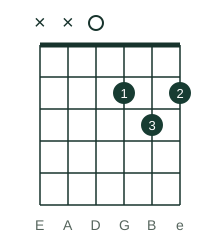
x x 0 2 3 2. The small numbers in its dots are finger numbers.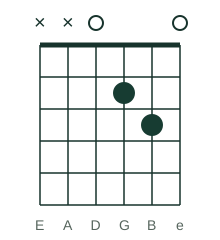
x x 0 2 3 0. The high E string is open. This diagram uses unnumbered dots.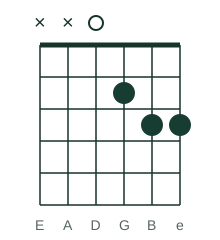
x x 0 2 3 3. The high E note moves to fret 3. This diagram uses unnumbered dots.For D major, put index on G-string fret 2, ring on B-string fret 3 and middle on high-E fret 2. D stays open. For Dsus2, lift the middle finger completely clear of high E so the open string can ring. Keep index and ring in place if comfortable.
For Dsus4, start with D major and add little finger on high-E fret 3. That high-E note is G. Keep middle at fret 2 behind little if comfortable. To return to D major, lift little finger, make sure middle is at fret 2, then pick again for F♯. These are example fingerings; adjust rather than forcing an uncomfortable reach. Stop if playing hurts.
Pick the four intended strings separately to check each shape. If the open high E is silent in Dsus2, check whether a neighbouring finger is touching it. The chord-diagram guide explains open and omitted strings.
| Shape | Sounding pitches, strings 4 to 1 | High E alone |
|---|---|---|
| D: x x 0 2 3 2 | D3, A3, D4, F♯4 | F♯4, major third |
| Dsus2: x x 0 2 3 0 | D3, A3, D4, E4 | E4, major second |
| Dsus4: x x 0 2 3 3 | D3, A3, D4, G4 | G4, perfect fourth |
The octave numbers name sounding pitches, with middle C called C4. D appears twice in each shape, so four played strings still give only three different chord notes. From low to high, these shapes sound root, fifth, root again, then the changed note.
Compare the changed note without a beat
This task is untimed. Settle each shape before you pick; moving a fretting finger by itself is not the requested attack.
- Form D major and pick strings 4, 3, 2 and 1 once each, from D through high E. Notice the F♯ on high E. Gently touch the strings to stop them.
- Form Dsus2 and pick the same four strings once each. High E now sounds E. Stop all four strings again.
- Return to D major, pick the four strings once each and stop them. Only the high-E pitch has changed between these exact shapes.
Repeat that three-shape comparison with D, Dsus4, D. The high-E note is now F♯, G, F♯. Take as much time as you need between grips. Each three-shape comparison has twelve separate picked notes; no tempo, beat length or automatic repeat is prescribed.
To repeat either comparison, silence the last D chord, form the first D grip again, then begin a new set of four picks. These practice routes finish on D major to make the returning third easy to hear. They are examples, not a rule about which chord must follow a sus symbol.
Sus does not mean minor
Changing D major to D minor lowers F♯ to F. D minor still contains a third: a minor third. In the open pattern x x 0 2 3 1, the high-E note is F4. That is a different change from replacing the third with E for Dsus2 or G for Dsus4.
Check the complete note set, not just the highest note. If another sounding string adds F or F♯, you no longer have one of the basic no-third Dsus2/Dsus4 voicings taught here. Other chord symbols can describe added notes, but those need their own note check.
Check the symbol and the shape
- Which chord member does sus2 replace, and with what interval?
- Name the three different notes in Dsus4. Does the 4 mean fret 4?
- Which note changes between the D and Dsus2 shapes here? What happens on the other three played strings?
- Why is Dm different from Dsus2?
- How many strings and how many different chord notes are played in each shape? How do you finish the untimed task?
Check your answers
- The third is replaced by a major second above the root.
- D, G and A. The 4 means a perfect fourth above D; this open shape uses high-E fret 3.
- High E changes from F♯4 at fret 2 to open E4. D3, A3 and D4 stay the same on strings 4, 3 and 2.
- Dm has the minor third F. Dsus2 omits the third and uses E instead.
- Four strings give three different chord notes, with D doubled. Pick each of the three shapes’ four strings once, then silence the last D. For another pass, settle the first D shape before picking again.
Build another chord before finding its shape
Try the formulas on C: C major is C, E and G; Csus2 is C, D and G; Csus4 is C, F and G. Keep the root and fifth, and identify which note replaces the third. Find a Csus2 shape in the chord charts, then check every sounding string.
To add a seventh, compare Dmaj7, D7 and Dm7. Those examples keep a third and add a seventh, which changes the construction again.
Source notes
Robert Hutchinson’s simple sus chords gives the intervals and bare-sus convention. Nick Stoubis’s Fender explanation gives the C examples. JustinGuitar’s written Dsus2 and Dsus4 instructions support the open shapes and finger changes. The D-root derivations, comparison diagram and untimed task were prepared for this lesson. No source song, video or artwork is reproduced.