In this lesson
Maj7, 7 and m7 name different seventh chords. A major seventh chord adds a major seventh to a major triad. A dominant seventh chord, written with a plain 7, uses a major triad and a minor seventh. A minor seventh chord uses a minor triad and a minor seventh.
You can check those differences in three four-string guitar shapes: Dmaj7, D7 and Dm7. Keeping D as the root makes the changed notes easier to follow. This is a comparison exercise; the three chords do not have to belong to one key or replace each other in a song.
Use standard tuning, E A D G B E from string 6 to string 1, without a capo. Start with triads if root, third and fifth are new. The interval table gives major and minor sevenths in semitones. Read chord diagrams if the shapes are unfamiliar.
Build the chord from a triad and a seventh
A triad has a root, third and fifth. Adding a seventh gives four different chord tones: root, third, fifth and seventh. The 7 identifies an interval above the root. It does not ask you to play seven notes or use fret 7.
These formulas use the major scale on the chord’s root as their reference. A flat lowers that scale degree by one semitone; the resulting note does not always have a flat sign in its name.
| Symbol and chord type | Formula | Semitones above root | D example |
|---|---|---|---|
| Dmaj7, major seventh | 1, 3, 5, 7 | 0, 4, 7, 11 | D, F♯, A, C♯ |
| D7, dominant seventh | 1, 3, 5, ♭7 | 0, 4, 7, 10 | D, F♯, A, C |
| Dm7, minor seventh | 1, ♭3, 5, ♭7 | 0, 3, 7, 10 | D, F, A, C |
D major has the notes D, E, F♯, G, A, B, C♯. Its seventh is C♯. Lowering that seventh by a semitone gives C for D7. Lowering the third F♯ to F as well gives Dm7. The chord letters stay D, F, A, C because they identify the root, third, fifth and seventh.
In Dmaj7, maj7 specifies a major seventh above a major triad. In D7, the plain 7 specifies a minor seventh above a major triad. The lowercase m in Dm7 makes the triad minor; its seventh is also minor. Keep the complete suffix when reading or writing a chord name.
This page covers those three chord types. Diminished, half-diminished and minor-major sevenths use other formulas. The name dominant seventh describes D7’s chord quality here. Deciding its role in a piece also needs musical context.
Compare three shapes with D as the lowest note
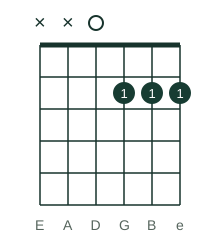
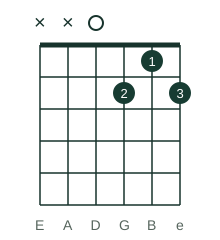
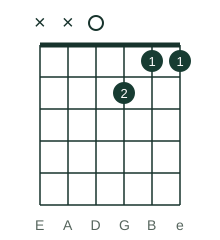
Read each compact pattern from string 6 to string 1, low E to high E. A number is a fret, 0 means open, and x means leave that string out. Play only D, G, B and high E in all three shapes. Keep the low E and A strings silent.
| Chord | Pattern, strings 6 to 1 | Sounding pitches, strings 4 to 1 |
|---|---|---|
| Dmaj7 | x x 0 2 2 2 | D3, A3, C♯4, F♯4 |
| D7 | x x 0 2 1 2 | D3, A3, C4, F♯4 |
| Dm7 | x x 0 2 1 1 | D3, A3, C4, F4 |
The octave numbers name sounding pitches, with middle C called C4. From the lowest sounding string upwards, these voicings put the chord tones in the order root, fifth, seventh, third. Guitar shapes can arrange chord tones differently from the root–third–fifth–seventh order used to explain their construction.
For Dmaj7, use an index-finger barre across G, B and high E at fret 2, leaving the D string open. For D7, place middle on G-string fret 2, index on B-string fret 1 and ring on high-E fret 2. For Dm7, keep middle on G-string fret 2 and use a small index barre across B and high E at fret 1. These are example fingerings; the diagrams number index as 1, middle as 2 and ring as 3.
Pick D, G, B and high E separately to check each note. Release between short attempts and adjust your hand instead of forcing the grip. If the small barre is uncomfortable, work on naming and locating the individual notes first. Stop if playing hurts. The barre-alternatives lesson also compares fewer-string voicings and explains why F and Fmaj7 differ.
Trace one pitch change at a time
From Dmaj7 to D7, the B-string note moves from fret 2, C♯4, to fret 1, C4. D, A and F♯ stay the same. Your fingers still need to rearrange for the new grip; one changed pitch does not guarantee one simple finger movement.
From D7 to Dm7, the high-E note moves from fret 2, F♯4, to fret 1, F4. D, A and C stay the same. Lowering that third makes the triad minor, while the minor seventh stays C.
Say which note changes, then pick all four strings again. Check the note names against the formula table. Leaving high E open changes the note set again, so it does not give any of the three complete voicings taught here.
Play a counted comparison
Learn each grip separately before trying the changes. The original example below has three bars of 4/4 at 60 BPM: Dmaj7, D7, then Dm7. Read the tab guide if you need help locating the strings.
Count an empty 1 2 3 4 before starting. In each bar, strum only D through high E on 1 and 3. Let the first chord ring through beat 2, then strum again on 3 and let it ring through beat 4. Change chord on the next 1.
Dmaj7, D7 and Dm7: compare chord qualities: score and practice
Three bars: Dmaj7, D7, then Dm7. Play each four-string chord on 1 and 3, holding through 2 and 4. Six chord attacks, twelve beats. After bar 3, stop on the following 1, or restart Dmaj7 there when repeating. No extra count-in bar. Grouped notes show a chord attack, without prescribing strum speed.
The score contains 3 played bars at 60 BPM, without a count-in. Follow the lesson's count-in and stopping instructions when you play. The guitar staff uses the usual octave-transposing treble convention; the tab gives the physical string and fret.
The static score is available without loading the player.
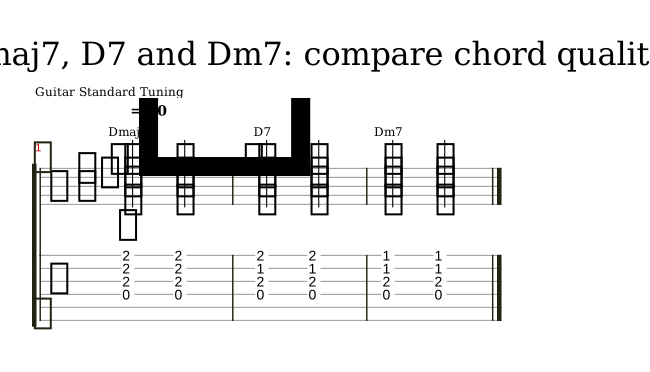
Scroll sideways for the complete score. Interactive notation loads when you ask for it. Practice audio loads separately and starts only after Play. Synthetic audio is a timing reference; it does not check your guitar or replace the instructions for stopping the strings.
| Bar | Chord | Beat 1 | Beat 2 | Beat 3 | Beat 4 |
|---|---|---|---|---|---|
| 1 | Dmaj7 | Strum | Keep ringing | Strum again | Keep ringing |
| 2 | D7 | Change and strum | Keep ringing | Strum again | Keep ringing |
| 3 | Dm7 | Change and strum | Keep ringing | Strum again | Keep ringing |
One pass has six chord attacks and twelve beats. After bar 3’s fourth beat, stop all four strings on the following 1 without another strum. To repeat, begin Dmaj7 on that same following 1 instead, without adding an extra beat. Select “Repeat this 3-bar score” in the optional player to repeat those bars. The player contains no extra count-in bar. The score groups the notes of each chord into one attack; it does not prescribe how quickly your pick crosses the strings.
The metronome can mark one click per numbered beat, with four beats per bar. If a change breaks the count, stop, practise the movement separately and restart after a fresh count-in. Keep the pace slow enough to check the changed notes.
Check the symbol and the notes
- Which note differs between Dmaj7 and D7? Which string and fret change in these shapes?
- Which note differs between D7 and Dm7?
- Does the 7 in D7 mean seven notes or fret 7?
- Name every note in Dm7 and its role.
- How many chord attacks and beats are in one comparison? Where do you stop or restart?
Check your answers
- C♯ becomes C. On the B string, fret 2 becomes fret 1.
- F♯ becomes F. On high E, fret 2 becomes fret 1.
- Neither. The chord includes the interval of a seventh above its root.
- D is the root, F the minor third, A the perfect fifth and C the minor seventh.
- Six attacks and twelve beats. After bar 3’s beat 4, stop or restart Dmaj7 on the following 1.
Use the chord tones in another task
Choose a chord type from the table and derive it from a different root before looking for a grip. Keep the root–third–fifth–seventh letters and check their intervals. The fretboard-note guide helps you locate those pitches. For a simpler melody task using triads, try choosing chord tones as the harmony changes.
Source notes
Open Music Theory’s triads and seventh chords, under “Seventh chords”, gives these chord members, interval structures and symbols. Robert Hutchinson’s introduction to seventh chords explains adding another third to a triad. Fender’s written D7 lesson and Dm7 lesson support the two stated fingerings. The same-root comparison, Dmaj7 fingering, pitch derivations and counted exercise were written for this lesson. No source music, video or artwork is reproduced.