In this lesson
- A chord change needs phrase context
- Four cadence patterns in C major
- Try the same chords with two phrase boundaries
- Check the guitar shapes
- Compare the four models in time
- Authentic model: G7 to C
- Plagal model: F to C
- Deceptive model: G7 to Am
- Half-cadence model: F to G
- Follow two notes from G7 to C
- Is every G7-to-C ending a perfect authentic cadence?
- Check your understanding
- Sources and next steps
A cadence is a harmonic arrival at the end of a musical phrase. In the tonal C-major examples here, G or G7 leading to C can support an authentic ending; F to C is a plagal pattern; G7 to Am is a common deceptive pattern; and a phrase ending on G is a half cadence. The phrase tells you where the ending happens.
This lesson keeps C major as the home key. You will identify those relationships, check their notes on guitar and compare short chord models. You can do the written tasks without an instrument. Start with chords in a major key if I, IV, V and vi are unfamiliar.
A chord change needs phrase context
A musical phrase is a short musical idea with a beginning and an ending. Cadences help mark that ending, which may feel settled or leave the music asking for more. Melody, rhythm and what comes before the arrival all matter. A G-to-C change halfway through a phrase is not automatically its cadence.
For example, suppose a phrase in C major ends on G, and the next phrase begins on C. The first ending can be a half cadence even though G is followed by C across the phrase boundary. Identify the boundary before naming its final harmony.
The models below isolate the chord patterns. They are short practice reductions, with C major supplied, rather than excerpts from songs. A real piece needs its own phrase and key analysis; a pair of chord symbols cannot supply that context by itself.
Four cadence patterns in C major
The uppercase numerals here have a major triad at their core; lowercase vi means A minor. V7 is the dominant seventh on G: G, B, D and F. The 7 adds a chord tone; it does not mean seven beats. See seventh-chord symbols for the construction.
On narrow screens, scroll the table sideways to read the final column.
| Ending pattern | Chords in this lesson | Numerals in C major | Where it arrives |
|---|---|---|---|
| Authentic | G7 to C | V7–I | C, the tonic chord |
| Plagal | F to C | IV–I | C, approached from IV |
| Deceptive, common example | G7 to Am | V7–vi | Am in place of the expected C |
| Half | F to G | IV–V | G, the dominant chord |
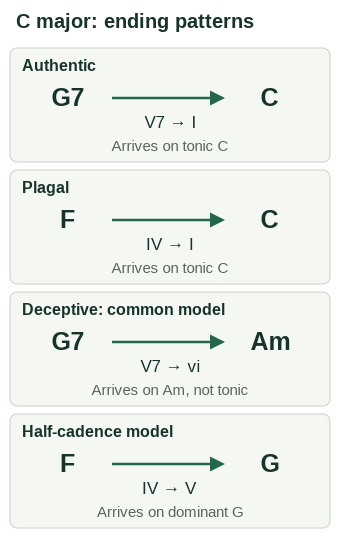
An authentic cadence can also use the G major triad instead of G7. A half cadence is defined by its arrival on V; it does not always have to come from IV. Deceptive endings can go to other chords too: V to vi is the common major-key example used here. These are introductory tonal patterns, not a rule that all music must end in one of four ways.
Try the same chords with two phrase boundaries
Keep C major as the home key and use the same chord stream, C–F–G–C, in both versions. Each box below represents one four-beat bar. The phrase boundaries are supplied for this written task; you are not being asked to infer them from chord names.
- Version A: the first phrase contains C–F–G and ends on G. The last C begins a new phrase, whose remaining chords are not shown.
- Version B: one phrase contains all four chords, C–F–G–C, and ends on the last C.
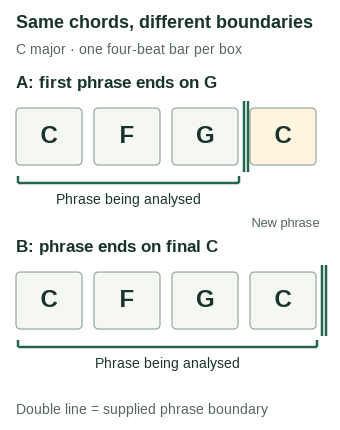
For each version, write the last two chords inside the phrase being analysed, give their Roman numerals and name the cadence. Why does the G-to-C change in version A not make its first ending authentic? Name one clue you could use to locate a phrase boundary in an actual piece.
Compare the two endings
Version A ends F–G, IV–V: a half cadence. Its final C starts the next phrase, so G–C crosses the boundary instead of forming the ending within the first phrase. Version B ends G–C, V–I: an authentic cadence. With this lesson’s guitar-only grips, the final C has E4 highest, so the stricter label would be IAC, as explained below.
A melodic pause, a sustained arrival or a change in rhythm can help mark a phrase boundary. Silence is one possible cue, not a requirement in every piece. In this task the boundaries are given; a real performance needs its melody, rhythm and harmonic context checked together.
Check the guitar shapes
Use standard tuning, E A D G B E from string 6 to string 1, with no capo. Read compact patterns from low E to high E. In the tab scores, string 1 is the top line. A number is a fret, 0 means open and x means leave that string out. Octave numbers name sounding pitches; middle C is C4.
| Chord | Strings 6 to 1 | Sounding pitches, low to high |
|---|---|---|
| C | x 3 2 0 1 0 |
C3 E3 G3 C4 E4 |
| G | 3 2 0 0 0 3 |
G2 B2 D3 G3 B3 G4 |
| G7 | 3 2 0 0 0 1 |
G2 B2 D3 G3 B3 F4 |
| Am | x 0 2 2 1 0 |
A2 E3 A3 C4 E4 |
| Small F | x x 3 2 1 x |
F3 A3 C4 |
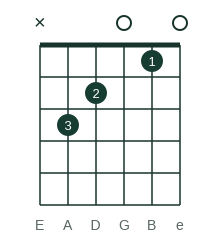
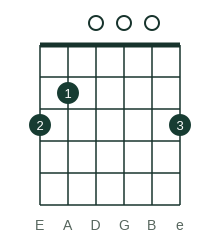
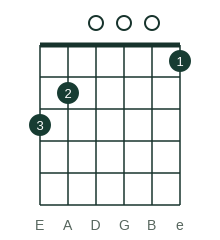
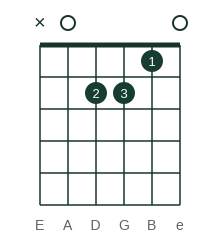
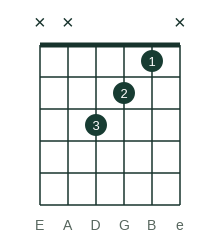
The small F sounds all three chord tones, F, A and C, and needs no barre. Keep both lower strings and high E silent. The numbers inside these diagram dots identify fretting fingers: index 1, middle 2 and ring 3. The first-chord lesson gives further C, G and Am placement checks.
Before using a beat, form each shape and pick its intended strings separately. Then strum the first chord of a pair once, let it ring briefly and gently touch all strings to stop it. Take time to form the second chord, strum it once and stop every string again. Repeat from the first shape after a pause. These separate checks give you time to find the notes. Stop if playing hurts.
Compare the four models in time
Each separate score has two bars of 4/4 at quarter-note 60 BPM. Count one silent bar, 1 2 3 4, before starting; keep the guitar quiet during that count. Strum the first chord down on bar 1’s beat 1 and let it ring through 2, 3 and 4. Change and strum down again on bar 2’s beat 1, then let that chord ring through its 2, 3 and 4. Keep strings marked x silent, including after a change from a wider shape.
One pass has two chord attacks and eight quarter-note beats, eight seconds at that tempo. After bar 2’s full fourth beat, damp all strings on the following 1 without strumming again. For continuous repetition, strum the first chord there instead, without adding a beat. For a fresh guitar attempt after stopping, use a new silent count-in. The scores contain no extra count-in bar. Grouped notes represent a chord attack without specifying how quickly the pick crosses the strings; the squared inverted-U means downstroke.
In the optional player, select “Repeat this 2-bar score” for continuous repetition. Press Pause to suspend playback and Play to continue from that position. To start again from bar 1, press Stop, count your silent bar, then press Play.
Set the metronome to 60 BPM and four beats per bar to match these scores, with one click per numbered beat. Slow down or return to the untimed shape checks if a change breaks the count. The player is a synthetic reference; compare it with your own playing without treating it as a guitar assessment.
Authentic model: G7 to C
This V7–I pattern arrives on C, the stated tonic. Compare it with G7 to Am below: the first chord stays the same while the destination changes. The highest note of this C shape is E4, which matters for the stricter perfect-authentic label discussed later.
Authentic model: G7 to C: score and practice
Two-bar model in stated C major, standard tuning without a capo, 4/4 at quarter-note 60 BPM: G7, then C. Count a fresh silent 1 2 3 4 first; no count-in bar is included. Strum down once on each bar's 1 and hold through 2, 3 and 4. Two chord attacks, eight beats, eight seconds of score. After bar 2's full fourth beat, damp on the following 1, or strum G7 there to repeat continuously. If you stop and start a new guitar attempt, count a fresh silent bar. Squared inverted-U means downstroke; grouped notes do not prescribe a strum's spread. Phrase context is needed to identify a cadence.
The score contains 2 played bars at 60 BPM, without a count-in. Follow the lesson's count-in and stopping instructions when you play. The guitar staff uses the usual octave-transposing treble convention; the tab gives the physical string and fret.
The static score is available without loading the player.
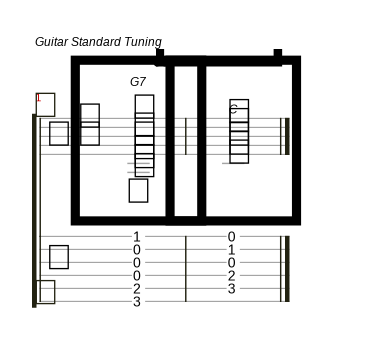
Scroll sideways for the complete score. Interactive notation loads when you ask for it. Practice audio loads separately and starts only after Play. Synthetic audio is a timing reference; it does not check your guitar or replace the instructions for stopping the strings.
Plagal model: F to C
This IV–I pattern also arrives on C, using F as the preceding chord. Use the three-string F given above; its complete triad is enough for this comparison. The phrase context still determines whether that move is functioning as an ending.
Plagal model: F to C: score and practice
Two-bar model in stated C major, standard tuning without a capo, 4/4 at quarter-note 60 BPM: F, then C. Count a fresh silent 1 2 3 4 first; no count-in bar is included. Strum down once on each bar's 1 and hold through 2, 3 and 4. Two chord attacks, eight beats, eight seconds of score. For F, play only strings 4, 3 and 2. After bar 2's full fourth beat, damp on the following 1, or strum F there to repeat continuously. If you stop and start a new guitar attempt, count a fresh silent bar. Squared inverted-U means downstroke; grouped notes do not prescribe a strum's spread. Phrase context is needed to identify a cadence.
The score contains 2 played bars at 60 BPM, without a count-in. Follow the lesson's count-in and stopping instructions when you play. The guitar staff uses the usual octave-transposing treble convention; the tab gives the physical string and fret.
The static score is available without loading the player.
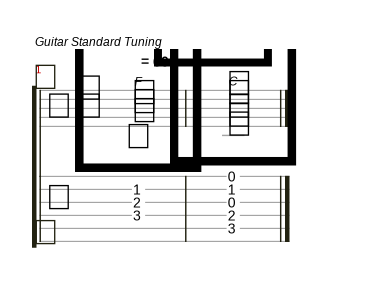
Scroll sideways for the complete score. Interactive notation loads when you ask for it. Practice audio loads separately and starts only after Play. Synthetic audio is a timing reference; it does not check your guitar or replace the instructions for stopping the strings.
Deceptive model: G7 to Am
The common V7–vi pattern substitutes Am for the expected tonic C. Am shares C and E with the C chord, but its root is A and it remains chord vi in the stated C-major key. This single move does not establish A minor as a new key.
Deceptive model: G7 to Am: score and practice
Two-bar model in stated C major, standard tuning without a capo, 4/4 at quarter-note 60 BPM: G7, then Am. Count a fresh silent 1 2 3 4 first; no count-in bar is included. Strum down once on each bar's 1 and hold through 2, 3 and 4. Two chord attacks, eight beats, eight seconds of score. After bar 2's full fourth beat, damp on the following 1, or strum G7 there to repeat continuously. If you stop and start a new guitar attempt, count a fresh silent bar. Squared inverted-U means downstroke; grouped notes do not prescribe a strum's spread. Phrase context is needed to identify a cadence.
The score contains 2 played bars at 60 BPM, without a count-in. Follow the lesson's count-in and stopping instructions when you play. The guitar staff uses the usual octave-transposing treble convention; the tab gives the physical string and fret.
The static score is available without loading the player.
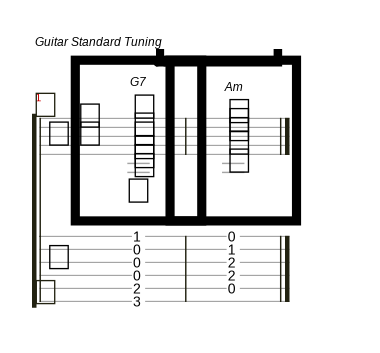
Scroll sideways for the complete score. Interactive notation loads when you ask for it. Practice audio loads separately and starts only after Play. Synthetic audio is a timing reference; it does not check your guitar or replace the instructions for stopping the strings.
Half-cadence model: F to G
Here the final chord is G, chord V, leaving the dominant unresolved at the end of the model. Stop after its full bar to compare that destination with the tonic endings. If you repeat the model immediately, that restart continues the music; it does not turn the final G into a tonic arrival.
Half-cadence model: F to G: score and practice
Two-bar model in stated C major, standard tuning without a capo, 4/4 at quarter-note 60 BPM: F, then G. Count a fresh silent 1 2 3 4 first; no count-in bar is included. Strum down once on each bar's 1 and hold through 2, 3 and 4. Two chord attacks, eight beats, eight seconds of score. For F, play only strings 4, 3 and 2. After bar 2's full fourth beat, damp on the following 1, or strum F there to repeat continuously. If you stop and start a new guitar attempt, count a fresh silent bar. Squared inverted-U means downstroke; grouped notes do not prescribe a strum's spread. Phrase context is needed to identify a cadence.
The score contains 2 played bars at 60 BPM, without a count-in. Follow the lesson's count-in and stopping instructions when you play. The guitar staff uses the usual octave-transposing treble convention; the tab gives the physical string and fret.
The static score is available without loading the player.
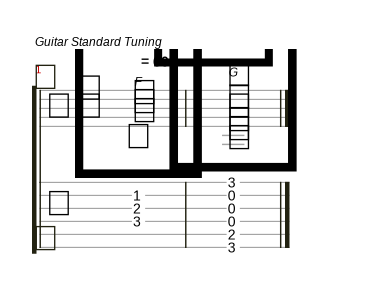
Scroll sideways for the complete score. Interactive notation loads when you ask for it. Practice audio loads separately and starts only after Play. Synthetic audio is a timing reference; it does not check your guitar or replace the instructions for stopping the strings.
Follow two notes from G7 to C
On string 2, G7 has open B3 and C has C4 at fret 1. That note rises one semitone. On string 1, G7 has F4 at fret 1 and C has open E4. That note falls one semitone.
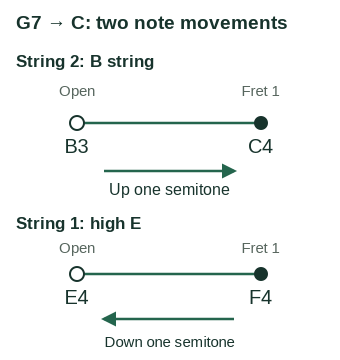
Pick the B-string pair on its own, stopping each note before the next. Stop again, then pick the high-E pair. To repeat, return to open B after stopping high E. B is the leading note of C major and F is the seventh of G7; these two movements show how they can resolve to C and E. The fretboard-note guide explains how each pitch follows from its open string and fret.
Is every G7-to-C ending a perfect authentic cadence?
In the major-key terminology used here, a strict perfect authentic cadence, or PAC, ends a phrase with V or V7 moving to I. Both chords must be in root position, and the tonic note must be in the highest melodic voice on the final tonic chord. Root position means the chord’s root is its lowest note. Other authentic endings fall under the imperfect-authentic label, IAC, in this terminology.
The guitar-only model uses G7 with G2 lowest, then C with C3 lowest and E4 highest. Although both chords are in root position, its final top note is degree 3, the third note of C major, rather than C. As a phrase-ending model, it fits an IAC rather than a strict PAC. If you accompany a singer or another instrument, inspect the ensemble melody and bass too; the highest and lowest guitar strings alone may not define the complete texture.
Check your understanding
- A stated C-major phrase ends F–G. Which cadence type fits, and does IV always have to precede that type?
- Change the final C in G7–C to Am. What common pattern results, and has the home key necessarily changed?
- Why does the guitar-only G7–C model fail the strict PAC test?
- Does a phrase boundary always require a bar of silence?
- How many attacks and beats are in each score? Where do you stop or restart?
Check your answers
- A half cadence: it ends on V, G. Other chords can precede V.
- A common deceptive pattern, V7–vi. That move alone does not prove a new home key.
- Its final C shape has E4 highest. In the stated major key, a strict PAC needs V or V7 moving to I, both chords in root position, and tonic in the highest melodic voice at the arrival.
- No. Melody, rhythm or a sustained arrival can help mark a phrase boundary without a silent bar. Check the actual musical context.
- Two chord attacks and eight quarter-note beats. After bar 2’s beat 4, damp on the following 1, or strum the first chord there for continuous repetition. For a fresh guitar attempt after stopping, count a new silent bar.
Sources and next steps
Robert Hutchinson’s Cadences introduces the four patterns and the wider meaning of deceptive resolution; his Perfect Authentic Cadence states the bass and melody conditions. Victoria Malawey’s Harmonic function and cadences gives contextual distinctions. Sean Butterfield’s Integrated Music Theory phrase and cadence lesson explains why a chord progression needs phrase context. The diagrams, guitar models and practice instructions here were prepared for IGDb.
Use the beginner chord progressions for longer counted sequences. To distinguish a temporary chord target from a new home key, continue with secondary dominants. Its D7–G–C example keeps the local target and home tonic separate.