In this lesson
A secondary dominant acts as the dominant of a non-tonic chord in the home key. In C major, D7 can lead to G: D7 is G’s dominant seventh, while G remains chord V of C. We write that relationship as V7/V, read “five-seven of five”.
This lesson keeps C major as the stated home key. You will compare Dm7 with D7, follow D7 to G and back to C, then check the notes on guitar. Start with chords in a major key if Roman numerals are new, and seventh-chord symbols if D7 and Dm7 are unfamiliar. You can do the written tasks before learning the shapes.
Change Dm7 into D7
C major contains C, D, E, F, G, A and B. Its chord on D is D minor; adding a seventh from the same scale gives Dm7: D, F, A, C. All four notes belong to C major, so this chord is diatonic to that key.
Raise F by one semitone to F♯. You now have D7: D, F♯, A, C. D, A and C stay the same; the changed third makes the triad major while its seventh stays minor.
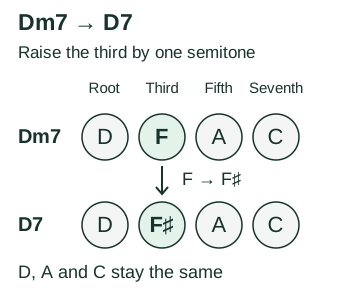
The plain 7 in D7 means a dominant seventh chord: major triad plus minor seventh, with the formula 1, 3, 5, ♭7. Dmaj7 would contain C♯ instead of C and would change this example.
Why does D7 point towards G?
Treat G as a temporary tonic, or local point of rest. The fifth degree of G major is D, and the dominant seventh on D is D, F♯, A, C. That gives D7 a dominant relationship to G.
The three chords have these roles in C major:
| Chord | Notes | Role in this C-major example |
|---|---|---|
| D7 | D, F♯, A, C | Dominant seventh of G: V7/V |
| G | G, B, D | Chord V of C, temporarily emphasised |
| C | C, E, G | Home-key tonic, I |
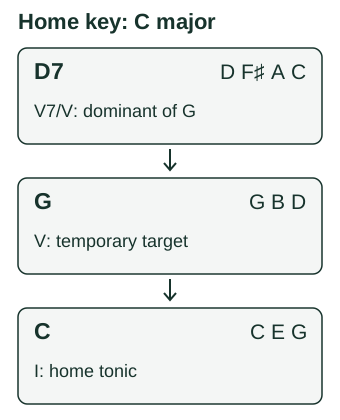
Making a non-tonic chord act briefly like a tonic is called tonicization. A major triad can also serve as a secondary dominant: D major to G can be V/V to V in C major. The seventh adds another chord tone, so keep V/V and V7/V distinct when describing the notes.
Read the slash as “of”
In V7/V, the first V7 describes the dominant seventh in the temporary key. The numeral after the slash identifies the target chord’s place in the home key. Here, the target is V of C, which is G. The whole label therefore identifies D7.
The slash has a different meaning in a chord symbol such as G/B. G/B asks for a G major chord with B as its lowest sounding note. V7/V describes harmonic function and does not give a bass-string instruction. The slash-chord lesson explains symbols such as G/B and C/E.
Find another secondary dominant
Choose a non-tonic major or minor triad in the stated key as your target. Find the note a perfect fifth above its root, then build a major triad or dominant seventh on that note. For a dominant seventh, use root, major third, perfect fifth and minor seventh. If you target the home tonic C itself, G7 to C is the ordinary V7 to I in C major.
These examples all keep C major as the home key and use a direct resolution to the stated target:
| Target chord | Its role in C | Dominant seventh leading to it | Label for that dominant |
|---|---|---|---|
| G: G, B, D | V | D7: D, F♯, A, C | V7/V |
| Am: A, C, E | vi | E7: E, G♯, B, D | V7/vi |
| Dm: D, F, A | ii | A7: A, C♯, E, G | V7/ii |
| F: F, A, C | IV | C7: C, E, G, B♭ | V7/IV |
The target can be minor even though the chord leading to it is a dominant seventh. In E7 to Am, G♯ is the leading note a semitone below A. A secondary dominant also need not introduce a sharp: C7 to F adds B♭ to the C-major setting.
This beginner procedure targets major and minor triads. It does not treat B diminished, C major’s vii°, as a temporary tonic. Keep the circle of fifths nearby to locate root relationships, but derive each chord’s complete notes separately.
Check D7, G and C on guitar
Use standard tuning, E A D G B E from string 6 to string 1, with no capo. Read the patterns from low E to high E. A number is a fret, 0 is open and x means leave that string out.
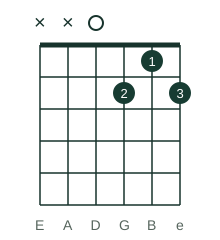
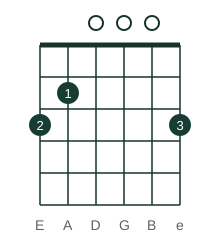
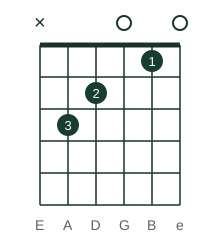
| Chord | Pattern, strings 6 to 1 | Sounding pitches, low to high |
|---|---|---|
| D7 | x x 0 2 1 2 |
D3, A3, C4, F♯4 |
| G | 3 2 0 0 0 3 |
G2, B2, D3, G3, B3, G4 |
| C | x 3 2 0 1 0 |
C3, E3, G3, C4, E4 |
Octave numbers identify the sounding pitches; middle C is C4. A grip can repeat chord tones and put them in a different order from the construction diagram. The small numbers inside the chord dots are fingers: index 1, middle 2 and ring 3.
Form each grip separately and pick its intended strings one at a time. Keep the lower two strings silent in D7 and the low E silent in C. Use the first-chord instructions for further G and C checks. Stop if playing hurts.
Then strum D7 once, let it ring briefly and gently touch all strings to stop them. Take time to form G and strum it once. Stop all strings again, form C and strum it once. Finish by stopping every string. To repeat, form D7 again and restart the same three-chord order. This is an untimed note-and-shape check, with no beat or playback to follow. Pauses let you check the grips without rushing.
Follow two notes from D7 to G
On high E, D7’s fret 2 sounds F♯4 and G’s fret 3 sounds G4. Pick those two notes in order, one at a time. The pitch rises by a semitone. On the B string, D7’s fret 1 sounds C4 and G’s open string sounds B3. Pick those in order too; this pitch falls by a semitone.
Those movements show the third and seventh of D7 resolving to notes of G. Stop each pair before restarting it. The full open grips also change the number and register of sounding notes; this is not a strict four-part voice-leading exercise. You can return to the full D7, G, C sequence after checking the two pairs.
Does an out-of-key chord mean the key has changed?
One F♯ or D7 chord does not establish a new home key. In the stated D7, G, C example, we use D7 to emphasise G briefly and then return to C. A modulation establishes a new key more broadly, with the surrounding phrase and its cadences helping confirm that new tonic.
There is no fixed number of bars that separates tonicization from modulation. A brief tonicization and a short modulation can be ambiguous. For a real song, inspect what comes before and after instead of deciding from one chord name.
Chord quality alone also does not establish function. A dominant seventh chord in a blues can have a different role, and music can delay or avoid a secondary dominant’s expected target. The direct resolutions above give you a starting method for this lesson.
Check your understanding
- Which note changes when Dm7 becomes D7?
- In C major, what chord does V7/V identify, and what is its target?
- Does V7/V ask you to put V in the bass, like G/B?
- In C major, spell V7/vi and name its target.
- Does D7 in a chord chart prove a modulation to G?
- Which two one-semitone movements occur on the highest two strings from these D7 and G shapes?
Check your answers
- F rises to F♯; D, A and C stay the same.
- D7, with notes D, F♯, A, C. Its target is G, chord V of C.
- No. Read the slash as “of”. The label describes a harmonic relationship, while G/B specifies a G chord with B lowest.
- E7: E, G♯, B, D. It leads to Am, chord vi of C.
- No. You need the musical context to decide whether G is a temporary target or an established new home key.
- High E rises from F♯4 at fret 2 to G4 at fret 3. B string falls from C4 at fret 1 to open B3.
Sources and next steps
Megan Lavengood and John Peterson’s Tonicization in Open Music Theory explains applied-chord notation, altered diatonic chords and major/minor targets (written text CC BY-SA 4.0). Robert Hutchinson’s Secondary dominants in major and minor discusses chord quality and function; his Tonicization versus modulation explains contextual ambiguity. Justin Rubin’s Secondary dominants discusses temporary emphasis, modulation and irregular resolutions (CC BY 4.0).
The guitar voicings, diagrams and untimed practice instructions were prepared for IGDb. D7 to G to C is a standard harmonic example also discussed in Open Music Theory. No source artwork, score or recording is reproduced.
For another written task, keep C as the home key and explain E7 to Am using the third G♯ and target A. Return to seventh-chord construction to check E7’s formula, or build the major-key family to see why Am is vi.