A cadential six-four adds two moving notes above the dominant bass as a phrase approaches its ending. In C major, play C/G, G, C. The bass stays on G for the first two chords while C falls to B and E falls to D. The final C brings in a C bass.
Start with triad inversions if slash chords and inversions are new. The cadences lesson shows how to find the phrase ending.
Hear the sixth and fourth fall
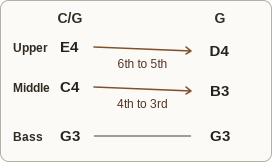
Use standard tuning with no capo. Pluck the D, G and B strings together at fret 5. They sound G3, C4 and E4. A light index-finger barre across those three strings is one way to fret them. Now play fret 5 on D, fret 4 on G and fret 3 on B. Try ring, middle and index in that order. The D string sounds G3 both times.
| Line | C/G | G |
|---|---|---|
| B string | E4, fret 5 (6th) | D4, fret 3 (5th) |
| G string | C4, fret 5 (4th) | B3, fret 4 (3rd) |
| D string | G3 at fret 5 | G3 at fret 5 |
Try the pair slowly. Listen for E falling two frets and C falling one while the low note keeps the same pitch. Next, pick each upper line on its own. Add the bass back when you can hear both changes.
The numbers 6–5 and 4–3 count intervals above the bass. The name C/G tells you the notes spell a C major chord with G lowest. Some theory books write I⁶₄ for that spelling. Others write V⁶₄–⁵₃ for the motion into G, the dominant. In this phrase, the C/G belongs to the dominant part of the ending. C/G in another progression can do a different job.
Play Dm/F, C/G, G and C
Keep your picking-hand thumb on D, index on G and middle finger on B for the first three shapes. For Dm/F, try middle on D fret 3, index on G fret 2 and ring on B fret 3. For the last C, move your thumb to A and let D stay quiet. Try index on A fret 3, ring on G fret 5 and little finger on B fret 5. This C grip uses the root and third.
| Grip | Low E to high E |
|---|---|
| Dm/F | x x 3 2 3 x |
| C/G | x x 5 5 5 x |
| G | x x 5 4 3 x |
| C | x 3 x 5 5 x |
Each x is a string to leave quiet. Practise the last change without a count first. Lift pressure from D fret 5 as you move to C and stop the old bass from ringing. Pluck the three new notes together.
Set the metronome to 60 BPM and four beats per bar. Press Start metronome and keep it visible in a separate window or on another device. Count one bar from the higher click before playing.
- In bar 1, pluck Dm/F on 1 and hold it through 4.
- In bar 2, pluck C/G on 1 and G on 3. Give each shape two beats.
- In bar 3, pluck C on 1 and hold it through 4. Damp the strings on the next 1 to stop, or play Dm/F there to repeat.
The notes stacked in the tab sound together. The score begins on the first played beat and lasts 12 seconds at 60 BPM. IGDb arranged this exercise for guitar.
Cadential six-four in C: score and practice
In 4/4 at 60 BPM, pluck three notes together for each chord. Bar 1 has Dm/F on beat 1 for four beats. Bar 2 has C/G on beat 1 and G on beat 3 for two beats each. On both chords in bar 2 the D string sounds G at fret 5. The frets on G and B drop from 5 and 5 to 4 and 3. Bar 3 starts C on beat 1, with A-string fret 3 as bass and the D string silent. Hold C through beat 4 and stop on the next 1, or play Dm/F there to repeat.
The score contains 3 played bars at 60 BPM, without a count-in. Follow the lesson's count-in and stopping instructions when you play. The guitar staff uses the usual octave-transposing treble convention; the tab gives the physical string and fret.
The static score is available without loading the player.
If part of the score is off screen, scroll sideways within the score.
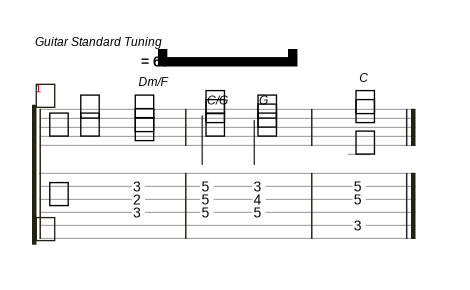
Interactive notation loads when you ask for it. Practice audio loads separately and starts only after Play. Synthetic audio is a timing reference; it does not check your guitar or replace the instructions for stopping the strings.
Check the bass and the two descending notes
Which chord has a C bass? On which beat does B appear?
The last chord is the only one with C in the bass. B sounds on beat 3 of bar 2, when the G-string fret moves from 5 to 4. D sounds with it as the B-string fret moves from 5 to 3. Both chords in that bar have G3 on D fret 5.
John Peterson traces the two resolutions in Open Music Theory. Robert Hutchinson explains the I⁶₄ spelling and its function in Music Theory for the 21st-Century Classroom.