D7sus4 replaces the F♯ in D7 with G and keeps the C. Play the two chords on the four highest strings and you can hear the difference on high E. It drops from fret 3 to fret 2. Then play G major and listen for that top note to return to G.
What does the 7 in 7sus4 mean?
In a basic 7sus4 chord, the 7 gives you a minor seventh above the root. The sus4 replaces the major third with a perfect fourth. The full chord still includes the root and perfect fifth, just as in the three-note suspended shapes.
| Chord | Formula | Notes from the root |
|---|---|---|
| Dsus4 | 1, 4, 5 | D, G, A |
| D7sus4 | 1, 4, 5, ♭7 | D, G, A, C |
| D7 | 1, 3, 5, ♭7 | D, F♯, A, C |
The C in both seventh chords is a minor seventh above D. When G moves down to F♯, the chord gains the tritone between F♯ and C. This is the third–seventh pair in D7. G is home in this exercise, and D is the fifth degree of G major. As D7 leads to G, the high E string rises by one fret from F♯ to G.
Play D7sus4, D7 and G
Use standard tuning with no capo. Read each pattern from low E to high E. An x means leave that string quiet. A 0 means play it open.
| Chord | Pattern, strings 6 to 1 | High E |
|---|---|---|
| D7sus4 | x x 0 2 1 3 |
Fret 3, G4 |
| D7 | x x 0 2 1 2 |
Fret 2, F♯4 |
| G | 3 2 0 0 0 3 |
Fret 3, G4 |
Start with open D7. Put index on B-string fret 1, middle on G-string fret 2 and ring on high-E fret 2. Add your little finger at high-E fret 3 to make D7sus4. If both fingers feel cramped on that string, use your ring finger at fret 3 and move it down to fret 2 for D7. Pick the four intended strings separately. Both shapes share the notes D3, A3 and C4 on strings 4, 3 and 2.
For G, put middle on low-E fret 3, index on A-string fret 2 and ring on high-E fret 3. Play all six strings. The bass is now G2, and the top note is G4. First pick the high-E note alone in each grip. Listen for G, F♯, G. Then play all three chords to hear the same line with the bass and inner notes.
Set a metronome to 60 BPM with four beats per bar. If you use the IGDb metronome, keep it visible in a separate window beside the score or on another device. Count four clicks before you start. In bars 1 and 2, downstrum from D through high E on beat 1. In bar 3, downstrum G from low E through high E on beat 1. Let each chord ring through beat 4. On the 1 after G, touch the strings to stop them ringing. To repeat, silence low E and A just before that click and downstrum D7sus4 from the D string on 1.
D7sus4, D7 and G: score and practice
Three bars at 60 BPM in 4/4. Play D7sus4, D7 and G. Use one downstrum on beat 1 and let each chord ring through 4. Strum strings 4 through 1 in the first two bars and all six strings in the third. The high E string plays fret 3, fret 2 and fret 3. To stop, touch the strings on the next 1. To repeat, silence low E and A just before that click and downstrum D7sus4 from the D string on 1.
The score contains 3 played bars at 60 BPM, without a count-in. Follow the lesson's count-in and stopping instructions when you play. The guitar staff uses the usual octave-transposing treble convention; the tab gives the physical string and fret.
The static score is available without loading the player.
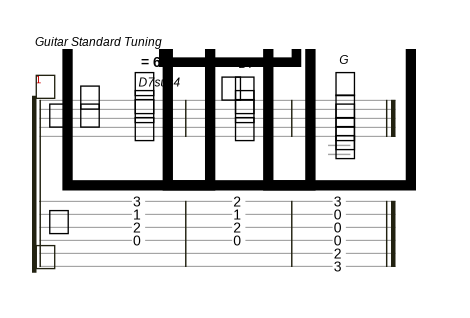
Scroll sideways for the complete score. Interactive notation loads when you ask for it. Practice audio loads separately and starts only after Play. Synthetic audio is a timing reference; it does not check your guitar or replace the instructions for stopping the strings.
The grip table gives sounding pitches. Standard guitar notation writes them an octave higher. Playback starts with D7sus4, so count in separately when you play along with a click.
Check which note moves first
Which note replaces F♯ in D7sus4? Does the C move when you change to D7?
G replaces F♯. The C stays at B-string fret 1. To change from D7sus4 to D7, move high E from fret 3 to fret 2 and strum again.
In G major, D7sus4 can also go straight to G. Try leaving out the middle bar and listen to how the ending changes. For more ways a dominant can lead into an ending, see the guitar cadence lesson.
Further reading. Robert Hutchinson explains how sus and 11 are used in chord symbols. Berklee Online discusses the sound and function of V7sus4. The guitar exercise is IGDb’s own.