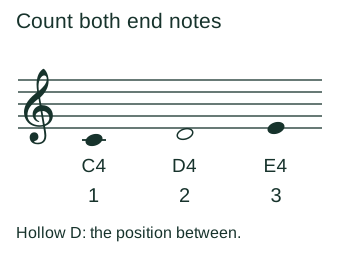
An interval describes the distance between two pitches. Its number tells you how many letter names it spans, counting both ends. C up to E is a third: C is one, D is two and E is three.
This number is called the generic interval. The specific interval adds a quality, such as major or minor.
Count letters, including both ends
These examples go upwards from C to notes within the next octave.
| Notes | Letters counted | Generic interval |
|---|---|---|
| C to the same C | C | Unison, also called a first or prime |
| C up to D | C, D | Second |
| C up to E | C, D, E | Third |
| C up to F | C, D, E, F | Fourth |
| C up to G | C, D, E, F, G | Fifth |
| C up to A | C, D, E, F, G, A | Sixth |
| C up to B | C, D, E, F, G, A, B | Seventh |
| C up to the next C | C, D, E, F, G, A, B, C | Octave |
An octave needs the higher C; repeating the starting pitch gives a unison. On a staff, count every line and space between the notes, including their starting and ending positions.
Accidentals keep the letter count
C up to E, E flat or E sharp is a third in each case. The accidentals change the pitch distance but keep the letters C and E. You need the quality to distinguish those thirds.
Fret numbers alone cannot tell you a generic interval. They show pitch distance on a string; the note spelling supplies the letter count.
Check it on the guitar
In standard tuning, play C at fret 1 of string 2, then D at fret 3 of the same string. The ascending letter count C, D gives a second. C at fret 1 to E at fret 5 gives a third.
Now count upwards from G to B before reading on. G, A, B gives a third too, even though the starting letter has changed.
Definitions checked against Open Music Theory: intervals and dyads and Introduction to intervals, by Robert Hutchinson.