Play B♭ on the G string and G♯ on high E. Move the B♭ down one fret and the G♯ up one. You’ll land on two As an octave apart. Add D on the B string before those moves and you have an Italian augmented sixth in D minor. In this exercise it leads to A major, then home to Dm.
Where the name comes from
The Italian augmented sixth contains the lowered sixth, the tonic and the raised fourth. In D minor those notes are B♭, D and G♯. B♭ already belongs to D natural minor. G♯ raises the scale’s G by a semitone.
Count the letters from B to G and you get a sixth. B♭ up to G♯ spans ten semitones, one more than a major sixth. The spelling shows which way the notes move. B♭ drops to A while G♯ rises to the A an octave higher. See how to name intervals if you want to work through the count.
Play the three grips
Use standard tuning with no capo. Read the frets from low E to high E. A dash means leave the string quiet. A zero means play it open.
| Grip | Frets, strings 6 to 1 | Notes, low to high |
|---|---|---|
| Italian sixth (It+6) | – – – 3 3 4 |
B♭, D, G♯ |
| A | – – – 2 2 5 |
A, C♯, A |
| Dm | – – 0 2 3 1 |
D, A, D, F |
For the first two grips, pluck only G, B and high E. Try using the index finger across G and B, with the ring finger on high E fret 4 for It+6. For A, move the index down a fret and use the little finger on high E fret 5. Practise each grip on its own if the change is awkward. The A grip leaves out its fifth, E. You can hear its major third as the note on the B string moves from D to C♯. Add open D for the last grip.
Hear the octave open up
Set a metronome to 60 BPM with four beats per bar. Keep the metronome visible beside the lesson or use a separate device. Count four clicks before you start. Play It+6, A and Dm in that order. Sound each grip on beat 1 and let it ring through beat 4. On the next 1, damp all four strings to finish. To repeat, touch the open D string with your picking-hand thumb as you pluck the first grip on that same click.
Italian sixth to A to D minor: score and practice
In 4/4 at 60 BPM, count four beats before starting. Play once on beat 1 of each bar and hold through beat 4. Bar 1 is It+6 on G, B and high E at frets 3, 3 and 4. Bar 2 is A on the same strings at frets 2, 2 and 5. Bar 3 is Dm on D, G, B and high E at frets 0, 2, 3 and 1. On the next 1, damp all four strings to finish. To repeat, mute open D as you pluck bar 1 again on that same beat.
The score contains 3 played bars at 60 BPM, without a count-in. Follow the lesson's count-in and stopping instructions when you play. The guitar staff uses the usual octave-transposing treble convention; the tab gives the physical string and fret.
The static score is available without loading the player.
If part of the score is off screen, scroll sideways within the score.
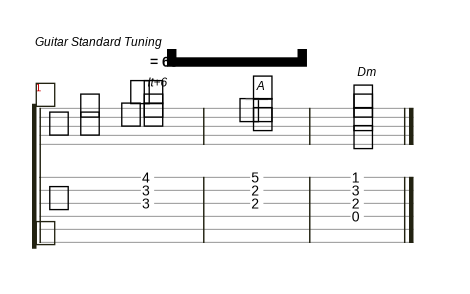
Interactive notation loads when you ask for it. Practice audio loads separately and starts only after Play. Synthetic audio is a timing reference; it does not check your guitar or replace the instructions for stopping the strings.
Isolate the G and high E strings if you have trouble hearing the octave. Play the two notes of the first shape together, then the same two strings of the second shape. On G, fret 3 falls to fret 2. On high E, fret 4 rises to fret 5. The B string is quiet for this two-note check. Then add that string back to hear D drop to C♯ as the chord moves to A major.
Which two notes move to A?
B♭ on the G string falls to A. G♯ on high E rises to A an octave above it.
Try the Neapolitan sixth on guitar for another chromatic chord that prepares the dominant in a minor key.
Further reading
- Justin Rubin describes the chord’s three basic pitches and how it resolves to the dominant. University of Minnesota, Augmented Sixth Chords
- The voice-leading section shows how the augmented sixth expands to an octave. Multimodal Musicianship, Augmented sixth chords