In A minor, play Bdim/D and move the note on the G string from fret 4 to fret 3. You’ve changed B to B♭. The other notes stay put, including the open D at the bottom. That gives you B♭/D, the first-inversion Neapolitan chord in A minor. Try it before E major and hear where the phrase goes.
Build B♭/D from B diminished
In A natural minor, the triad on the second scale degree is B–D–F. Lower B to B♭ and keep D and F. B♭–D–F makes a major triad on the lowered second degree, written ♭II.
Put D, the third of B♭ major, in the bass to get the first inversion. It’s called the Neapolitan sixth and written N6 or ♭II6. The 6 refers to the interval from the bass D to the B♭ above it. The guitar chord symbol B♭/D gives the same bass instruction. See how to read slash chords for more shapes with the third in the bass.
Find the four grips
Use standard tuning with no capo. Read each row from low E to high E. A dash means leave the string quiet. A zero means play it open.
| Chord | Frets, strings 6 to 1 | Bass |
|---|---|---|
| Bdim/D | – – 0 4 3 1 |
D |
| B♭/D | – – 0 3 3 1 |
D |
| E | – – 2 1 0 0 |
E |
| Am | – 0 2 2 1 0 |
A |
For Bdim/D, try your little finger on G fret 4, ring on B fret 3 and index on high E fret 1. Let open D ring. For B♭/D, replace the little finger with your middle finger on G fret 3. Check the four strings individually before strumming. Start at the D string for the first three shapes. Start at open A for Am.
Hear each shape lead to E
Set a metronome to 60 BPM with four beats per bar. Keep it visible in a separate window or use another device. Count four clicks before you start. On beat 1 of each bar, strum the written chord once and let it ring through beat 4. Damp the final Am on the next 1. Use that click to start a fresh four-count for the second pass.
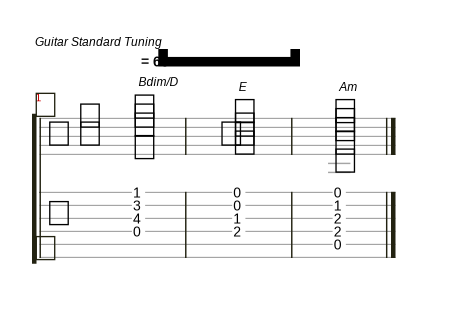
Pass 1. Play Bdim/D, E and Am, one chord per bar.
Pass 1: B diminished to E to Am: score and practice
In 4/4 at 60 BPM, count four beats before you start. In bar 1, play Bdim/D: use D, G, B and high E at frets 0, 4, 3, 1. In bar 2, play E using those same strings at frets 2, 1, 0 and 0. In bar 3, play Am from the A string at frets 0, 2, 2, 1 and 0. Strum each chord on beat 1 and let it ring through beat 4. Stop after Am on the next 1.
The score contains 3 played bars at 60 BPM, without a count-in. Follow the lesson's count-in and stopping instructions when you play. The guitar staff uses the usual octave-transposing treble convention; the tab gives the physical string and fret.
The static score is available without loading the player.
If part of the score is off screen, scroll sideways within the score.
Interactive notation loads when you ask for it. Practice audio loads separately and starts only after Play. Synthetic audio is a timing reference; it does not check your guitar or replace the instructions for stopping the strings.
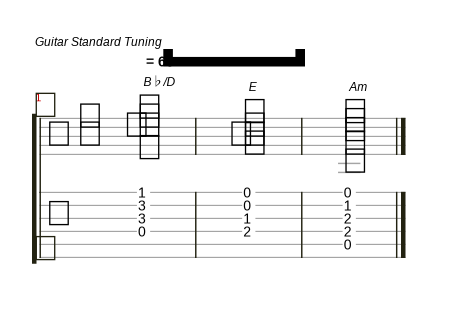
Pass 2. Play B♭/D, E and Am with the same count. Listen for the lower note on the G string at the start.
Pass 2: Neapolitan sixth to E to Am: score and practice
In 4/4 at 60 BPM, count four beats before you start. In bar 1, play B♭/D: use D, G, B and high E at frets 0, 3, 3, 1. In bar 2, play E using those same strings at frets 2, 1, 0 and 0. In bar 3, play Am from the A string at frets 0, 2, 2, 1 and 0. Strum each chord on beat 1 and let it ring through beat 4. Stop after Am on the next 1.
The score contains 3 played bars at 60 BPM, without a count-in. Follow the lesson's count-in and stopping instructions when you play. The guitar staff uses the usual octave-transposing treble convention; the tab gives the physical string and fret.
The static score is available without loading the player.
If part of the score is off screen, scroll sideways within the score.
Interactive notation loads when you ask for it. Practice audio loads separately and starts only after Play. Synthetic audio is a timing reference; it does not check your guitar or replace the instructions for stopping the strings.
In the second pass, the G string goes from fret 3 to fret 1 to fret 2. That’s B♭–G♯–A. G♯ leads into A, and the low notes move D–E–A. The B♭/D chord sets up E before the phrase lands on Am. That’s its predominant job in this example.
What changes between the two openings?
The G-string fret drops from 4 to 3, changing B to B♭. Both chords start on open D and keep the same notes on the B and high E strings.
Next, hear C and E fall over a G bass in a C-major cadence.
For a different approach to the dominant, play an Italian augmented sixth in D minor. Hear B♭ and G♯ move in opposite directions to A.
Further reading
- Justin Rubin explains the usual first-inversion shape and how its voices move to the dominant. University of Minnesota, Neapolitan Chord
- Integrated Music Theory compares N6 with the diatonic chords that can prepare V. Neapolitan chords