Play Bm7♭5, E7 and Am. The roots B, E and A are the second, fifth and first degrees of A minor. That gives you a minor ii–V–i. On the G string, the middle chord lowers A to G♯. Listen for that note rising back to A as the Am chord arrives.
Build the three chords in A minor
Bm7♭5 contains B, D, F and A. All four notes belong to A natural minor. Starting on B, stack alternate scale notes to get a diminished triad and a minor seventh. That makes Bm7♭5 the half-diminished chord on degree 2, written iiø7. The half-diminished lesson shows the grip and how its seventh differs from Bdim7.
E7 contains E, G♯, B and D. Raise the G of A natural minor by a semitone to get G♯, the leading tone of A harmonic minor. That note gives E7 its major third and sits a semitone below A. Am contains A, C and E. It is the tonic.
Jazz examples often use a minor seventh chord on degree 1. This exercise uses the open Am triad so you can keep your attention on the two moving lines.
Follow the G and B strings
Read the shapes from the thickest string to the thinnest. An x means leave that string out. Use standard tuning.
| Chord | Shape | G string | B string |
|---|---|---|---|
| Bm7♭5 | x 2 3 2 3 x | Fret 2, A | Fret 3, D |
| E7 | 0 2 0 1 3 0 | Fret 1, G♯ | Fret 3, D |
| Am | x 0 2 2 1 0 | Fret 2, A | Fret 1, C |
Try the G-string line by itself. Play frets 2, 1 and 2. Then try the B-string line at frets 3, 3 and 1. D repeats across the first two chords and drops a whole step to C on Am. You can hear both of those moves in the full chords below.
Give each chord four beats
For Bm7♭5, use index on A, ring on D, middle on G and little finger on B. Strum from A through B and leave both E strings quiet. For E7, fret A at 2, G at 1 and B at 3, then strum all six strings. For Am, fret D and G at 2 and B at 1, then strum the five strings from A.
Set the metronome to 80 BPM and four beats per bar. Keep its page visible. Count four clicks and start on the next 1. Strum Bm7♭5 once and let it ring through 4. Stop those notes as you change to E7 on the next 1. On bar 3’s first click, damp E7, including the open low E, and strum Am from the A string. Let Am ring through 4.
On the 1 after Am, damp the strings to stop. To repeat, stop the Am notes as you return to Bm7♭5 and strum the four middle strings on that click. Try the two shape changes without a click first if you need time to get all the notes clean.
Bm7 flat five, E7 and Am: score and practice
At 80 BPM in 4/4, play one chord on 1 in each bar and hold it through 4. For Bm7 flat five, play A-string fret 2, D-string fret 3, G-string fret 2 and B-string fret 3. E7 uses 0, 2, 0, 1, 3 and 0 across strings 6 to 1. Am starts on open A and uses 0, 2, 2, 1 and 0 across strings 5 to 1. Damp the old chord at each change. On the first click of bar 3, stop E7, including the open low E, and strum Am from the A string. On the 1 after Am, damp and stop or damp and restart with the four middle strings of Bm7 flat five.
The score contains 3 played bars at 80 BPM, without a count-in. Follow the lesson's count-in and stopping instructions when you play. The guitar staff uses the usual octave-transposing treble convention; the tab gives the physical string and fret.
The static score is available without loading the player.
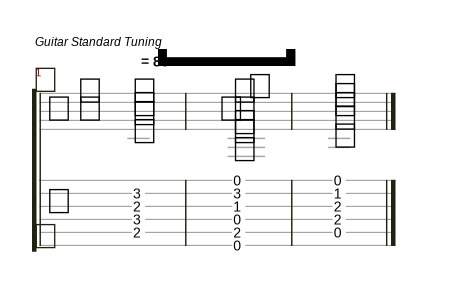
Scroll sideways for the complete score. Interactive notation loads when you ask for it. Practice audio loads separately and starts only after Play. Synthetic audio is a timing reference; it does not check your guitar or replace the instructions for stopping the strings.
Repeat this 3-bar score starts again at Bm7♭5. Use the metronome for a count-in when you play the exercise yourself.
Check the two lines
Which note on the G string leads into A, and what happens on the B string as Am arrives?
G♯ at G-string fret 1 rises to A at fret 2. D at B-string fret 3 drops to C at fret 1.
For the same harmonic idea with one fewer chord, compare E and Em before Am.
Sources
Open Music Theory gives the minor ii–V with a half-diminished chord and dominant seventh and explains the raised leading tone in harmonic minor. Learn Jazz Standards describes the same chord qualities in jazz and shows variations on the tonic. The three-bar exercise and its guitar voicings were assembled for IGDb. ii–V–I · Minor Scales, Scale Degrees, and Key Signatures · Mastering the Minor 2-5-1