In this lesson
A natural minor gives these seven triads: Am, Bdim, C, Dm, Em, F and G. A minor key can also use E major: raising G to G♯ changes Em’s notes E, G and B into E, G♯ and B. The tonic chord can remain Am, containing A, C and E.
This lesson shows how to build that chord family and check the Em/E difference on guitar. You can do the written tasks without an instrument. For the playing task, use standard tuning, E A D G B E from string 6 to string 1, with no capo. The first-chord lesson gives finger placement for Em, E and Am; triads explains major, minor and diminished qualities.
Build chords from A natural minor
A natural minor uses A, B, C, D, E, F and G. Its ascending steps are tone, semitone, tone, tone, semitone, tone, tone, returning to A an octave above. A tone spans two semitones. The minor-scale lesson compares this pattern with harmonic and melodic minor.
To build a triad, start on one scale note, skip the next, take the following note, then skip and take once more. From A, take A, skip B, take C, skip D and take E. That gives Am: A, C and E. Continue through the next octave when you run out of notes.
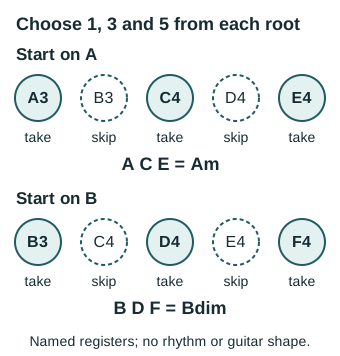
Starting on B gives B, D and F. B to D spans three semitones, while B to F spans six. That makes B diminished, written Bdim or B°. Am has three semitones from A to C and seven from A to E, so it is minor. The same skip-and-take process gives different qualities because scale steps have different sizes.
The seven chords in A natural minor
| Root’s scale degree | Chord notes | Chord name | Roman numeral |
|---|---|---|---|
| 1 | A C E | A minor (Am) | i |
| 2 | B D F | B diminished (Bdim or B°) | ii° |
| 3 | C E G | C major (C) | III |
| 4 | D F A | D minor (Dm) | iv |
| 5 | E G B | E minor (Em) | v |
| 6 | F A C | F major (F) | VI |
| 7 | G B D | G major (G) | VII |
These are the diatonic triads of A natural minor: all their notes belong to that scale. Their quality pattern is minor, diminished, major, minor, minor, major, major. This table describes natural minor; it does not list every chord available in an A-minor piece.
Read the numerals in the stated minor key
Here, the numeral counts the chord root’s degree from A. Lowercase means minor, uppercase means major, and the small circle means diminished. Thus iv is D minor, and VII is G major. The scale-degree reference distinguishes a single degree, such as E, from a whole chord built on it, such as Em.
This lesson counts III, VI and VII within the minor key. You may meet charts that compare every root with the parallel major scale and write these as ♭III, ♭VI and ♭VII. In A minor those labels still identify C, F and G major. Check the chart’s convention before translating its numerals. Neither convention tells you which guitar voicing or rhythm to use.
C major and A natural minor share seven note names, so they produce the same seven triads. Their degree numbers change: Am is vi in C major and i in A minor. Their tonics differ too. The relative and parallel minor lesson explains that relationship; sharing a chord family does not make the two keys interchangeable.
Why can A minor use E major?
Compare the triads on E:
| Chord | Root | Third | Fifth | Third above E |
|---|---|---|---|---|
| Em | E | G | B | 3 semitones, minor |
| E major | E | G♯ | B | 4 semitones, major |
G is degree 7 of A natural minor. Raising it one semitone to G♯ gives a note one semitone below A, called the leading note or leading tone. G natural is two semitones below A and is called the subtonic.
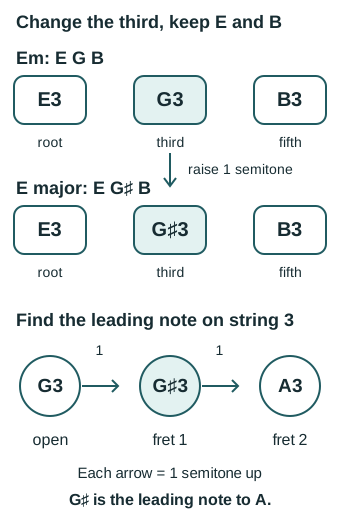
In A minor, Em is minor v and E major is major V. V to i is E major to Am. The raised seventh supplies a leading note that can rise to the tonic, a common feature of tonal minor harmony. It does not require every G in a piece to become G♯, or every minor piece to use E major.
The collection A, B, C, D, E, F, G♯ is A harmonic minor. It explains the notes in E major alongside Am, but a minor key can vary its sixth and seventh degrees with the melody and harmony. The tonic triad remains A, C and E in this comparison. Raising G to G♯ does not turn it into A major, which would need C♯.
Check Em, E and Am on guitar
Read the compact shapes from low E, string 6, to high E, string 1. 0 means open and x means leave that string out. The pitch numbers identify sounding octaves, with middle C called C4. The small numbers inside the diagram dots identify fretting fingers.
| Chord | Strings 6 to 1 | Notes sounded, low to high |
|---|---|---|
| Em | 0 2 2 0 0 0 |
E2 B2 E3 G3 B3 E4 |
| E major | 0 2 2 1 0 0 |
E2 B2 E3 G♯3 B3 E4 |
| Am | x 0 2 2 1 0 |
A2 E3 A3 C4 E4 |
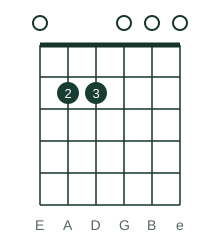
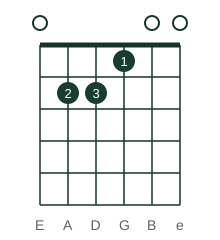
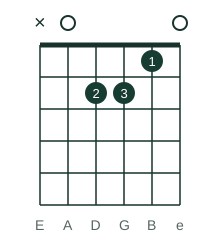
Work without a beat, allowing time to place each shape:
- Form Em. Pick strings 6, 5, 4, 3, 2 and 1 once each, slowly. Check the open G string in particular. Then gently touch all six strings with your plucking hand to stop them.
- Keep A and D at fret 2, and add your index finger to G at fret 1 for E major. Pick strings 6 through 1 once each, then stop all six. The G-string pitch has risen from G3 to G♯3; the other five positions stay the same.
- Form Am using the first-chord instructions. Pick strings 5, 4, 3, 2 and 1 once each, leaving low E out. Stop all sounding strings. Its three different note names are A, C and E, even though the shape sounds five strings.
To repeat, return to Em after stopping the strings and begin step 1 again. These are separate shape checks, with no required tempo or note length. Take breaks and stop if playing hurts.
Now isolate the leading-note relationship on string 3. Keep the other strings quiet. Pluck open G3, stop it, fret 1 and pluck G♯3, then stop it. Move to fret 2 and pluck A3, then stop. Each move up one fret raises the pitch one semitone. Return to open G after stopping A if you want another pass. The fretboard-note lesson shows how to derive each pitch from its open string.
The three-note task demonstrates a possible G♯-to-A movement. It does not prescribe voice leading for every string in the full chord shapes. For counted strumming, use the existing Em/E exercise after the shapes feel comfortable.
Is Em wrong in an A-minor song?
No. Em belongs to the natural-minor family, while E major uses the raised seventh. Both can occur in A minor. Follow the chord written for the music you are playing; this table is a way to explain the options, not a reason to replace Em automatically.
A chord list or key signature alone may not establish a piece’s key. This lesson states A minor so you can practise the derivation. Its minor-key numerals describe relationships to A as tonic; identifying a tonic in unfamiliar music needs the melody and harmony in context.
Check your understanding
- Build the triad on D using only A natural minor’s notes. What is its numeral?
- Which note changes when Em becomes E major?
- In A minor, what are v to i and V to i?
- Does E major make the tonic chord A major?
- Which of G3, G♯3 and A3 is the leading note to A, and where is it on string 3?
Answers and note checks
- D F A: D minor, iv.
- G rises one semitone to G♯. E and B remain.
- v to i is Em to Am; V to i is E major to Am. Uppercase V marks the major chord.
- No. Am remains A C E here; A major would contain A C♯ E.
- G♯3, at fret 1. It is one semitone below A3 at fret 2; open G3 is two semitones below A3.
Continue with chords in a major key to compare the quality patterns, or revisit the minor-scale forms to work through raised sixth and seventh degrees in D minor.
Source notes
Samuel Brady, Chelsey Hamm, Megan Lavengood and Kris Shaffer’s Roman Numerals in Open Music Theory explains chord-quality labels and how raising the seventh in minor changes v to V. Chelsey Hamm and Bryn Hughes’s Minor Scales, Scale Degrees, and Key Signatures distinguishes minor scales from minor keys and explains the leading note. The book is available under CC BY-SA 4.0. Robert Hutchinson’s Diatonic Chords in Minor discusses the extra chord choices created by variable sixth and seventh degrees.
Open Music Theory’s modal pop/rock discussion also uses flat-III, flat-VI and flat-VII labels. The open-position fingerings follow Fender’s Em instructions and the finger-placement sections of D’Addario’s Am and E lesson. The tables, pitch derivations, diagrams and untimed tasks were prepared for this lesson. No source score, song or artwork is reproduced.