In this lesson
A half-diminished seventh chord has a diminished triad and a minor seventh. A fully diminished seventh chord has the same triad and a diminished seventh. On B, the notes are B D F A for half-diminished, or B D F A♭ for fully diminished. The seventh moves down one semitone.
Half-diminished is commonly written m7♭5 or ø7; fully diminished is written dim7 or °7. This lesson compares their notes and two guitar shapes. You can complete the written checks without an instrument. For playing, use standard tuning, E A D G B E from string 6 to string 1, with no capo.
Build both chords from the same triad
A diminished triad contains a root, minor third and diminished fifth: 1, ♭3, ♭5. Above B, those notes are B, D and F. They sit 0, 3 and 6 semitones above the root.
Add A, a minor seventh above B, for Bm7♭5. Add A♭, a diminished seventh above B, for Bdim7. Each chord has four different notes. “Half” does not mean half as many notes or strings.
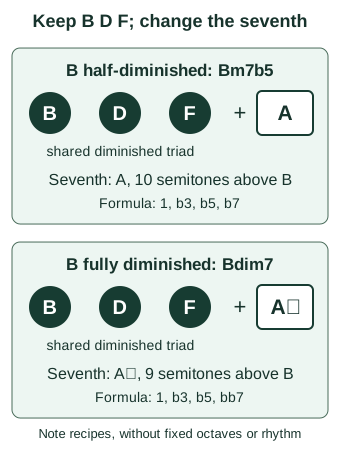
| Chord quality | Formula | Semitones above root | Notes on B |
|---|---|---|---|
| Half-diminished seventh | 1, ♭3, ♭5, ♭7 | 0, 3, 6, 10 | B D F A |
| Fully diminished seventh | 1, ♭3, ♭5, ♭♭7 | 0, 3, 6, 9 | B D F A♭ |
The formulas use the major scale on the chord’s root as a reference. B major is B C♯ D♯ E F♯ G♯ A♯. Lower its third and fifth one semitone each: D♯ becomes D, and F♯ becomes F. Its seventh A♯ becomes A when lowered once, or A♭ when lowered twice. A flat sign in a formula describes a lowering; it does not require the resulting note name to contain a flat.
Why the fully diminished formula has a double flat
A major seventh spans eleven semitones. Lower it once for a minor seventh of ten semitones; lower it again for a diminished seventh of nine. Thus ♭♭7 means two semitones below the major seventh, or one below the minor seventh.
Keep the root–third–fifth–seventh letters. For a C-root chord, those letters are C E G B. Cm7♭5 is C E♭ G♭ B♭, while Cdim7 is C E♭ G♭ B♭♭. B♭♭ sounds at the same pitch as A in equal temperament, but its B spelling identifies a seventh above C. C to A has a sixth’s letter count.
The interval reference explains how letter count and semitone distance work together. The accidentals guide explains double sharps and double flats.
Read the whole chord symbol
Bm7♭5, Bm7b5 and Bø7 are common ways to write B half-diminished seventh. Start with Bm7, B D F♯ A, and lower its fifth F♯ to F. Its minor seventh A stays in place. The slash through ø distinguishes the half-diminished sign from the plain circle °.
You can read Bm7♭5 aloud as “B minor seven flat five”, or Bø7 as “B half-diminished seventh”. Bdim7 is “B diminished seventh”.
Bdim7 and B°7 mean B fully diminished seventh: B D F A♭. The 7 names the chord’s seventh; it does not mean fret 7 or seven notes. Here, the diminished sign describes both the triad and the seventh.
In this site’s triad lessons, Bdim or B° means the three-note B D F triad. Chord shorthand varies, so check the chart’s convention or its written notes when a symbol is ambiguous. Writing dim7 or m7♭5 makes this comparison explicit.
A chord symbol names a chord’s notes and quality. It does not by itself establish the key or tell you to substitute one of these chords for the other. To compare major, dominant and minor sevenths first, use the seventh-chord lesson.
Compare two four-string guitar shapes
Read these patterns from low E, string 6, to high E, string 1. x means leave that string out. Play only A, D, G and B, strings 5, 4, 3 and 2, keeping both outer E strings silent. The chord-diagram guide explains the grids and finger numbers.
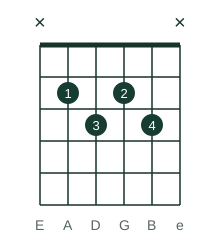
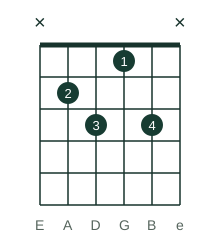
| Chord | Strings 6 to 1 | Sounding notes on strings 5, 4, 3, 2 |
|---|---|---|
| Bm7♭5 | x 2 3 2 3 x |
B2 F3 A3 D4 |
| Bdim7 | x 2 3 1 3 x |
B2 F3 A♭3 D4 |
These octave numbers name sounding pitches, with middle C called C4. The shapes arrange the chord tones as root, fifth, seventh, third. You can rearrange chord tones without changing which four note names belong to the chord.
Only the G-string pitch changes: fret 2, A3, moves down to fret 1, A♭3. B, D and F remain. Your fingers rearrange between the suggested grips, so one changed pitch is not a promise of a one-finger move. Diagram finger numbers are 1 index, 2 middle, 3 ring and 4 little finger. These are example fingerings; use the written note checks if the grips are not comfortable. Release between attempts and stop if playing hurts.
Check the notes without a beat
Take as long as you need to place each grip. This original task has no required tempo or note length:
- Form Bm7♭5. Pick strings 5, 4, 3 and 2 once each, checking B2, F3, A3 and D4. Gently touch all sounding strings with your plucking hand to stop them before changing shape.
- Form Bdim7. Pick strings 5, 4, 3 and 2 once each, checking B2, F3, A♭3 and D4. Stop all sounding strings again.
- Keep the other strings quiet. On string 3 alone, fret 2 and pluck A3 once; stop it. Fret 1 and pluck A♭3 once; stop it. This isolates the changed seventh.
One pass has ten separate note attacks: four, four, then two. To repeat, stop the strings, return to the Bm7♭5 grip and begin step 1 again. If you pause to adjust, restart from step 1 after stopping the strings. There is no counted change or extra strum between steps. The fretboard-note guide shows how to derive each pitch from an open string.
Check your understanding
- Which three notes do Bm7♭5 and Bdim7 share?
- Which seventh belongs to each, and what changes on the G string?
- How far below a major seventh is a diminished seventh?
- Spell Cm7♭5 and Cdim7 using the letters C E G B.
- How many notes do you pick in one complete task, and how do you restart?
Answers and note checks
- B D F: root, minor third and diminished fifth.
- Bm7♭5 has A; Bdim7 has A♭. On string 3, fret 2 moves to fret 1, lowering the pitch one semitone.
- Two semitones. It is one semitone below a minor seventh.
- Cm7♭5 is C E♭ G♭ B♭. Cdim7 is C E♭ G♭ B♭♭; B♭♭ is enharmonic with A in equal temperament.
- Ten separate attacks. Stop the strings, return to Bm7♭5 and begin step 1 again without a time limit.
For a next written task, use D major, D E F♯ G A B C♯, to derive Dm7♭5 and Ddim7. Keep the letters D F A C and apply each formula before finding a guitar shape.
Check the D-root spellings
Dm7♭5 is D F A♭ C: 0, 3, 6 and 10 semitones above D. Ddim7 is D F A♭ C♭: 0, 3, 6 and 9 semitones. C♯ is D major’s seventh; lowering it once gives C, and lowering it twice gives C♭. C♭ sounds at the same pitch as B in equal temperament, while keeping the seventh’s letter C.
Revisit triads if the diminished fifth needs more work, or compare chords in a minor key to see a diminished triad within a chord family.
Source notes
Chelsey Hamm’s Seventh Chords in Open Music Theory explains the diminished triad plus minor or diminished seventh, and spelling chords from a major-key reference. Megan Lavengood’s Chord Symbols gives half-diminished and diminished symbols and explains variation in chord shorthand. The book is licensed under CC BY-SA 4.0, except where separately noted. Robert Hutchinson’s Introduction to Seventh Chords explains adding another third to a triad and names the five common seventh-chord qualities.
The B-root comparison, guitar fingerings, diagram, pitch derivations and untimed task were prepared for this lesson. No source score, song, recording or artwork is reproduced.