Play a D minor chord, then lower the note on the B string by one fret at a time. Keep the other three notes in place. The chords are Dm, Dm(maj7), Dm7 and Dm6. The line you hear inside them is D–C♯–C–B. This is one form of a minor line cliché.
Hear the movement on one string
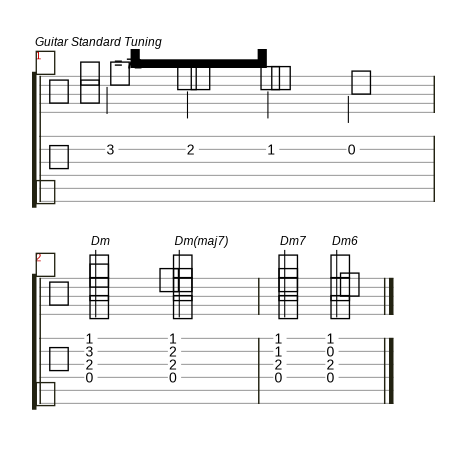
Use standard tuning with no capo. On the B string, play frets 3, 2, 1, open. Each step is one semitone. Let each note sound until you pick the next one. Listen to the last step from C at fret 1 to the open B, then stop the string.
The four notes sit between the A on the G string and the F on the high E string when you add the chords. Play the B-string line alone once more and listen for it in the full shapes.
Add the other three strings
Use the top four strings, D–G–B–high E. Leave low E and A quiet. Keep D open, keep G at fret 2 and keep high E at fret 1. Those strings sound D, A and F each time. Change only the B-string position.
| Chord | Frets, D to high E | Note on B |
|---|---|---|
| Dm | 0 2 3 1 |
D |
| Dm(maj7) | 0 2 2 1 |
C♯ |
| Dm7 | 0 2 1 1 |
C |
| Dm6 | 0 2 0 1 |
B |
Start with your middle finger on G fret 2, index on high E fret 1 and ring finger on B fret 3. Move the ring finger to B fret 2 for Dm(maj7). For Dm7, let the index cover both B and high E at fret 1. For Dm6, fret high E on its own again and check that the open B rings clearly. Pick the four strings one at a time to check each shape before strumming them together.
The m in Dm(maj7) tells you the third is still F. The maj7 refers to C♯, a major seventh above D. Lower C♯ one fret for C, the minor seventh that gives Dm7 its name. Lower C one more fret to B, the major sixth in Dm6. The seventh chord lesson shows how to work out chord quality from the third and seventh.
Play a counted pass
Count four beats per bar. Set the metronome to 72 BPM if you want a click on every beat. Rehearse the shape changes slowly before adding the click.
- Bar 1. Pick the B string four times. Play fret 3 on beat 1, fret 2 on beat 2, fret 1 on beat 3 and open B on beat 4.
- Bar 2. Strum Dm on beat 1, then Dm(maj7) on beat 3. Let each chord ring for two beats. Start the downstroke on the D string each time.
- Bar 3. Strum Dm7 on beat 1 and Dm6 on beat 3. Let the last chord ring through beat 4. Stop all four strings on the following 1 before you start another pass.
A descending line inside D minor: score and practice
In 4/4 at 72 BPM, play B-string frets 3, 2, 1 and open on beats 1, 2, 3 and 4 of the first bar. Use strings D, G, B and high E from bar 2. Play frets 0, 2, 3 and 1 on beat 1, then 0, 2, 2 and 1 on beat 3. In bar 3, play 0, 2, 1 and 1 on beat 1, then 0, 2, 0 and 1 on beat 3. Each chord lasts two beats. Stop on the next 1.
The score contains 3 played bars at 72 BPM, without a count-in. Follow the lesson's count-in and stopping instructions when you play. The guitar staff uses the usual octave-transposing treble convention; the tab gives the physical string and fret.
The static score is available without loading the player.
If part of the score is off screen, scroll sideways within the score.
Interactive notation loads when you ask for it. Practice audio loads separately and starts only after Play. Synthetic audio is a timing reference; it does not check your guitar or replace the instructions for stopping the strings.
What should stay the same in all four chords?
Open D, G fret 2 and high E fret 1 sound in every grip. The B string supplies the descending line. If the high E drops out, check your index finger before bringing the beat back.
For another way to hear a moving part against a steady note, try an open A pedal beneath changing chords. There the bass stays on A as the chord above it changes.
Further reading
- Jimmy Brown explains how the stable bass gives the minor-drop chords their names. Guitar World’s minor-drop lesson
- Dirk Laukens gives examples with the line in the bass or inside the chords. Jazz Guitar Online’s chord progression lesson